
Date: 2026-03-20
You've designed the perfect board. The components are placed, the solder joints look clean, and everything seems fine. But how do you really know? In electronics manufacturing, what you can't see can definitely hurt you.
That's where optical inspection comes in. It's the unsung hero of quality control—the process that catches missing components, bad solder joints, and alignment errors before they turn into expensive field failures.
Let's break down what optical inspection actually is, how it works, and why it matters for your products.
Optical inspection in electronics manufacturing refers to using cameras and image processing to check printed circuit boards for defects. It's essentially giving a machine eyes to do what human inspectors used to do—but faster, more consistently, and with far greater accuracy .
The most common form is Automated Optical Inspection (AOI) , which combines advanced optics, high-resolution cameras, and sophisticated software to scan boards and identify problems . These systems can catch both catastrophic failures (like missing components) and quality defects (like poor solder fillet shape or component skew) .
Think of it as a tireless quality control expert that never blinks, never gets tired, and inspects every single board with the same level of attention.
Not all optical inspection is created equal. The industry has evolved significantly from the early days.
2D AOI was the original approach. It captures flat, two-dimensional images of the board and compares them to a reference. While effective for many defects, 2D systems struggle with height-related issues—like lifted leads or insufficient solder volume .
3D AOI adds another dimension entirely. Using structured light or laser technology, these systems create a detailed topographical map of the board . They capture height, volume, and shape data for solder joints and components .
The difference is significant. A 2D system might see a solder joint that looks fine from above. A 3D system can measure whether it has the right volume and shape to be reliable . For today's high-density boards with tiny components, 3D inspection has become essential .
Modern 3D AOI systems use multiple cameras—often one orthogonal (top-down) camera and several angled cameras—to capture boards from every angle, virtually eliminating shadows and providing complete coverage .
AOI systems are remarkably versatile. They can identify a wide range of defects :
Component-related issues:
Missing components
Incorrect components
Misalignment or skew
Tombstoning (where a component stands up on one end)
Polarity errors (components placed backward)
Lifted or bent leads
Solder joint problems:
Insufficient or excess solder
Solder bridges (shorts between pins)
Solder balls that could cause shorts
Poor wetting or cold joints
Voids in solder (though X-ray is better for this)
PCB fabrication defects:
Scratches on traces
Contamination
Surface irregularities
For high-density boards, 3D AOI can inspect components as small as 03015 (0.3mm × 0.15mm) and detect issues that would be invisible to human inspectors .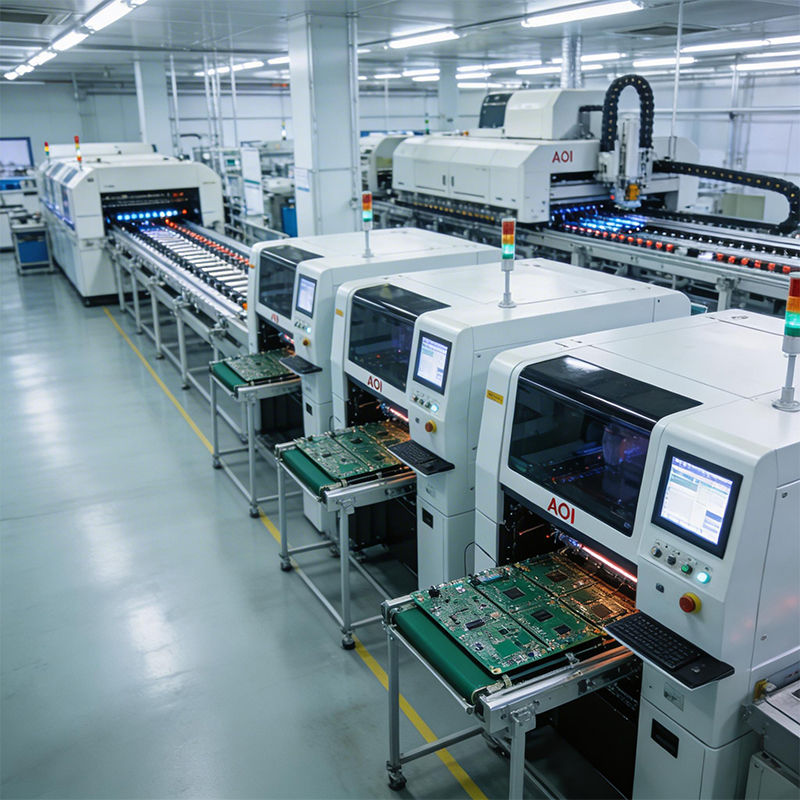
AOI isn't a single checkpoint—it can be deployed at multiple stages of production :
After solder paste printing: Some lines use solder paste inspection (SPI) to verify that the right amount of paste is deposited in the right places before any components are placed. This catches printing defects early.
After component placement (before reflow): Post-placement AOI checks that all components are present and correctly positioned before soldering. If something's wrong, it can be fixed without rework.
After reflow soldering: This is the most common AOI application. It verifies that components are properly soldered and that the reflow process worked correctly.
For through-hole components: Even THT assemblies can benefit from AOI, checking for missing, reversed, or misaligned components .
Some manufacturers use inline AOI systems integrated directly into the production line, while others use offline systems for batch inspection .
For optical inspection to be meaningful, there has to be a standard defining what "good" looks like. That's where IPC-A-610 comes in—the most widely used electronics assembly standard in the world .
IPC-A-610 provides detailed criteria for:
Solder joint acceptability (fillet size, shape, wetting)
Component placement and orientation
Cleanliness and workmanship
Defect conditions with full-color references
AOI systems are programmed to check against these criteria, ensuring that what passes inspection meets industry-accepted quality levels .
The standard classifies products into different acceptability classes based on their end use:
Class 1: General consumer electronics
Class 2: Industrial and dedicated service equipment
Class 3: High-performance and critical systems
For manufacturers supplying automotive, medical, or aerospace industries, Class 3 compliance is often required.
If you're still relying on human inspectors, the data might convince you to upgrade. Studies show that AOI achieves 98-99% accuracy in defect detection, compared to just 85-90% for manual visual inspection .
The speed difference is even more dramatic. AOI systems can inspect 5,000+ components per hour—far exceeding the 500-800 components per hour a human can manage . High-speed systems can scan at rates up to 65 cm² per second .
Human inspectors also suffer from fatigue, leading to inconsistent results over time. AOI systems deliver the same performance at the start of a shift as at the end.
Traditional AOI systems use rule-based algorithms—if X happens, flag it as a defect. But modern systems are getting smarter .
Machine learning and AI are transforming optical inspection. Instead of being explicitly programmed with every possible defect, AI-powered systems can be trained on sample images and learn to recognize anomalies .
One semiconductor OEM using AI-driven AOI achieved 98% accuracy with 12-14ms processing speed, and in some tests reached 99.62% accuracy . The AI could detect subtle defects like breakage, abrasion, contamination, fragments, and air bubbles that rule-based systems might miss.
Deep learning software is now often pre-trained, requiring only tens of additional samples to adapt to specific applications rather than hundreds . This makes AI-powered AOI accessible even for smaller manufacturers.
Companies like Omron have integrated AI into their inspection systems, allowing them to distinguish between true defects and cosmetic variations—reducing false calls and increasing accuracy over time .
Modern optical inspection systems don't work in isolation. They're part of the connected factory .
IPC-CFX (Connected Factory Exchange) and IPC-HERMES-9852 standards enable seamless communication between inspection systems and other production equipment . When an AOI system detects a defect trend, it can automatically adjust upstream processes—like fine-tuning a pick-and-place machine or alerting operators to a solder paste printing issue .
This closed-loop control transforms AOI from a simple inspection tool into a cornerstone of smart manufacturing .
Inspection data can also feed into MES (Manufacturing Execution Systems) for traceability, allowing manufacturers to track quality metrics and respond quickly to issues .
At Kaboer, we've been integrating optical inspection into our manufacturing processes since 2009. Based in Shenzhen with our own PCBA factory, we understand that catching defects early is the key to delivering reliable products.
Our capabilities include:
3D AOI inspection for all assembled boards, checking component placement, solder joints, and polarity
Solder paste inspection (SPI) to verify printing quality before components are placed
X-ray inspection for BGA and QFN hidden joints that AOI can't see
In-circuit testing (ICT) and functional testing as additional verification layers
We work with you to ensure your boards meet the right quality standards—whether that's IPC Class 2 for commercial products or Class 3 for demanding applications.
If you're looking for a manufacturing partner who takes quality seriously—with rigorous optical inspection at every stage—send us your requirements or Gerber files. We'll review your design, give you honest feedback, and get back to you with a quote. We've been at this for over 15 years, and we believe the best partnerships start with straightforward conversations.
And if you're ever in Shenzhen, we'd be happy to show you around our factory and demonstrate our inspection processes firsthand.

Kaboer manufacturing PCBs since 2009. Professional technology and high-precision Printed Circuit Boards involved in Medical, IOT, UAV, Aviation, Automotive, Aerospace, Industrial Control, Artificial Intelligence, Consumer Electronics etc..


 English



 Wechat
 +86 13670210335
 +86 13670210335
 E-mail