
Date: 2026-03-20
If you're in the business of manufacturing electronic devices, you've probably come across the term modulator HDMI RF. It's one of those products that sits at the intersection of digital video and traditional broadcasting—taking HDMI signals from modern sources and converting them into RF signals that can travel over coaxial cable.
Hotels use them to stream content to hundreds of rooms. Hospitals use them for patient entertainment systems. Sports bars use them to show different games on different TVs without running HDMI cables everywhere. And at the heart of every reliable modulator is something that most buyers never think about: the printed circuit board.
Let's break down what HDMI RF modulators actually do, why their performance depends on the quality of their internal electronics, and what you need to know if you're sourcing these devices or their components.
An HDMI RF modulator is a device that converts a high-definition multimedia interface (HDMI) signal into a radio frequency (RF) signal that can be distributed over coaxial cable . Think of it as creating your own mini TV broadcast station. The modulator takes the video and audio from a source—like a streaming box, Blu-ray player, or security camera—and encodes it onto a specific TV channel frequency. Any TV connected to the same coaxial network can tune to that channel and watch the content .
This is incredibly useful because coaxial cable can carry signals much farther than HDMI without degradation. A single modulator can send content to dozens or even hundreds of TVs using wiring that already exists in most buildings .
Modern HDMI modulators typically support:
Resolutions up to 1080p or 4K
Multiple broadcast standards (ATSC, DVB-T, DVB-C, ISDB-T) for different regions
Single-channel or multi-channel configurations
Standalone or rack-mounted form factors for different installation scales
The use cases are surprisingly broad :
Hotels and Hospitality: Deliver TV channels, movies, and promotional content to hundreds of guest rooms without putting a streaming device in every room.
Hospitals: Patient entertainment systems that let patients watch TV from a bed-side screen.
Schools and Universities: Distribute lectures, announcements, or training videos across campus.
Sports Bars and Restaurants: Show different games on different TVs from a single source.
Multi-Room Homes: Send a Blu-ray player or cable box signal to every TV in the house.
Digital Signage: Display advertising or information on multiple screens in retail stores or lobbies.
Security Systems: Distribute CCTV feeds to multiple monitors.
The common thread is needing to get the same (or different) high-quality video content to many displays without the cost and complexity of running separate HDMI cables everywhere.
From a PCB and PCBA perspective, an HDMI RF modulator is a fascinating convergence of several technologies :
High-Speed Digital Input: The HDMI input itself is a multi-gigabit serial interface that requires precise controlled impedance routing on the PCB—typically 100Ω differential pairs with strict length matching .
Digital Processing Core: An FPGA or dedicated encoder chip handles video compression (like H.264) and multiplexing. This section requires dense BGA fanouts, clean power planes, and often external memory .
RF Modulation Stage: This is where the digital stream gets converted to an RF signal. A digital-to-analog converter and mixer translate the data to an intermediate frequency, which is then upconverted to the final output channel (QAM, ATSC, DVB-T, etc.) . This section is extremely sensitive to noise.
Power Management: Multiple clean voltage rails (1.0V, 1.8V, 3.3V, 5V) are needed for different sections, requiring careful power supply design to keep switching noise away from sensitive analog circuits .
Output Stage: Amplifiers, SAW filters, and protection circuits condition the final RF signal before it reaches the F-connector .
The PCB for an HDMI modulator is essentially a high-performance mixed-signal platform where digital processing, RF purity, and thermal management all have to coexist peacefully .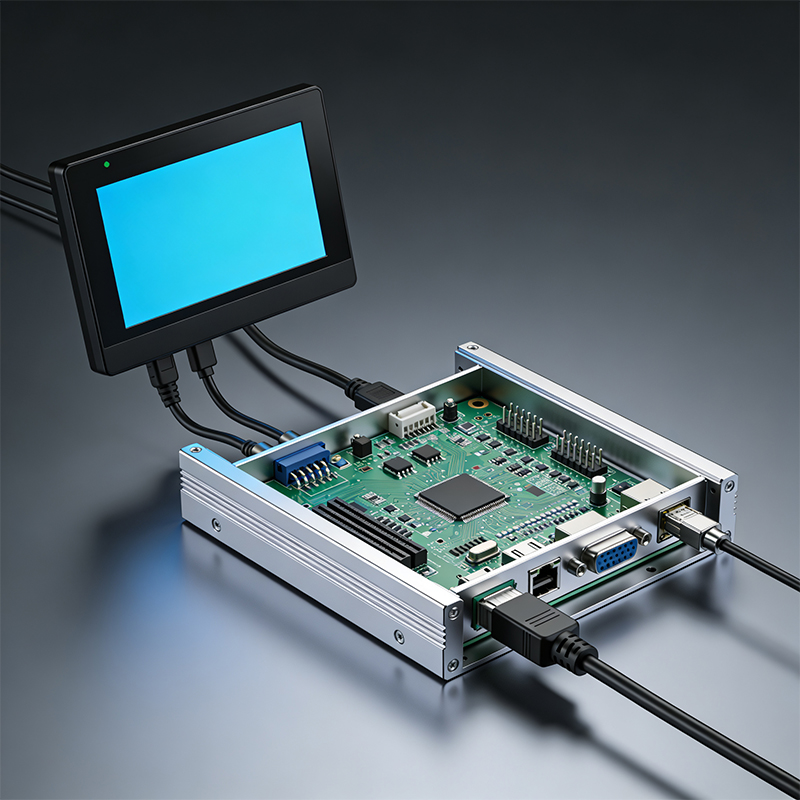
Building a reliable HDMI modulator isn't simple. Here are the challenges that manufacturers face :
The biggest challenge is keeping the noisy digital section (FPGA, processors, switching regulators) from contaminating the sensitive analog RF section. Digital noise can easily couple into the RF path, causing spurious signals, phase noise, and degraded modulation error ratio . Good PCB design requires careful floor planning, separate ground planes tied together at a single point, and strategic use of moats and shielding .
Different signals have completely different impedance requirements :
HDMI: 100Ω differential pairs
RF traces: 50Ω single-ended
DDR memory: Specific single-ended impedance (often 40Ω or 50Ω)
The PCB stackup must be engineered to achieve all these impedances simultaneously on different layers with different trace widths. This requires precise control of dielectric thicknesses and trace geometries.
At multi-gigabit speeds, even tiny imperfections matter. Clock jitter can propagate through the encoding and modulation chain, showing up as phase noise in the RF output . Maintaining clean return paths, controlling crosstalk, and matching transmission line impedance all the way to the connector are essential .
HDMI modulators generate heat. FPGAs, encoders, and RF power amplifiers all dissipate significant power. Without proper thermal design, components overheat, leading to signal drift, reduced lifetime, and eventual failure . Solutions include thermal vias, thick copper planes, and sometimes heat sinks integrated into the design .
The RF section needs protection from both internal and external interference. Grounded copper pours with dense via stitching create localized Faraday cages . Proper component placement keeps noisy digital circuits away from sensitive RF paths .
While FR-4 works for the digital sections, the RF output stage may benefit from low-loss materials like Rogers laminates, especially for higher frequencies or tighter performance requirements .
If you're sourcing HDMI modulators or developing your own, here's what matters :
Experience with high-speed and RF designs: Not every PCB manufacturer understands the nuances of mixed-signal design. Look for a partner with proven capability in multi-layer boards (8-12 layers) with controlled impedance and careful RF layout .
Rigorous testing: The final product needs more than just basic functional test. Look for manufacturers who perform signal integrity testing, RF validation, and thermal stress testing .
Quality certifications: ISO 9001 is the baseline. For medical or broadcast applications, additional certifications may be required.
Component sourcing capability: Many modulator designs use fine-pitch BGAs and specialized RF ICs that can be difficult to source. A manufacturer with strong supply chain relationships helps avoid delays .
Design support: A good partner will review your design for manufacturability and flag potential issues before they become expensive problems .
At Kaboer, we've been manufacturing complex PCBs since 2009. Based in Shenzhen, with our own PCBA factory, we understand the unique challenges of building mixed-signal products like HDMI RF modulators.
Our capabilities include:
Multi-layer boards up to 30 layers, with the controlled impedance required for high-speed HDMI and precise RF traces
HDI technology with microvias down to 2 mil for dense BGA fanouts
Advanced materials including high-frequency laminates for demanding RF sections
Thermal management expertise with heavy copper options and thermal via arrays
Rigorous testing including automated optical inspection, X-ray for hidden joints, and functional testing
We work with you from design through production:
We review your Gerber files and provide DFM feedback before manufacturing
We help source quality components through our established supply chain
We offer fast prototyping to validate your design quickly
We handle full PCBA assembly, delivering finished, tested modules
If you're developing an HDMI RF modulator or sourcing them for your business, send us your requirements or Gerber files. We'll review your design, give you honest feedback, and get back to you with a quote. We've been at this for over 15 years, and we believe the best partnerships start with straightforward conversations.
And if you're ever in Shenzhen, we'd be happy to show you around our factory.

Kaboer manufacturing PCBs since 2009. Professional technology and high-precision Printed Circuit Boards involved in Medical, IOT, UAV, Aviation, Automotive, Aerospace, Industrial Control, Artificial Intelligence, Consumer Electronics etc..


 English



 Wechat
 +86 13670210335
 +86 13670210335
 E-mail