
Date: 2026-03-24
You know that moment when you send off a design for the first time? There's excitement, sure. But there's also that nagging voice in the back of your head: "What if it doesn't work? What if I missed something? What if I just spent money on boards that are going straight into the trash?"
That's exactly why PCB board prototypes exist. They're your chance to be wrong cheaply. To catch the mistake before it becomes a warehouse full of useless boards. To validate that the clever idea in your head actually works in the real world.
Let's talk about why prototyping matters, how to do it without wasting time or money, and what to look for in a partner who can get you working boards fast.
A PCB board prototype is a sample version of your circuit board, made in small quantities to test and validate your design before mass production . It's proof that your schematic translates into working hardware.
Prototypes serve a few purposes:
Functional testing: Does the circuit actually do what you designed it to do?
Fit checking: Does the board fit in its enclosure? Do connectors line up?
Performance validation: Does it meet speed, power, and signal integrity requirements?
Design verification: Are there any errors in your schematic or layout?
Software development: Give your firmware team hardware to code against
Early demonstrations: Show investors or stakeholders a working model
The beauty of prototypes is that they're forgiving. If something's wrong, you haven't wasted much time or money. You fix the design and try again. That's infinitely better than discovering a fatal flaw after you've bought components for ten thousand boards.
Here's the reality that every engineer learns eventually: your first design is rarely perfect. Maybe the impedance is off. Maybe a component runs hotter than expected. Maybe the mechanical fit isn't quite right. Maybe there's a trace that should connect to pin 3 but actually goes to pin 4.
These problems are cheap to fix at the prototype stage. A design tweak costs a few hours and another small batch of boards. The same problem discovered after production? That's rework, scrap, delayed shipments, and unhappy customers.
A study by the Center for Advanced Life Cycle Engineering found that the cost of fixing a defect increases exponentially the later it's found . A problem caught during prototyping might cost a few dollars and a week of time. The same problem caught after full production could cost thousands and delay your product launch indefinitely.
Prototyping isn't an extra step. It's the step that keeps you from disaster.
Working with a manufacturer that understands prototyping should feel different from ordering production boards. Here's what it looks like:
You send your Gerber files and assembly requirements. Before anything is built, the manufacturer performs a Design for Manufacturing (DFM) review. This isn't just a formality—it's where experienced engineers look at your design and ask: can we actually build this?
They check trace widths, hole sizes, spacing between pads, copper balance, and potential assembly issues. A good DFM review catches problems before they become expensive.
What good looks like: Acknowledgment within hours, initial DFM feedback within 24 hours. They flag issues, suggest fixes, and confirm they can meet your timeline.
For prototypes, materials need to be on-hand. The manufacturer stocks common laminates (FR-4, high-Tg, flexible polyimide) and standard copper weights so there's no waiting for material orders.
What good looks like: No delays waiting for material procurement. If your design needs something exotic, they flag it immediately.
This is where the speed matters. The fab runs your boards on accelerated schedules, often dedicating specific production slots for quick-turn work. Your small batch doesn't wait behind million-board orders.
What good looks like: Clear status updates. You know where your boards are in the process. If there's a delay, you hear about it before it becomes a crisis.
For assembled prototypes, components are the biggest variable. Long lead times kill fast prototyping. Good manufacturers stock common components or have relationships with distributors that allow quick procurement.
What good looks like: They check component availability before quoting. If a part has long lead time, they flag it and suggest alternatives.
Assembly for prototypes happens on dedicated quick-turn lines. These are set up for fast changeovers, so your small batch doesn't have to wait behind a 10,000-unit production run.
What good looks like: Assembly completed within agreed timeline, with regular progress updates.
Even fast prototypes need testing. Good manufacturers have testing capabilities integrated into their quick-turn workflow—AOI, X-ray for hidden joints, and basic functional testing.
What good looks like: Test reports included with your prototypes. You know what was checked and what passed.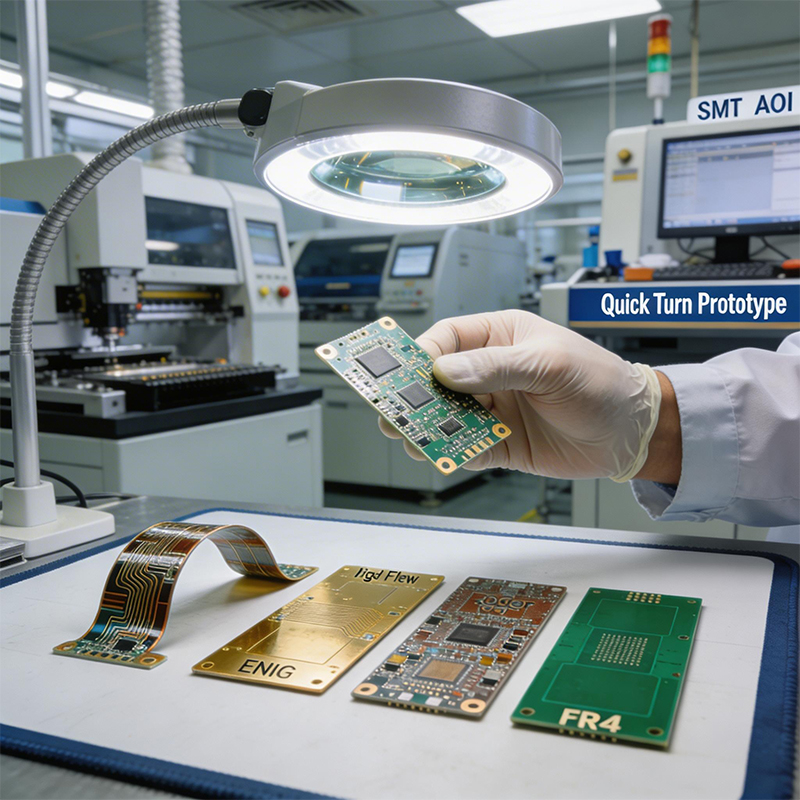
When you're in a hurry, it's tempting to skip the manufacturing review and just get boards made. That's how you end up with boards that can't be assembled or fail in testing.
The fix: Even with fast turnaround, insist on a DFM check. A good manufacturer can do this quickly without adding days to your timeline.
A few boards that light up doesn't mean your design is ready. Test edge cases, temperature ranges, power variations. Be thorough.
The fix: Build a test plan. Know what you need to verify before you get boards. Test systematically.
The board works electrically, but does it fit in the enclosure? Do the connectors line up with the cutouts?
The fix: Print a 1:1 paper version or get a 3D print of your board outline. Check fit before you order.
Yes, prototypes cost more per board than production. That's fine. The goal is speed and learning, not minimizing unit cost.
The fix: Accept that prototyping is an investment. The knowledge you gain is worth more than the few dollars you'd save by rushing.
Vague fabrication notes lead to misunderstandings. Be clear, be specific, and provide complete files.
The fix: Include a fabrication drawing with your Gerber files. Specify materials, thickness, copper weight, surface finish, and any special requirements.
For most projects, 5-10 boards is a good starting point. Enough to test multiple configurations, share with software engineers, and have spares in case something gets damaged.
If your design has high-risk sections, you might want 20-30 to thoroughly test variations. If it's a simple board you've built before, 3-5 might be enough.
The key is to order enough to actually validate the design. One board that works is encouraging. Five boards that work across temperature and voltage variations is confidence.
Not all prototype services are created equal. Here's what to look for:
Speed without quality sacrifice. Can they turn boards in days while maintaining inspection standards? Fast doesn't mean sloppy.
DFM feedback. Do they review your design and flag issues before building? Or do they just run your files and hope?
Component availability. For assembled prototypes, can they source parts quickly? Do they check lead times before quoting?
Clear communication. Do you get regular updates without asking? Do they flag problems immediately?
Flexible quantities. Can they handle 5 boards or 50? Do they have minimum order requirements that make small runs impractical?
At Kaboer, we've been building custom PCBs since 2009. Based in Shenzhen with our own PCBA factory, we understand that prototypes are where your design meets reality. We've seen thousands of them, and we know what works.
Our prototyping capabilities:
Bare PCBs: 24-72 hours for standard boards
Flexible PCBs: 3-5 days (1-20 layers, 0.075mm to 0.4mm thick)
Rigid-Flex: 5-7 days (2-30 layers)
HDI and high-frequency boards: 5-7 days
Assembled PCBA: 5-7 days for SMT assembly, 7-10 days for mixed technology
Prototype quantities: 5-50 boards
What makes us different:
We review every design. Before we build, our engineers check your files for manufacturability. We flag potential issues and suggest improvements.
We stock materials. Common laminates, flexible polyimide, and standard copper weights are kept on hand. No waiting for material orders.
We check components before quoting. When you send us your BOM, we verify availability immediately. If there's a long-lead part, we flag it and suggest alternatives.
We communicate constantly. You get regular updates on your order status. If something changes, you hear about it immediately.
We maintain quality even at speed. Every prototype gets the same quality checks as production boards: AOI, X-ray when needed, electrical test.
We work across the full range—rigid boards, flexible circuits, rigid-flex, HDI high-frequency boards—and we understand that the same principles apply whether your design is simple or complex.
Prototypes are where good ideas become real products. The right partner makes the difference between a smooth validation process and weeks of wasted time.
If you need a PCB board prototype to validate your design, send us your requirements or Gerber files. We'll review your design, give you honest feedback, and get back to you with a quote. We've been at this for over 15 years, and we believe the best partnerships start with straightforward conversations.
And if you're ever in Shenzhen, we'd be happy to show you around our factory and walk you through how we build prototypes that work.

Kaboer manufacturing PCBs since 2009. Professional technology and high-precision Printed Circuit Boards involved in Medical, IOT, UAV, Aviation, Automotive, Aerospace, Industrial Control, Artificial Intelligence, Consumer Electronics etc..


 English



 Wechat
 +86 13670210335
 +86 13670210335
 E-mail