
Date: 2026-03-25
If you've ever looked at a circuit board and thought, "That's actually kind of beautiful," you're not alone. There's something about the clean lines of copper traces, the geometric precision of component placement, the contrast between green solder mask and gold pads. It's functional art, whether the designer intended it or not.
But here's the thing: most circuit boards are designed for function first, appearance a distant second. Traces go where they need to go. Components sit where they fit. Silkscreen text gets squeezed in wherever there's room. The result works, but it's not exactly something you'd frame and hang on a wall.
That's where minimalist circuit board print comes in. It's the practice of designing PCBs with intention—not just for electrical performance, but for visual clarity, for elegance, for the sheer satisfaction of looking at a board and seeing order instead of chaos.
Let's talk about what minimalist PCB design actually means, why it matters for your products, and how to achieve that clean, intentional look without compromising functionality.
A minimalist circuit board print is exactly what it sounds like: a PCB designed with visual clarity and simplicity as a priority. It's the opposite of cramming every possible feature into the smallest possible space. It's about making deliberate choices about what goes where, leaving breathing room, and letting the structure of the circuit speak for itself.
Think of it like architecture. A minimalist building isn't empty—it's intentional. Every element has a reason. The space itself becomes part of the design. Same with a minimalist PCB. The empty space isn't wasted; it's part of the visual language.
Minimalist design principles applied to PCBs include:
Clean, straight traces with minimal unnecessary meandering
Generous spacing between components and traces
Consistent orientation of components where possible
Thoughtful silkscreen that labels without cluttering
Balanced copper pours that create visual rhythm
Unified color schemes with intentional use of solder mask and silkscreen contrast
This isn't just about aesthetics. Boards designed with clarity in mind are often easier to assemble, easier to troubleshoot, and more reliable. The same discipline that makes a board look good also makes it work better.
If you're building products for customers, the inside of your device matters. Not everyone will see it, but the ones who do—engineers, technicians, reviewers, curious customers—will notice.
Here's why minimalist PCB design is worth considering:
Brand perception. A clean, thoughtfully laid-out board says something about your company. It says you care about details. It says you don't cut corners where they don't show. It builds trust.
Easier assembly. When components have room to breathe, pick-and-place machines have an easier time. When traces are clearly routed, inspection is faster. Minimalist design often translates to more manufacturable design.
Simpler troubleshooting. When something goes wrong, a cluttered board is a nightmare to debug. Clean layout, clear labeling, and logical grouping make finding the problem faster.
Better signal integrity. Surprisingly, minimalist design often improves electrical performance. Generous spacing reduces crosstalk. Straight traces minimize reflections. Clean power distribution with proper decoupling placement is part of the minimalist ethos.
Reduced manufacturing defects. Less clutter means fewer opportunities for solder bridges, less risk of tombstoning, fewer assembly errors.
You don't need to sacrifice function for form. In fact, good minimalist design is about making function visible. Here's how to approach it:
Before you route a single trace, think about where components go. Group related functions together. Leave space between functional blocks. Give power components room to breathe. Place connectors where they make mechanical sense.
The minimalist approach: don't let the placement be just a byproduct of routing. Make it deliberate.
Minimalist traces are direct, clean, and consistent. Use 45-degree angles or curves—no messy right angles. Keep trace widths consistent for signals with similar requirements. Route in straight lines where possible; let traces run parallel when it makes sense.
Avoid the "spaghetti" look where traces weave between pads and vias unnecessarily. Sometimes the most efficient route isn't the prettiest, but often, the prettiest route is also the most efficient.
Where possible, orient components the same way. Resistors lined up. ICs with pin 1 in the same direction. This creates visual order and makes assembly easier. It's not always possible—fine-pitch BGAs have their own constraints—but when you have the freedom, use it.
Silkscreen is where minimalist design often goes wrong. The instinct is to label everything. Every resistor, every capacitor, every test point. But on a dense board, that becomes visual noise.
Instead, be selective. Label the things that matter: connectors, test points, polarity indicators, key ICs. Use consistent font sizes. Keep text aligned. Avoid overlapping component outlines.
For minimalist boards, sometimes less silkscreen is more. If the component placement is clear, you don't need a label for every single resistor.
Solid ground planes are essential for signal integrity, but they don't have to be visually oppressive. In minimalist design, copper pours become part of the visual language. Use them to create structure. Leave deliberate voids where they make sense. Use thermal reliefs that are consistent and clean.
Solder mask isn't just protective—it's visual. Green is traditional, but blue, black, white, and red are increasingly common in minimalist designs. Each creates a different mood. White on black creates high contrast. Black on gold is sleek. Green with white silkscreen is classic for a reason.
Surface finish also matters. ENIG (gold) creates a warmer look than HASL (silver). Immersion silver has its own aesthetic. Choose what fits your product's identity.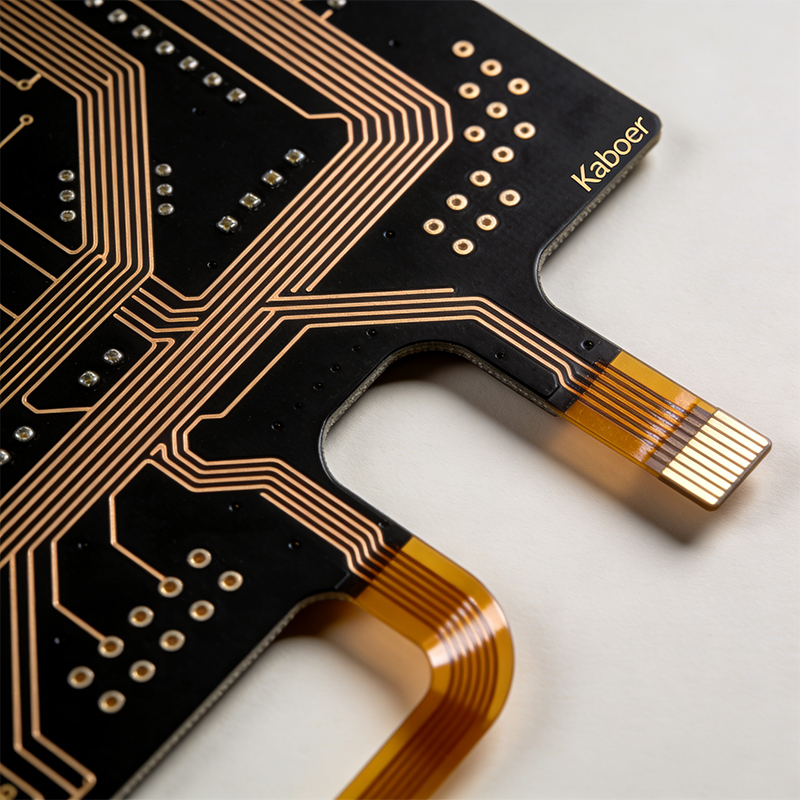
Minimalist PCB design isn't for every product. A consumer gadget where the board is buried inside a sealed case? Probably not worth the extra effort. A development board where engineers will be probing and debugging? Absolutely worth it. A product where the board is visible—like a smartwatch, or a piece of high-end audio gear, or a demo board for a trade show? Critical.
Consider minimalist design when:
The board will be seen (transparent enclosures, open designs, demonstration units)
The product is marketed as premium (design matters to your customers)
You're building a development platform (clean layout helps users)
You want to build trust with technical customers (they notice quality)
You're prototyping and will need to debug (you'll thank yourself later)
The good news: minimalist design doesn't require exotic processes or higher costs. In fact, it often reduces costs by simplifying assembly and improving yield. But it does require attention to detail in the design phase.
At Kaboer, we've been manufacturing custom PCBs since 2009. We see designs from all over the world—some beautiful, some functional, some both. We understand that minimalist design isn't just about aesthetics; it's about clarity, manufacturability, and reliability.
What we offer:
Flexible manufacturing for rigid, flexible, and rigid-flex boards
HDI capabilities for high-density designs that still need clean layout
Fast prototyping so you can iterate on your minimalist design quickly
Expert DFM review that respects your design intent while ensuring manufacturability
Multiple solder mask and silkscreen options to match your visual goals
We work with you to achieve the look you want without compromising the function you need.
If you're designing a board where aesthetics matter—or if you just want to see how minimalist design can improve your next product—send us your requirements or Gerber files. We'll review your design, give you honest feedback, and get back to you with a quote. We've been at this for over 15 years, and we believe the best partnerships start with straightforward conversations.
And if you're ever in Shenzhen, we'd be happy to show you around our factory and walk you through how we turn clean designs into beautiful boards.

Kaboer manufacturing PCBs since 2009. Professional technology and high-precision Printed Circuit Boards involved in Medical, IOT, UAV, Aviation, Automotive, Aerospace, Industrial Control, Artificial Intelligence, Consumer Electronics etc..


 English



 Wechat
 +86 13670210335
 +86 13670210335
 E-mail