
Date: 2026-02-25
Have you ever wondered how your air conditioner knows exactly how much to cool down when you press the remote button? Or how your car's engine instantly responds the moment you step on the accelerator? Behind all these actions is a quietly working core component—the PCB controller.
In simple terms, a PCB controller is the "brain" or "commander" of a printed circuit board. It's a specially designed electronic circuit responsible for managing and controlling the entire board's operation. It receives input signals from sensors, switches, or other devices, processes and evaluates this information, then sends out commands telling other components what to do and when to do it.
Think of it this way:
The PCB itself is like a city's infrastructure—the roads, bridges, and utility pipes.
The PCB controller is like the city's traffic control center and mayor's office—it decides when to let traffic flow, when to turn on streetlights, and how to allocate resources.
Without a controller, a circuit board is just a lifeless collection of copper traces and components. With a controller, it gains intelligence and comes to life.
A PCB controller isn't a single component but a system made up of several parts. Its core typically includes:
Microcontroller or Microprocessor: This is the true "brain," responsible for executing instructions, processing data, and making decisions. Think of it as a miniature computer with its own processor, memory, and input/output interfaces, all integrated into one chip.
Input/Output Interfaces: These are the controller's "mouth and ears," allowing it to communicate with the outside world—receiving sensor signals, controlling motors, connecting to displays, and more.
Power Management Circuitry: Ensures all components receive stable, appropriate power—like a city's electrical grid.
Memory: Stores program code and data, telling the controller "what to do" and helping it "remember things".
Communication Modules: Some controllers include Wi-Fi, Bluetooth, Ethernet, or other communication features, allowing devices to connect to networks and talk to each other.
Just as different types of "brains" are suited for different tasks, PCB controllers come in several varieties, each with its own strengths:
Microcontroller Units are the most common type, perfect for handling single, well-defined tasks like controlling a microwave's cooking time or reading temperature sensor data. Their advantages include low power consumption, low cost, and ease of use.
Digital Signal Processors are specialized for handling complex signals, particularly excelling at real-time processing of audio, video, and communication data. Your smartphone and noise-canceling headphones rely on them.
Field-Programmable Gate Arrays are "reshapeable" chips whose hardware functions can be reconfigured like software. They're ideal for applications requiring high-speed parallel processing, such as telecom base stations, aerospace equipment, and AI acceleration.
Application-Specific Integrated Circuits are custom-designed for specific applications. Once manufactured, they cannot be changed. They offer optimal performance and lowest power for their specific task, but development costs are extremely high, making them economical only for very high-volume production (like Bitcoin mining chips).
System-on-Chip integrates processor, memory, graphics processing, wireless connectivity—essentially everything—into a single chip. Your phone's processor is a typical SoC—it's simultaneously a CPU, GPU, and communication baseband.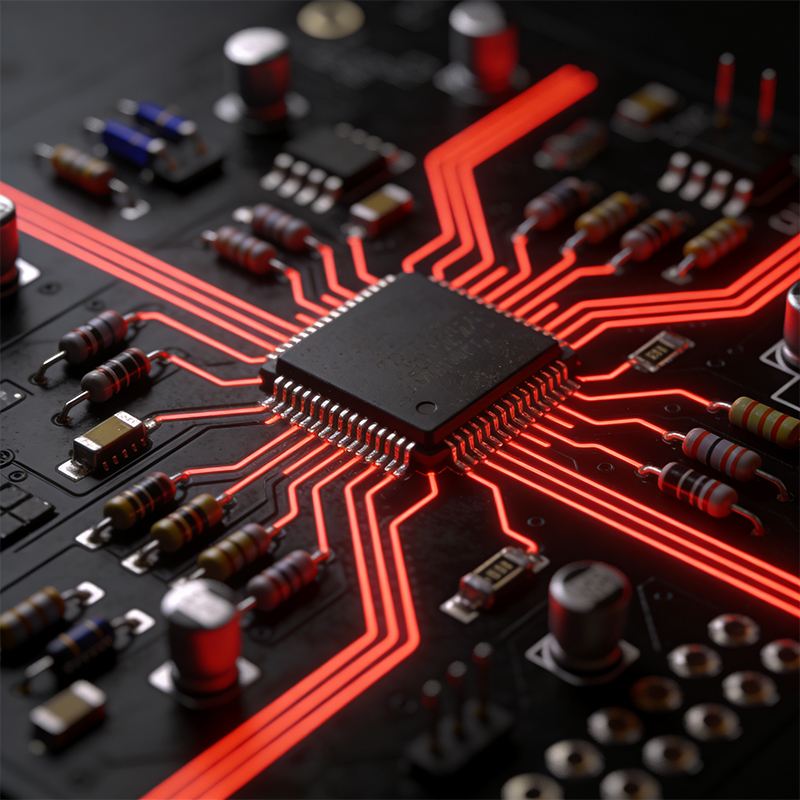
A typical PCB controller handles several key tasks:
Data Processing: It receives input signals from sensors, switches, or other devices, performs calculations and analysis on this information, then makes decisions based on the results.
Timing Control: It ensures all operations happen in the correct sequence and at the right time, like an orchestra conductor making sure each instrument plays at precisely the right moment.
Communication Coordination: It manages data exchange between different components, enabling memory, sensors, displays, wireless modules, and more to "talk" smoothly with each other.
Power Management: It monitors and regulates power distribution, ensuring each component gets the right voltage and current—and switching to power-saving modes when not needed.
Error Detection and Handling: It monitors system operation, detects anomalies, and takes appropriate action when something goes wrong—like restarting, triggering alarms, or safely shutting down.
PCB controllers are everywhere:
Consumer Electronics: Smartphones, tablets, smart TVs, gaming consoles, home appliances—every smart device contains multiple PCB controllers working together.
Automotive Industry: Modern cars have hundreds of controllers—engine control units managing fuel injection and ignition timing; body control modules handling windows, door locks, and lights; infotainment systems connecting your phone; advanced driver-assistance systems keeping you in your lane and braking automatically when needed.
Industrial Automation: Factory robots, conveyor belts, automated assembly lines all rely on PCB controllers to execute commands precisely. Programmable Logic Controllers are the robust controllers commonly found in industrial environments.
Medical Devices: CT scanners, MRI machines, patient monitors, insulin pumps—all depend on精密 reliable PCB controllers to function accurately.
Aerospace and Defense: Aircraft navigation systems, satellite communications, radar equipment, missile guidance systems—all rely on PCB controllers to work reliably in extreme environments.
Energy Systems: Smart grids regulating voltage distribution, solar inverters optimizing power generation, electric vehicle battery management systems monitoring charging and discharging—all离不开 precise controller management.
If you need to design or select a PCB controller for your product, several key factors matter:
Define Requirements: First, get clear on what the controller needs to do—how fast must it process data? How much memory is needed? What input/output interfaces are required? What are the size constraints? Budget? Power consumption targets?
Choose the Right Core: Select an appropriate microcontroller or processor based on your requirements. For simple sensor reading, a low-cost 8-bit MCU might suffice; for HD video processing, you may need a high-performance SoC or FPGA.
Component Placement and Routing: In PCB layout, place critical components close to the controller, shorten signal paths, and minimize interference. Also consider heat—high-performance controllers generate heat and need adequate thermal design.
Signal Integrity: High-speed signals require careful handling—impedance control, crosstalk reduction, proper grounding. A poorly designed controller won't work reliably, no matter how good the chip is.
Testing and Validation: Test thoroughly before production. Use simulation tools to model circuit behavior, then build physical prototypes to verify all functions. This step saves enormous debugging effort later.
With countless controller options on the market, consider these factors:
Power Requirements: Battery-powered devices need low-power controllers with sleep modes.
Memory Capacity: Program complexity determines how much flash and RAM you need.
Compatibility: Will the controller play nicely with other system components? Do communication protocols match?
Cost: More performance usually means higher price—balance needs against budget.
Reliability: Critical applications like medical, automotive, and industrial require proven, reliable products.
Ease of Use: Are development tools mature? Is documentation comprehensive? Is community support active? This directly impacts development efficiency.
The PCB controller—that tiny chip hidden on a green board—is the true brain and soul of modern electronic devices. It gives cold hardware the ability to sense, think, and respond. For electronic device manufacturers, understanding PCB controllers means holding the key to product intelligence. Choose the right controller, design it well, test it thoroughly—that's how you build products that stand out in the market and earn customer trust.

Kaboer manufacturing PCBs since 2009. Professional technology and high-precision Printed Circuit Boards involved in Medical, IOT, UAV, Aviation, Automotive, Aerospace, Industrial Control, Artificial Intelligence, Consumer Electronics etc..


 English


 Wechat
 +86 13670210335
 +86 13670210335
 E-mail