
Date: 2026-06-16
You’ve definitely seen them. Green boards with lots of tiny silver lines and dots. Inside your computer, phone, TV, even a toy. That’s a PCB. But do you know what the three letters PCB stand for? They have a full name, and in this guide I’ll explain that name and what it means in plain English.
PCB stands for Printed Circuit Board.
Let’s break those three words down:
Printed – The circuit patterns are created on the board using a chemical etching process, somewhat like printing a picture from a negative.
Circuit – The fine copper traces that carry electricity and signals from one component to another.
Board – The flat insulating material (usually fiberglass) that holds everything together.
Put together: an insulating board that has electrical circuits “printed” onto it.
A PCB does two very important jobs:
Hold components in place – It provides a solid mounting surface for chips, resistors, capacitors, connectors, and all the other parts.
Connect components – The copper traces on the board wire everything together exactly as the circuit diagram shows.
Without a PCB, you would have to connect every component by hand with loose wires. That would be a giant mess of spaghetti wiring, huge in size, and likely to short out if you sneeze on it. That’s why almost every electronic product today uses PCBs – they make things small, reliable, and cheap to manufacture.
The word “printed” might make you think of a printer. Early PCB manufacturing was indeed like printing a photograph. A copper‑clad board (a board with a copper layer on it) was coated with a light‑sensitive film, then a negative of the circuit pattern was placed on top and exposed to light. The exposed areas hardened. Then the board was dipped in chemicals that washed away the unhardened film, and etched away the copper underneath. Only the circuit pattern remained. This “expose‑develop‑etch” process was borrowed from photography, so they called it “printing.” Today, the process uses laser direct imaging, but the name “printed” stuck.
Before PCBs, electronics were built using “point‑to‑point” wiring – every component was connected by hand with individual wires. In the 1930s and 40s, Austrian engineer Paul Eisler developed the first real PCB while working on a radio. His idea was to replace the messy wiring with a flat board that had conductive traces. By the 1950s, PCBs were being used in military equipment. Today, smartphone motherboards have 10+ layers of copper traces thinner than a human hair.
1. Single‑sided PCB
Copper on only one side. Very simple and cheap. Used in toys, remote controls, power supplies.
2. Double‑sided PCB
Copper on both sides, with tiny plated holes (vias) connecting the two sides. Allows more circuits in the same space. Found in many consumer electronics, chargers, and appliance control boards.
3. Multi‑layer PCB
Three or more copper layers separated by insulating material. The layers are laminated together. High density, good noise immunity. Used in computer motherboards, smartphones, and servers.
4. Flexible PCB
The base material is a thin plastic (polyimide) instead of fiberglass. The board can bend and fold. Used in wearables, foldable phones, printer cables, and camera modules.
5. Rigid‑Flex PCB
Combines rigid sections (for strength) and flexible sections (for bending) in one piece. Saves connectors and cables. Used in drones, medical endoscopes, and aerospace equipment.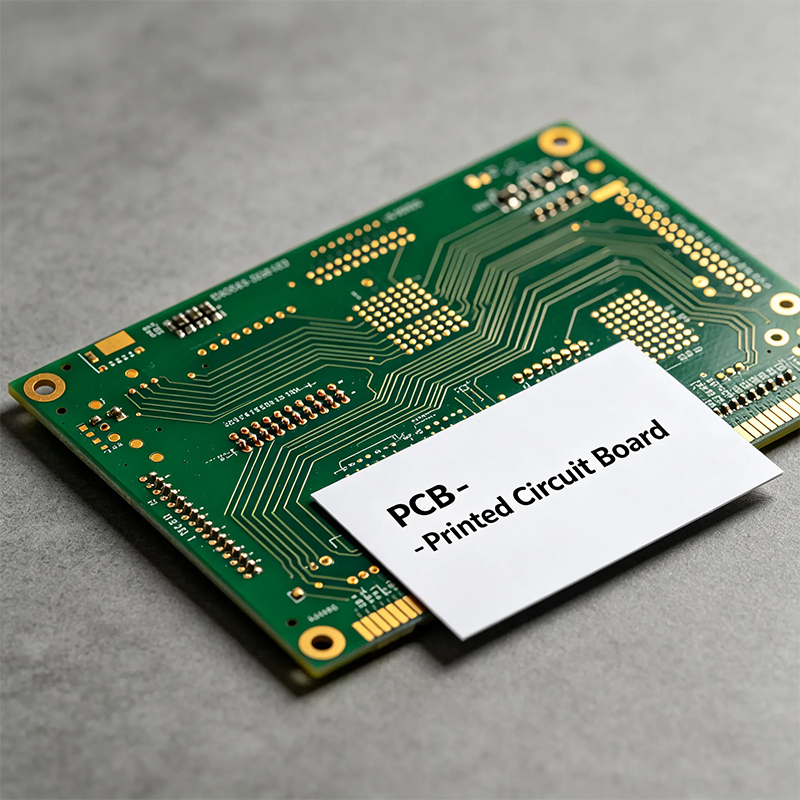
The green color you see on most PCBs is solder mask (soldermask). It’s a protective coating that prevents copper from oxidizing and stops solder from bridging between pads during assembly. It comes in other colors too: red, blue, black, white, yellow.
The white text and outlines are called silkscreen. They label components (R1, C2, U3) and indicate polarity or pin‑1 orientation. This helps assembly operators place parts correctly.
The full form of PCB is Printed Circuit Board. It’s a flat, insulating board with copper traces “printed” on it to connect electronic components. Without PCBs, your phone would be the size of a suitcase and much less reliable.

Kaboer manufacturing PCBs since 2009. Professional technology and high-precision Printed Circuit Boards involved in Medical, IOT, UAV, Aviation, Automotive, Aerospace, Industrial Control, Artificial Intelligence, Consumer Electronics etc..


 English



 Wechat
 +86 13670210335
 +86 13670210335
 E-mail