
Date: 2026-06-18
You see the words “red iron oxide” and your first thought is probably — isn’t that just rust? Chemically speaking, it’s ferric oxide (Fe₂O₃), and yes, it’s essentially the same stuff as rust. But you’d never guess that this most ordinary-looking material is becoming a hot topic in flexible electronics.
Inside phones, watches, medical sensors — devices that are getting “softer” by the day — red iron oxide is quietly playing several key roles. In this guide, I’ll explain what red iron oxide actually does in flexible circuits and why engineers are getting more and more interested in it. Plain English, no fluff.
Red iron oxide — chemical formula Fe₂O₃ — is a common iron compound. It’s everywhere in nature: the red color in soil, the red in bricks, the reddish-brown of rusted metal — that’s all red iron oxide.
It has several key properties:
Magnetic (weakly) — Fe₃O₄ is strongly magnetic, while red iron oxide is weakly magnetic, but under certain conditions it can exhibit useful magnetic properties.
Semiconductor behavior — It’s not as conductive as copper, but it has semiconductor properties, which make it valuable in certain electronic applications.
Chemically stable — It doesn’t easily react with other substances.
Cheap and environmentally friendly — Abundant on Earth, non-toxic, extremely low cost.
Heat resistant — Can withstand relatively high operating temperatures.
It’s this combination of properties that gives it a unique place in flexible circuitry.
The biggest difference between flexible circuits and traditional rigid boards is: they have to bend, fold, and stretch. Components and traces on rigid boards would crack after a few bends. Red iron oxide plays several key roles in flexible circuits:
1. Making Flexible Sensors — Letting Devices “Feel” Bending and Stretching
This is currently one of the most important applications of red iron oxide in flexible electronics. Researchers embed iron oxide nanoparticles into flexible materials (like graphene or polymers) to create highly sensitive strain sensors.
How it works: when you bend or stretch it, the conductive network inside the material changes, and so does its electrical resistance. By measuring the resistance change, you can tell exactly how much it’s bending and how much force is being applied.
Iron oxide-based flexible strain sensors are extremely sensitive, with response times as fast as 40 milliseconds, and they can withstand over 5,000 bending cycles without failing. This means they can be used in:
Wearable health monitors — attached to skin to monitor breathing, heartbeat, and joint movement
Soft robotics — letting robots “feel” their own posture and touch
Smart clothing — sensors in your clothes that track your movements
2. EMI Shielding — Protecting Flexible Circuits from Interference
Flexible electronic devices are getting denser, and electromagnetic interference (EMI) between circuits is a major problem. Researchers have combined Fe₃O₄ nanoparticles with graphene and rubber to create flexible materials that can bend and shield EMI at the same time.
The advantage: even after repeated bending and stretching, the shielding performance doesn’t degrade significantly. Normal shielding materials might lose 16% of their effectiveness after a few bends, while iron oxide composites lose less than 2.9%. For wearable devices that need to bend constantly, this is a huge advantage.
3. Flexible Energy Storage — Bendable Batteries and Supercapacitors
Flexible electronics need bendable power sources. Iron oxide has a role here too. Researchers have turned iron oxide into porous nanostructured flexible electrodes for wearable supercapacitors.
These flexible electrodes can bend repeatedly without performance degradation, while storing and releasing electrical energy. In the future, the battery inside your smartwatch or health patch could be made from iron oxide.
4. Conductive Inks — Printing Flexible Circuits
Another way to make flexible circuits is to print them directly using conductive ink. Traditional conductive inks use silver or gold — highly conductive but very expensive.
Iron oxide is emerging as a low-cost alternative. While it’s not as conductive as silver, for many applications that don’t need extremely high conductivity, it’s more than sufficient. And the advantages are clear: cheap, environmentally friendly, and stable. Researchers are optimizing the size and shape of iron oxide nanoparticles to further improve the conductivity of these inks.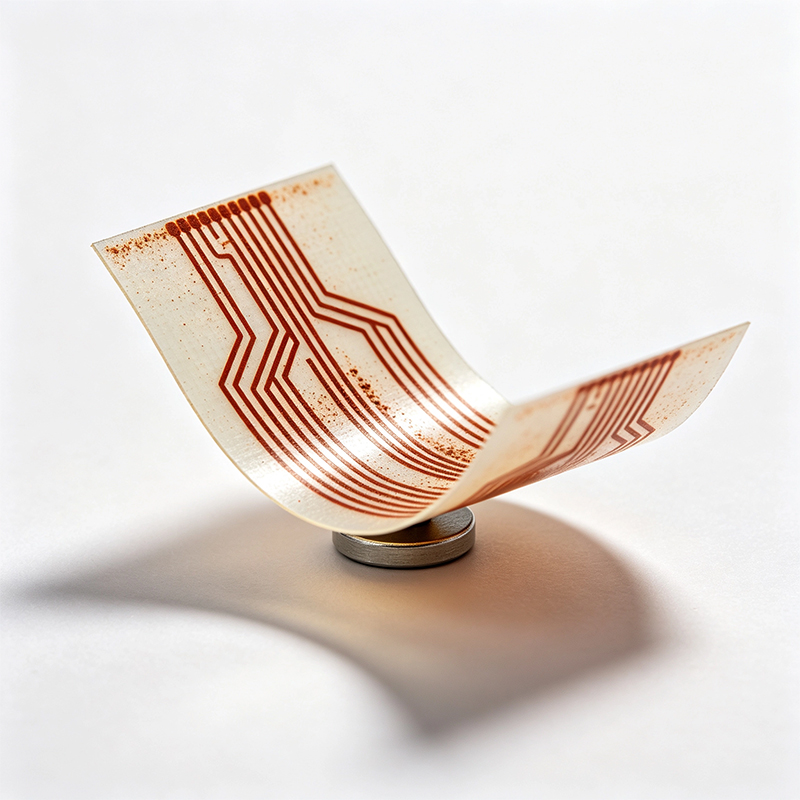
5. Magnetic Memory and Spintronics
Iron oxide also has magnetic properties, giving it potential applications in magnetic memory and spintronic devices — for example, flexible magnetic recording media or magnetic sensors.
You might ask: since iron oxide isn’t as conductive as copper and isn’t as magnetic as pure iron, why not just use better materials?
The answer is simple:
1. It’s cheap
Silver and gold conductive inks are extremely expensive. Iron oxide is everywhere and costs almost nothing. For consumer electronics that need to be manufactured in huge volumes, this is a massive advantage.
2. It’s environmentally friendly and non-toxic
Many electronic materials are toxic or environmentally damaging. Iron oxide is a naturally occurring substance that’s safe for humans and the environment.
3. It’s flexible-friendly
Iron oxide can be made into nanoparticles, thin films, porous structures — all sorts of forms that easily combine with polymers, rubber, and other flexible materials.
4. It’s multi-functional
One material that has magnetism, semiconductor properties, and chemical stability — that’s a rare combination in materials science.
Of course, iron oxide isn’t a magic bullet. Its main limitations right now are:
Conductivity isn’t high enough — nowhere near copper or silver. So it’s not suitable for applications that need high current or extremely high-frequency signals.
Still in development — many applications are still at the lab stage; large-scale commercialization will take time.
Complex to control — the performance of iron oxide depends heavily on its crystal structure, particle size, and purity. Making consistently high-quality products isn’t easy.
Red iron oxide (Fe₂O₃) in flexible circuits isn’t there to be the main “conductor.” Instead, it plays supporting but critical roles: sensors, shielding layers, energy storage electrodes, low-cost inks, and more.
Its greatest value lies in being cheap, environmentally friendly, flexible-friendly, and multi-functional. In the world of flexible electronics — which is all about low cost, high volume, and wearability — iron oxide is quietly transforming from an unremarkable “rust” into an indispensable functional material.

Kaboer manufacturing PCBs since 2009. Professional technology and high-precision Printed Circuit Boards involved in Medical, IOT, UAV, Aviation, Automotive, Aerospace, Industrial Control, Artificial Intelligence, Consumer Electronics etc..


 English



 Wechat
 +86 13670210335
 +86 13670210335
 E-mail