
Date: 2026-04-11
Let’s be real: no matter how brilliant your circuit design is, if your manufacturer’s pcb inspection process is weak, your product is a ticking time bomb. You’ve put months of engineering into your sample BOM, so why risk a field failure because of a tiny solder bridge or a micro-crack that no one noticed?
In 2026, electronics are getting smaller, faster, and more flexible. Whether you're building aerospace sensors on Rigid-Flex boards or AI hardware using high-speed HDI, the inspection phase is where the "real" manufacturing happens.
We’ve all seen the old-school photos of workers with magnifying glasses. While manual visual inspection is still a part of the mix, it’s nowhere near enough for modern tech.
Today, we rely on AOI (Automated Optical Inspection). These machines use high-resolution cameras and clever algorithms to compare your boards against the golden CAD file. It catches "tombstoning," polarities, and missing components in seconds. But at our facility, we take it a step further. We calibrate our AOI specifically for custom Flexible PCBs, which tend to "wiggle" more than rigid boards.
If your design uses BGAs (Ball Grid Arrays) or complex HDI (High Density Interconnect) layers, standard cameras are useless. You can’t see what’s happening underneath a chip.
This is where X-Ray Inspection comes in. It’s the only way to verify that those tiny solder balls have reflowed correctly and aren't causing a hidden circuit shorting issue. For high-frequency designs, even a tiny void in the solder can cause signal noise. Our 3D X-Ray tech ensures that the internal layers of your high-speed boards are as perfect as the outside.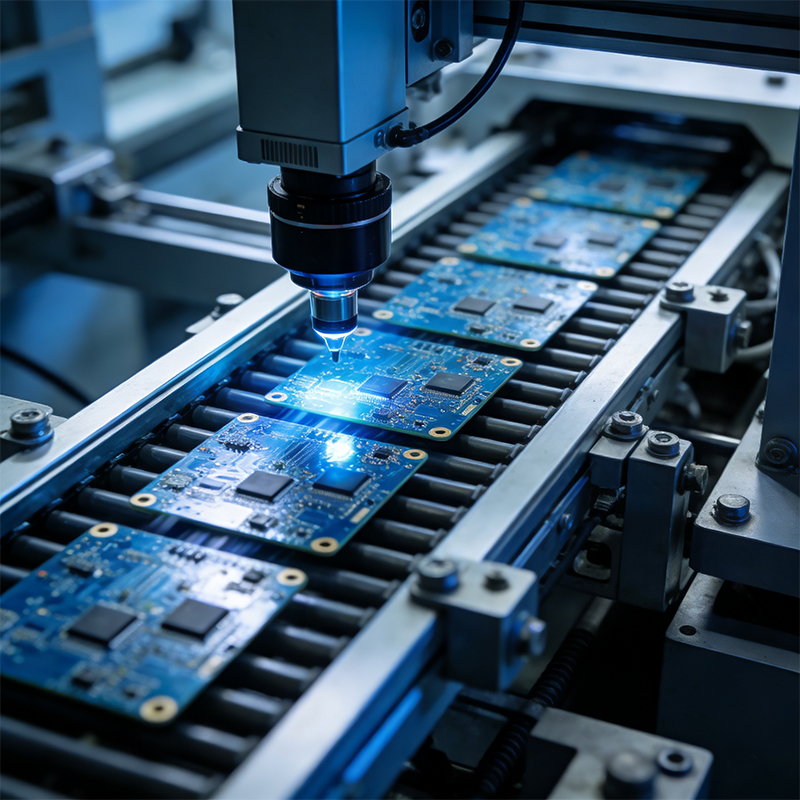
Inspecting a flexible pcb board is a nightmare for most shops. Why? Because they aren't flat! Flex circuits can shrink, stretch, and warp during production.
A "pass" on a rigid board might be a "fail" on a flex board. We look for specific issues like "coverlay adhesive bleed" or micro-cracks in the copper traces after bending. If your current supplier treats your Rigid-Flex boards like standard FR4, you’re likely getting a high failure rate in the field.
Before your boards leave our factory in China, they go through the ultimate gauntlet.
Flying Probe Testing: Perfect for prototypes where a "bed of nails" fixture isn't cost-effective. It checks for open circuits and shorts with high precision.
Functional Testing (FCT): We can simulate the real-world environment of your device to make sure it actually works, not just that it’s built correctly.
We know that for international manufacturers, being compliant with RoHS directive and maintaining IPC Class 2 or 3 standards is non-negotiable. Quality pcb inspection isn't an "extra cost"—it’s an insurance policy. It protects your brand, reduces your RMA costs, and ensures your project stays on schedule.
At our facility, we don't just "make" boards; we verify them. From the moment we receive your Gerber files to the final 100% inspection report, we are your eyes on the ground in China.
Don't leave your quality to chance. Whether you need a quote for a complex PCBA or a specialized Flex PCB project, our engineering team is ready to help. Send us your files today, and let’s make sure your next batch is flawless.

Kaboer manufacturing PCBs since 2009. Professional technology and high-precision Printed Circuit Boards involved in Medical, IOT, UAV, Aviation, Automotive, Aerospace, Industrial Control, Artificial Intelligence, Consumer Electronics etc..


 English



 Wechat
 +86 13670210335
 +86 13670210335
 E-mail