
Date: 2026-04-11
We’ve all been there: you plug in an old toaster, hear a loud pop, and suddenly the kitchen lights go out. You’ve just experienced a short circuit. But what is a short circuit, really? And why does it happen in everything from your home appliances to the high-tech Flexible PCBs inside your smartphone?
Let’s break it down in plain English.
Electricity is a bit like people during the morning commute—it always wants to take the path of least resistance. In a normal, healthy circuit, electricity flows through a designated path (the wires) to a load (like a lightbulb or a motor) and then back again.
A short circuit happens when electricity finds a "shortcut" that bypasses the load. Because the shortcut has almost zero resistance, a massive amount of electrical energy rushes through the wires all at once. Imagine a garden hose suddenly turning into a high-pressure fire hose—that’s a short circuit in a nutshell.
Short circuits don't just happen out of nowhere. There’s always a culprit. In everyday life, it’s usually:
Damaged Insulation: If the plastic coating on a wire gets frayed (maybe a pet chewed it or it just got old), the "hot" wire can touch the "neutral" wire.
Loose Connections: A wire that wiggles loose inside a plug can easily touch something it shouldn't.
Water and Moisture: Water is a great conductor. If it gets onto a circuit board, it can bridge two points that were never meant to be connected.
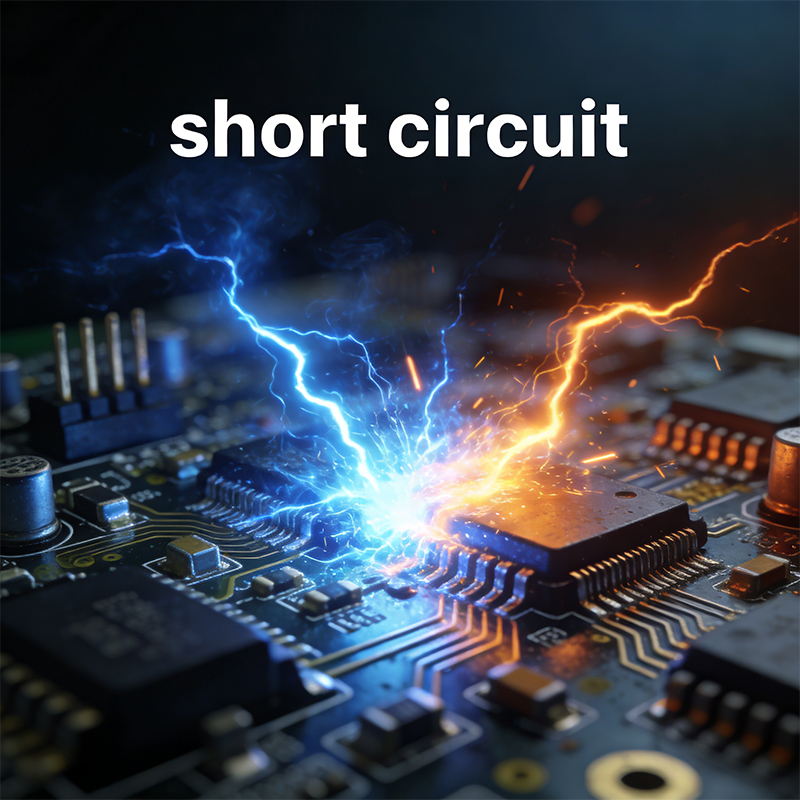
As a company specializing in custom Flexible PCBs and HDI high-frequency boards, we deal with short circuits on a microscopic level. In the world of high-end electronics, a short circuit isn't just a frayed wire—it’s often a manufacturing defect.
Solder Bridges: During the PCBA (assembly) process, if a tiny drop of solder connects two pins that should be separate, you get a "bridge." This is why we use ultra-precise 3D AOI (Automated Optical Inspection) to catch these before they leave the factory.
Dendritic Growth: This is a fancy term for tiny, hair-like metallic structures that "grow" between circuits over time due to moisture or poor cleaning. It’s a silent killer for Rigid-Flex boards used in industrial environments.
When that massive rush of electricity happens, things get hot—fast.
Heat & Fire: The wires can melt their insulation and start a fire.
Arcing: You might see sparks or a bright flash as the electricity literally jumps through the air.
Component Death: The surge can instantly fry expensive chips on a circuit board, turning your $1,000 device into a paperweight.
Thankfully, we have defenses. Fuses and circuit breakers are designed to "trip" and cut the power before the heat starts a fire. But in the world of manufacturing, prevention starts with the design.
Using high-quality HDI boards with proper spacing (creepage and clearance) and choosing the right PCB coating (like conformal coating) can protect your device from moisture-induced shorts.
So, what is a short circuit? It’s an uninvited shortcut that turns electricity from a helpful tool into a dangerous force. Whether you are a hobbyist or an electronics manufacturer, the key to safety is quality. At our facility, we make sure every Rigid-Flex or high-speed PCB we produce is tested to the highest standards, so you never have to deal with the "pop" of a short circuit.

Kaboer manufacturing PCBs since 2009. Professional technology and high-precision Printed Circuit Boards involved in Medical, IOT, UAV, Aviation, Automotive, Aerospace, Industrial Control, Artificial Intelligence, Consumer Electronics etc..


 English



 Wechat
 +86 13670210335
 +86 13670210335
 E-mail