
Date: 2026-05-12
You look at a circuit board and you see green, maybe a few copper lines. But have you ever wondered what the board itself is actually made of? It’s not just random plastic. The material underneath all those components is carefully chosen – and it can make or break your electronic device.
Let’s pull back the curtain and talk about PCB material in plain English. No chemistry degree required. Just what you need to know to understand why boards behave the way they do.
What Is a PCB Material, Anyway?
A PCB (printed circuit board) material is the base substance that holds the copper traces and components. It’s the “bread” in your electronic sandwich. Sometimes it’s stiff like a board. Sometimes it’s bendy like a piece of plastic. Sometimes it’s special stuff that can handle high heat or high-speed signals.
The most common name you’ll hear is FR4. But that’s just the beginning.
FR4 – The Workhorse of the Industry
If you’ve ever held a typical circuit board – from a computer, a TV, or a microwave – you’ve held FR4. FR4 stands for “Flame Retardant type 4”. It’s a composite material made of woven fiberglass cloth soaked in epoxy resin, then pressed and cured under heat.
In everyday words: it’s like fiberglass cloth that’s been glued together with epoxy. It’s stiff, strong, doesn’t burn easily, and it’s a great electrical insulator.
FR4 is cheap, reliable, and works for most standard applications. That’s why 90% of boards you see are FR4. It can handle temperatures up to about 130°C. Above that, it starts to soften and lose its mechanical strength.
Beyond FR4 – Other PCB Materials You Should Know
But not every circuit lives a calm life. Some need to bend. Some need to handle extreme heat. Some need to carry super-high-frequency signals without losing them along the way. So engineers developed other materials.
1. Flexible PCB Materials (Polyimide)
When you need a board that can bend, fold, or twist, you use a flexible PCB material. The most common is polyimide – the same stuff as the orange Kapton tape you might have seen. It’s a thin, flexible plastic film that can withstand soldering temperatures (around 260°C) and is very chemically resistant.
Flexible PCBs are used in wearables, foldable phones, cameras with moving parts, and anywhere space is super tight. The material is more expensive than FR4, but you can’t bend FR4 – it would crack.
2. High-Frequency (RF) Materials
For signals above 1 GHz – think 5G, radar, satellite, or high-speed digital – regular FR4 starts to lose signal energy. The electrons get “tired” and the signal degrades. That’s where high-frequency laminates come in.
Popular brands include Rogers, Taconic, Isola, and Panasonic Megtron. These materials have a lower dielectric constant and dissipation factor – fancy terms that mean the signal moves faster and loses less energy. They’re also more expensive and harder to process than FR4.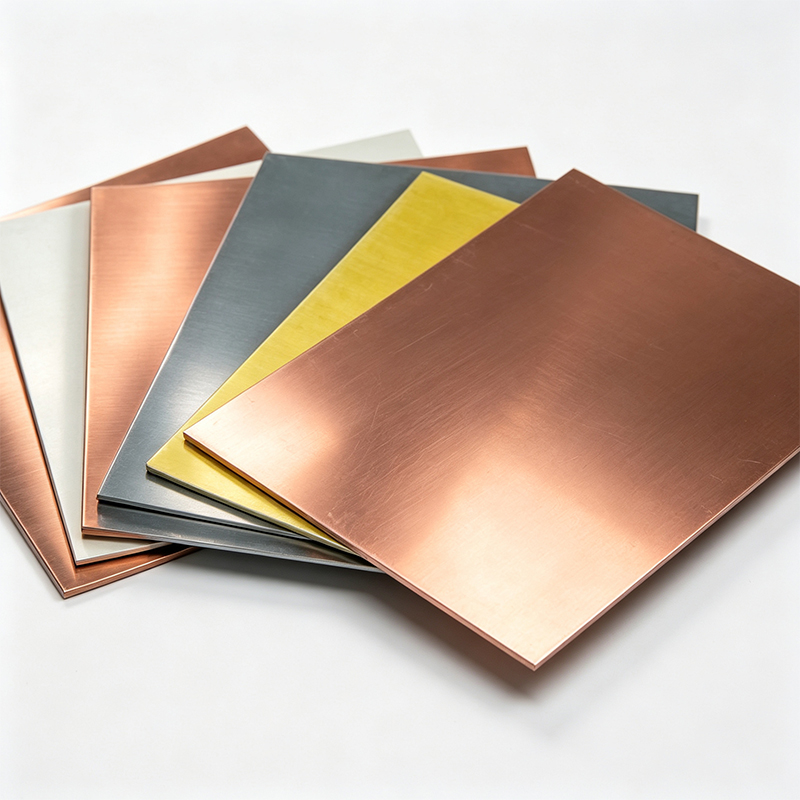
3. Metal-Core PCBs (Aluminum or Copper)
Some boards need to get rid of a lot of heat – for example, in LED lighting or power electronics. A regular FR4 board is a poor heat conductor, so heat builds up and damages components. The solution: a metal-core PCB.
Instead of fiberglass, the base is a thick sheet of aluminum (sometimes copper). A thin insulating layer separates the copper traces from the metal core. The metal pulls heat away from hot components and spreads it out. These boards are common in LED bulbs, motor controllers, and automotive electronics.
4. High-Temperature PCBs (like Polyimide or PTFE)
When the board itself will sit in a hot environment (like under the hood of a car, or near an engine), standard FR4 can warp or fail. High-temperature materials can handle continuous temperatures of 150°C to 200°C and sometimes higher.
Polyimide (the flexible material) is one option – it can take the heat. So can PTFE (Teflon), which is also used for high-frequency work. These are less common and more expensive.
5. Paper Phenolic / CEM-1 (Cheap, Low-end)
You find this stuff in very cheap consumer electronics – the kind you might see in a disposable radio, a toy, or an old TV remote. It’s made of paper soaked in phenolic resin. It’s brownish and looks cheaper than FR4 (because it is).
But it’s brittle, absorbs moisture, and can’t handle much heat. It does the job for ultra-low-cost products, but you wouldn’t use it for anything serious.
How to Choose the Right PCB Material?
If you’re just building a hobby project or a simple device, FR4 is fine. It’s affordable and works for most low-speed, low-temperature designs.
But ask yourself a few questions:
Does the board need to bend? → Flexible polyimide
Will it be in a hot environment? → High-Tg FR4 or polyimide
Does it carry high-frequency signals (above 1 GHz)? → Rogers or other RF laminates
Does it generate lots of heat (LEDs, power supplies)? → Aluminum-core PCB
Is cost the only concern? → FR4 or even paper phenolic (but know the trade-offs)
What About Color? Does That Matter?
No, the color of the board (green, blue, red, black, white) is just the solder mask – a protective layer painted over the copper. It doesn’t affect the performance except for minor optical reasons (like for LEDs). The underlying FR4 is normally pale yellow or off-white. The green color is just dye in the solder mask.
A Quick Comparison Table of Common PCB Materials
| Material | Main Feature | Strengths | Weaknesses | Typical Use |
|---|---|---|---|---|
| FR4 | Standard rigid | Cheap, strong, flame-retardant | Not for bending or very high heat | Most consumer electronics |
| Polyimide (Flex) | Flexible | Bends, high heat resistance | Expensive, harder to handle | Wearables, foldable devices |
| Rogers | High-frequency | Low signal loss, stable dielectric | Very expensive, harder to process | 5G, radar, microwave |
| Aluminum core | Heat dissipation | Pulls heat away from components | Heavy, only single-layer | LED lights, power modules |
| Paper phenolic | Low cost | Very cheap | Weak, absorbs moisture | Disposable electronics, toys |
How Thick Are PCB Materials?
Standard FR4 boards are usually 1.6 mm thick (about 1/16 of an inch). But you can get thinner (0.8 mm, 0.4 mm) or thicker (2.0 mm, 3.2 mm) depending on your needs. Flexible polyimide is much thinner – often 0.1 mm or less, like a piece of paper.
The Most Important Property You Should Know: Tg
Tg stands for glass transition temperature. It’s the temperature at which the material changes from hard and glassy to soft and rubbery. For standard FR4, Tg is around 130°C to 140°C. For “high-Tg” FR4, it can be 170°C or higher.
If you’re soldering or operating in a hot environment, you want a higher Tg so the board doesn’t warp. Lead-free soldering (which runs hotter) often demands high-Tg materials.
A Quick Story: When Material Choice Matters
A friend once designed a small LED lamp board. He used standard FR4 because it was cheap. The boards worked for a few days, then the LEDs started to fail. Why? The heat from the LEDs built up, the FR4 acted like an insulator, and the LEDs cooked themselves. Switching to an aluminum-core PCB solved the problem instantly – the metal pulled heat away, and the lamp lasted for years.
Final Answer – What Are PCB Materials?
PCB materials are the base substances that circuit boards are built on. The most common is FR4 (fiberglass with epoxy). But depending on whether you need bending, heat dissipation, or high-frequency performance, you might choose flexible polyimide, aluminum core, or special RF laminates like Rogers.
Next time you pick up a circuit board, you’ll know that the green part isn’t just “plastic” – it’s a carefully chosen material that someone picked to make your device work.
And if you’re ever designing your own board, remember: pick the material first, then the traces. It makes all the difference.

Kaboer manufacturing PCBs since 2009. Professional technology and high-precision Printed Circuit Boards involved in Medical, IOT, UAV, Aviation, Automotive, Aerospace, Industrial Control, Artificial Intelligence, Consumer Electronics etc..


 English



 Wechat
 +86 13670210335
 +86 13670210335
 E-mail