
Date: 2026-05-14
You’ve seen it before. A circuit board covered in a hard, rubbery, or sometimes clear block of material. It looks like someone poured glue all over it. That’s not a manufacturing mistake. That’s PCB potting.
Let’s dive into what potting is, why manufacturers use it, what materials they use, and when you might want to pot your own boards.
What Is PCB Potting?
PCB potting is a process where you fill an electronic assembly or an entire enclosure with a liquid compound (usually epoxy, silicone, or polyurethane). That compound then hardens into a solid mass, completely surrounding every component and wire.
In plain English: you take a circuit board, put it in a housing, and pour goo inside until everything is buried. When the goo cures, you have a solid, sealed block of electronics.
Why Would Anyone Pot a Circuit Board?
Four big reasons:
Protection from moisture and dust – The potting compound seals the board completely. Water, dirt, and chemicals can’t get in. This is crucial for outdoor sensors, automotive electronics, and marine equipment.
Shock and vibration resistance – The solid mass holds every component in place. Nothing can wiggle loose, even if you drop the device or mount it on a vibrating engine.
Thermal management – Some potting compounds are formulated to conduct heat away from hot components, spreading it to the housing or a heatsink.
Tamper resistance / security – Once potted, you can’t easily probe or reverse-engineer the circuit. You’d have to destroy the potting material, which often damages the board. This is common in anti-tamper designs, military gear, and some consumer products (like smart meters).
Where Do You See Potted PCBs?
Automotive electronics – Engine control units (ECUs), transmission controllers, ABS modules. Cars are full of vibration and temperature swings.
LED drivers – Outdoor or industrial LED lights use potting to keep moisture out.
Power supplies – Many sealed power supplies are potted for safety and reliability.
Sensors – Pressure sensors, temperature transmitters, flow meters in harsh environments.
Marine electronics – Anything on a boat or underwater.
Washing machines and dishwashers – The main control board is often potted to survive humidity and occasional water splashes.
Common Potting Materials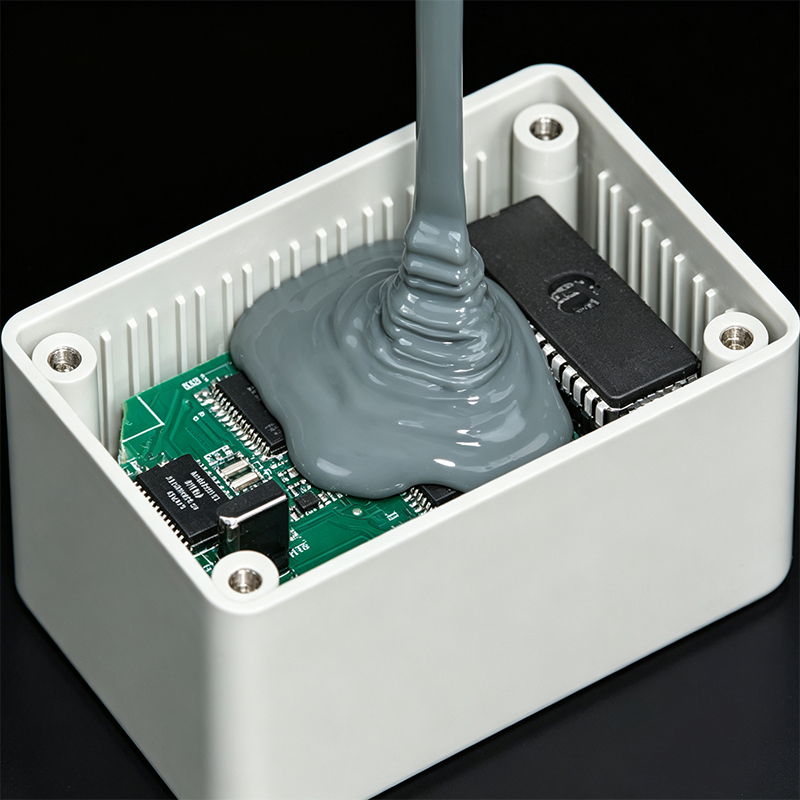
1. Epoxy – The Hard, Strong Choice
Epoxy is a two‑part compound (resin + hardener) that cures into a very hard, rigid plastic. It’s excellent for mechanical strength and chemical resistance. But it’s brittle – it can crack under extreme shock or thermal expansion. Also, once cured, it’s almost impossible to remove without destroying the board.
Best for: High-strength, permanent sealing. Not for boards that may need repair.
2. Silicone – The Soft, Flexible Choice
Silicone potting compounds cure into a soft, rubbery gel or elastomer. They remain flexible, which is great for absorbing vibration and thermal expansion. Silicone is also very heat-resistant (up to 200°C or more) and chemically stable. It’s easier to remove than epoxy – you can cut it away with a knife.
Best for: High-vibration environments, high-temperature applications, and where repairability is desired.
3. Polyurethane – The Middle Ground
Polyurethane offers a balance between hardness and flexibility. It’s tougher than silicone but not as brittle as epoxy. It also provides excellent moisture resistance. However, some polyurethanes can absorb moisture over long periods and may not be as heat-resistant as silicone.
Best for: General-purpose potting, especially for moisture protection.
4. UV-Curable Resins – For Fast Production
These are liquid resins that harden in seconds when exposed to ultraviolet light. Used in high‑volume manufacturing where speed is critical. But they’re expensive and require UV lamps.
What Is “Conformal Coating” vs. “Potting”?
Don’t confuse them. Conformal coating is a thin, paint‑like layer (25‑75 microns) sprayed or brushed onto a PCB. It protects against moisture and dust but doesn’t add mechanical strength or hide components. Potting is thick – it fills an entire enclosure, often centimeters thick. Potting offers much more protection but adds weight and makes repairs impossible.
How Is Potting Done? Step by Step
Prepare the board – Make sure the board is clean and dry. Any moisture trapped under the potting can cause failures later.
Place the board in a housing – The housing acts as a mold. Sometimes the board is potted without a housing, just a dam around the edges, but that’s less common.
Mix the compound – Two‑part epoxies and silicones must be mixed thoroughly, often under vacuum to remove air bubbles.
Pour or inject – The liquid is poured into the housing until the board is fully covered. Air bubbles must be avoided – sometimes a vacuum chamber is used to degas.
Cure – The compound hardens according to its chemistry. Room‑temperature cure takes hours to days. Heat‑cure takes minutes to hours.
Final test – The potted assembly is tested to ensure no shorts or opens were introduced.
Can You Pot a Board at Home?
Yes, but with caveats. You can buy small hobby‑sized potting compounds (especially silicone and epoxy). However, professional potting requires vacuum degassing to remove bubbles – otherwise, bubbles can cause voids where moisture collects or corona discharge in high‑voltage circuits.
For simple protection (e.g., keeping moisture out of an outdoor sensor), you can use two‑part silicone or epoxy from a hardware store. But don’t expect the same quality as industrial potting.
What About Heat? Potting Traps Heat?
Yes, most potting compounds are thermal insulators. That’s a problem for hot components like voltage regulators or power transistors. Some specialty potting compounds are thermally conductive (filled with ceramic or metal particles) to pull heat away. But even then, they’re less effective than a simple heatsink in open air.
If your board has hot parts, either use a thermally conductive potting or design the housing to act as a heatsink (e.g., metal housing with potting contacting it).
What If You Need to Repair a Potted Board?
Good luck. Potting is often permanent. To repair:
Silicone – You can cut it away with a sharp knife or scalpel. It’s tedious but possible. After repair, you can re‑pot with fresh silicone.
Epoxy – Almost impossible to remove without destroying the board. You can try carefully heating it (epoxy softens around 150‑200°C) but you’ll likely damage components. In many cases, a potted epoxy board is replace‑only.
Polyurethane – Some can be softened with heat or specific solvents, but it’s messy.
That’s why manufacturers only pot boards that are designed to be disposable or where failure is rare.
Common Potting Mistakes
Not removing air bubbles – Bubbles lead to voids, which can trap moisture and cause corona discharge. Vacuum degassing is critical.
Using the wrong compound – Hard epoxy on a board with large components that expand with heat? The epoxy may crack or rip component leads.
Potting connectors or switches – If you pour goo into a connector, it’s ruined. Mask them first.
Potting before full cleaning – Flux residues or moisture under the potting can cause corrosion over time.
Overheating during cure – Some exothermic reactions get very hot and can damage components. Follow the datasheet.
A Quick Story: The Unpotted ECU
A friend’s car developed an intermittent engine stalling problem. The mechanic traced it to the ECU (engine control unit). When they opened the ECU, there was no potting – just a bare board. Over years of vibration and moisture, a few solder joints had cracked. If the ECU had been potted, those joints would have been supported and likely never failed. The repair cost hundreds of dollars. Potting would have cost a few cents at manufacturing time.
Is Potting Always Necessary?
No. For indoor consumer electronics (phones, TVs, laptops), potting is overkill – it adds weight, cost, and prevents repair. But for anything exposed to water, vibration, or harsh chemicals, potting is a lifesaver.
Final Answer – What Is PCB Potting?
PCB potting is the process of encasing a circuit board in a solid or gel‑like compound (epoxy, silicone, or polyurethane) to protect it from moisture, vibration, shock, and tampering. It’s used in automotive, marine, industrial, and outdoor electronics. Potting makes repairs difficult but greatly increases reliability in harsh environments.
Next time you see a brick‑like module with wires coming out, you’ll know – inside that block of goo is a circuit board that’s built to last.

Kaboer manufacturing PCBs since 2009. Professional technology and high-precision Printed Circuit Boards involved in Medical, IOT, UAV, Aviation, Automotive, Aerospace, Industrial Control, Artificial Intelligence, Consumer Electronics etc..


 English



 Wechat
 +86 13670210335
 +86 13670210335
 E-mail