
Date: 2026-06-16
You’re an electronics manufacturer. You’ve designed your schematic, picked your components, and received your bare PCBs. But those bare boards don’t do anything yet. You need to solder all the components onto them. That process is called PCBA manufacturing.
PCBA stands for Printed Circuit Board Assembly. It turns an empty board into a functional “brain” for your product. Whether you make smartwatches, industrial sensors, or automotive controllers, the quality of your PCBA directly determines how stable your product is and how often it comes back for repair.
In this guide, I’ll walk you through the complete PCBA process, what to watch for at each step, and how to pick a reliable manufacturing partner. Plain English, no fluff.
A bare board becomes a fully assembled board through these steps. You may have heard some of the names but not known what they actually do.
1. Solder Paste Printing
This is the first step and the one most likely to go wrong. A stencil is used to print solder paste precisely onto the PCB pads. Paste thickness, position, and shape directly affect everything that follows. Good factories use SPI (Solder Paste Inspection) to check print quality — catching insufficient paste, bridging, or misalignment before reflow.
2. SMT Placement (Pick and Place)
Pick‑and‑place machines put components onto the paste‑covered pads one by one. High‑speed machines handle small passives (01005, 0201). High‑precision machines handle chips (QFN, BGA). Placement accuracy is typically within ±0.05mm. If a chip is placed crooked, reflow will cause tombstoning, bridging, or cold joints.
3. Reflow Soldering
The board with placed components goes into a reflow oven. Multiple heating zones gradually melt the solder paste, then cool it down to solidify the joints. The reflow profile is critical — preheat too fast and you get solder spatter; peak too low and joints won’t form; cool too fast and you get stress cracks. Good shops monitor the profile with a thermal profiler.
4. Automated Optical Inspection (AOI)
After reflow, boards go to an AOI machine. AOI uses high‑resolution cameras to compare the board to a golden sample, automatically detecting missing parts, wrong polarity, bridging, tombstoning, and other defects. AOI catches what the eye can’t see, but it doesn’t replace human judgment entirely.
5. Through‑Hole Assembly (DIP)
Some components (large capacitors, terminal blocks, connectors) can’t be placed by SMT machines. They must be inserted manually or by an auto‑insertion machine, then soldered using wave soldering or hand soldering. This is called DIP (Dual In‑line Package). DIP is slower and more expensive, so it’s best to minimize through‑hole parts.
6. Depaneling
If your design uses multiple PCBs in one panel (panelization), you need to separate them after soldering. This is done with a router‑based depaneler or a V‑cut separator. Never snap panels by hand — it can crack ceramic capacitors.
7. Programming
If your board has an MCU or Flash chip, you need to program the firmware. Small batches can be programmed manually; large volumes use auto‑programmers that can flash dozens of chips at once.
8. Functional Test (FCT)
This is the most important quality check. A custom test fixture powers up the board and runs it through real‑world scenarios: do buttons respond? Does communication work? Are output voltages correct? Does the buzzer beep? Only boards that pass FCT ship to customers.
9. Conformal Coating (Optional)
If your product will be used in humid, dusty, or corrosive environments (outdoor equipment, automotive), the board should be coated with a protective lacquer — acrylic, urethane, or silicone. Automated spray coating is the most consistent.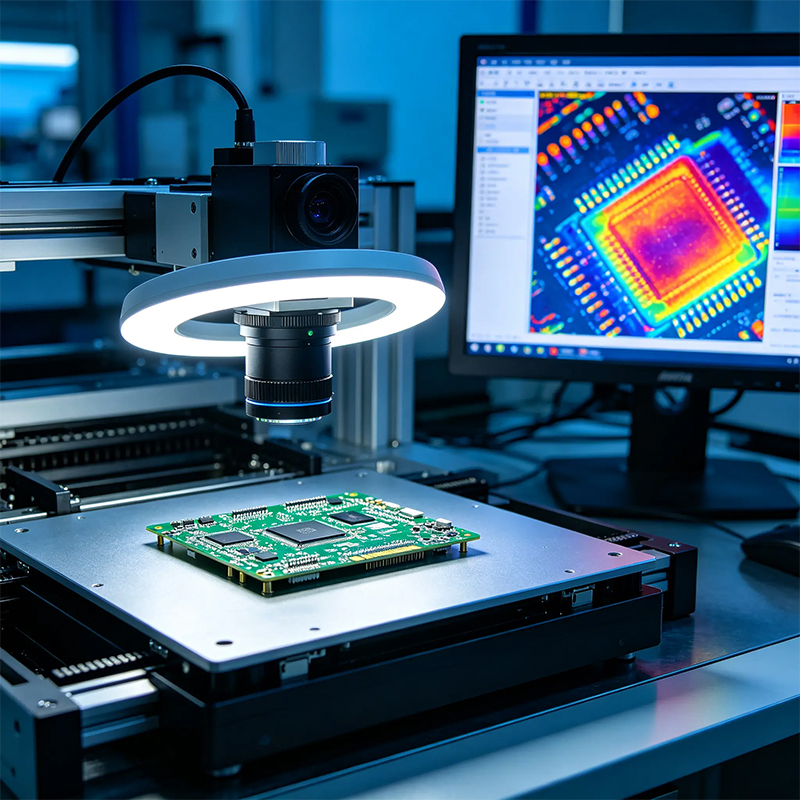
10. Packaging and Shipping
Final step: boards go into ESD bags, then anti‑static foam, then cartons with proper labels, and ship out.
Many customers ask: “Why does my board work fine from Factory A but keeps failing from Factory B?” The differences are often in these details.
1. Stencil Design and Solder Paste Printing
Aperture size, shape, and stencil thickness directly control paste volume. Too large → bridging. Too small → insufficient paste. SPI catches these before reflow. Factories without SPI rely on luck.
2. Reflow Oven Thermal Uniformity
After years of use, the actual temperatures inside an oven drift from the setpoints. A poorly calibrated oven can have 10°C difference between the top and bottom of a board. Good factories measure the profile weekly.
3. Electrostatic Discharge (ESD) Protection
Many chips (especially MOSFETs and RF chips) are static‑sensitive. A factory must have grounded wrist straps, ESD workstations, conductive flooring, and proper packaging. Without ESD control, chips can suffer “soft failure” — they work for weeks then die mysteriously.
4. Component Storage
Moisture‑sensitive devices (MSDs) — like BGA and QFN packages — must be used within a specific time after opening, or they need baking. Good factories have dry cabinets and ovens, and they log each component’s exposure time.
5. Test Coverage
Functional test (FCT) only checks that the board works, not that every solder joint is perfect. In‑circuit test (ICT) can electrically isolate and test each joint. ICT gives much higher coverage and accuracy, but the fixtures are expensive. Ask your PCBA shop what test methods they offer.
If your product uses flex PCBs or rigid‑flex boards, assembly is harder than for rigid boards because flex material warps, bends, and shifts during SMT.
Difference 1 – Must use a carrier
A flex board cannot run on a standard SMT conveyor. It must be taped or magnetically held onto a rigid carrier (aluminum or synthetic stone) before paste printing and placement. No carrier = terrible placement accuracy.
Difference 2 – Reflow support
Flex boards warp when heated. The carrier must be designed to keep the flex board flat throughout reflow. Otherwise, pads shift and you get bridging and opens.
Difference 3 – Depaneling method
Rigid boards can be V‑cut or routed. Flex boards must be laser cut or die‑punched. Routing will fray or tear the soft flex material.
Difference 4 – Rigid‑flex transition zone
The transition from rigid to flex is fragile. Components should never be placed in the transition area. Reflow must account for different thermal masses. After depaneling, the flex edges may need sealing.
We have been doing flex and rigid‑flex PCBA for over a decade. We have custom carriers and reflow profiles that achieve >98% yield.
As a buyer or R&D lead, ask these five questions when evaluating a PCBA shop.
1. Do you have SPI and AOI?
No SPI means paste inspection is visual only. No AOI means post‑reflow inspection is visual only. Skip such shops. SPI and AOI are standard equipment for modern SMT.
2. What pick‑and‑place machines do you use?
Ask for the brand and model. Old machines (15+ year old Panasonic or Yamaha) lack the precision for 0.4mm pitch QFN and 01005 passives. Modern machines are a must for dense boards.
3. Have you built similar products before?
If your design has flex, rigid‑flex, or BGA packages, choose a shop with experience. An experienced shop will DFM your design and flag issues before you order bare boards. An inexperienced shop will only tell you “we can’t place this” after you’ve spent money on PCBs.
4. How do you test? Who makes the functional test fixtures?
Many shops only do AOI and a simple power‑on test. If your product has complex functions, you need a custom FCT fixture. Ask: do they design and build their own fixtures? What is their test coverage?
5. What about lead time and warranty?
Sample lead time is usually 5‑10 days; volume depends on order size. Also ask: what happens if samples fail? What is the warranty for volume production? Do they have field application engineers to help debug?
We are not just an SMT house. We are a one‑stop manufacturer that designs and makes flexible PCBs, rigid‑flex boards, HDI high‑frequency boards, and then does full PCBA.
All in‑house – PCB fabrication, SMT, DIP, testing, and conformal coating under one roof. No hand‑offs, better quality and lead time.
Flex/rigid‑flex expertise – We have custom carriers and reflow profiles for flex boards. Thousands of flex and rigid‑flex PCBA projects completed.
High‑precision placement – ±0.025mm accuracy. We handle 01005 passives, 0.4mm pitch QFN, and BGAs.
SPI + AOI + X‑ray – Every step from paste to final assembly is inspected.
In‑house FCT fixture design – Our mechanical and electrical engineers design and build custom functional test fixtures for your product.
Free DFM review – Send your Gerber and BOM, get a DFM report within 24 hours with potential issues and suggestions.
PCBA projects we’ve served: consumer electronics (TWS earbuds, smartwatches, POS systems), industrial (PLCs, motor drives, sensors), automotive (BMS, light controllers, window controls), medical (patient monitors, glucometers, infusion pumps), communications (routers, baseband boards, optical modules).
Three simple steps:
Send your files – Gerbers, BOM, and pick‑and‑place XY data if available. If you don’t have complete files, send schematics and PCB screenshots – we’ll help organize.
We review and quote – Within 24 hours, you’ll receive a DFM report, sample and volume pricing, and lead time estimate.
Sample, then scale – We build 10‑20 samples. You run functional and reliability tests. Then we move to pilot and volume production.
PCBA manufacturing is the last mile from a drawing to a real product — and it’s the step where the most can go wrong. One bad solder joint on a board with hundreds of components can kill the whole assembly.
If you’re looking for a reliable PCBA partner, especially if your product involves flex PCBs, rigid‑flex boards, or high‑density SMT, send us your files. We won’t push a contract — we’ll first run a free DFM review and let our expertise speak.
When you contact us, please include:
Product type and basic functionality
Whether it uses flex or rigid‑flex boards
Estimated annual quantity (samples, small batch, or mass production)
We’ll give you an honest answer — what we can do, what we can’t, and how to modify your design to make it work. Let’s turn your bare boards into reliable, production‑ready assemblies.

Kaboer manufacturing PCBs since 2009. Professional technology and high-precision Printed Circuit Boards involved in Medical, IOT, UAV, Aviation, Automotive, Aerospace, Industrial Control, Artificial Intelligence, Consumer Electronics etc..


 English



 Wechat
 +86 13670210335
 +86 13670210335
 E-mail