
Date: 2026-06-13
You're an electronics engineer. You've definitely used or seen TQFP chips – those square packages with legs sticking out on all four sides. They're everywhere: microcontrollers, display drivers, audio codecs, and more.
TQFP stands for Thin Quad Flat Package. It's a member of the QFP family, but the "thin" part brings its own challenges for PCB design and soldering. In this guide, I'll explain what TQFP is, how it differs from regular QFP, what design mistakes to avoid, and why choosing the right PCBA shop matters. No engineering degree required – just plain talk.
TQFP and regular QFP look almost identical – both have "gull wing" leads extending outward from all four sides. The differences are in thickness and lead pitch.
| Feature | Regular QFP | TQFP |
|---|---|---|
| Package thickness | 2.0mm - 3.4mm | 1.0mm - 1.2mm |
| Lead pitch | 0.65mm - 1.0mm | 0.4mm - 0.8mm (0.5mm common) |
| Typical use | Industrial, automotive | Portable devices, phones, tablets |
| Soldering difficulty | Moderate | Higher (fine pitch, thin) |
TQFP is less than half the thickness of regular QFP and has finer lead pitch (0.4mm or 0.5mm is common). That means more pins in the same footprint – but also harder soldering and PCB routing.
1. Thin – fits in slim devices
Laptops, tablets, smartwatches have limited internal height. Regular QFP is too thick. TQFP at ~1mm is perfect for thin designs.
2. High pin density
A 0.5mm pitch TQFP packs about 30% more pins than a 0.65mm pitch QFP in the same body size. Great for microcontrollers with many I/Os.
3. Cheaper than BGA
For the same pin count, TQFP is less expensive than BGA. Plus, you can visually inspect most solder joints without X‑ray. For medium‑density designs, TQFP offers great value.
1. Fine pitch – easy to bridge or cold‑joint
With 0.4mm or 0.5mm pitch, the gap between adjacent leads is only about 0.2mm. A little too much solder paste causes bridging. A little too little causes opens. Reflow profile must be precise.
2. Lead coplanarity issues
TQFP leads are thin and soft. They can bend during shipping or handling. If leads are not perfectly flat, some won't contact the solder paste – resulting in open joints.
3. Difficult hand rework
Soldering TQFP with a hand iron is nearly impossible – you need hot air and very fine tips. Rework is slow and risky. If your product needs manual repair, TQFP is not a great choice.
Mistake 1 – Incorrect pad length
TQFP leads have a short extension. PCB pads that are too long create solder balls at the far end. Pads that are too short don't allow proper toe fillet. Standard recommendation: pad length = lead extension + 0.3mm to 0.5mm.
Mistake 2 – Pad width too close to lead width
To prevent bridging, pad width should be 10‑15% narrower than the lead width. Example: lead width 0.25mm, pad width 0.22mm. This gives a small safety margin for placement shift.
Mistake 3 – Missing solder mask dams
The green solder mask between pads (solder mask dams) is critical to prevent bridging. For 0.5mm pitch, the gap between pads is only about 0.2mm. Many PCB fabs can't reliably produce dams that thin. Confirm your fab's minimum dam width.
Mistake 4 – Wrong stencil thickness and aperture
For TQFP, use 0.1mm or 0.12mm stencil – not 0.15mm. Aperture width should be 10‑15% narrower than pad width. Aperture length can be 5‑10% longer than pad length for better toe fillet. Always use laser‑cut stencils with rounded corners.
Mistake 5 – Placing TQFP on flexible areas (for rigid‑flex boards)
On rigid‑flex PCBs, never place a TQFP on the flexible section or right at the rigid‑flex transition. The fragile leads will crack under bending. TQFP must be placed on rigid FR4 areas only.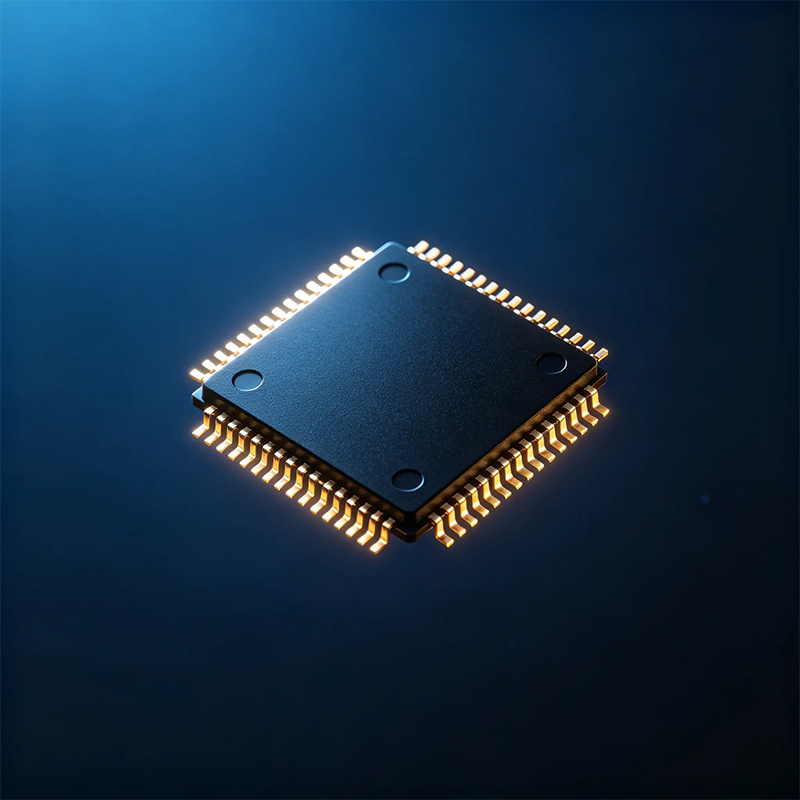
If you plan to outsource PCBA with TQFP, ask these questions:
Do you have high‑precision placement machines? 0.5mm pitch requires placement accuracy of ±0.05mm or better. Old machines won't cut it.
Are your stencils laser‑cut or etched? Laser‑cut gives cleaner aperture walls and better paste release. Etched stencils clog easily.
Do you have SPI (solder paste inspection)? SPI catches printing defects before reflow – saves boards from bridging or opens.
Have you done similar pitch TQFP projects before? Ask for case studies or sample photos.
We are not just an SMT house. We are a one‑stop manufacturer that designs and makes flexible PCBs, rigid‑flex boards, HDI high‑frequency boards, and then does full PCBA. For TQFP, we have extensive experience.
High‑precision placement – ±0.025mm accuracy, fully capable of 0.4mm pitch TQFP.
Laser‑cut stencils + SPI – Every board gets solder paste inspection. We catch issues before reflow.
Rigid‑flex TQFP rules – We know exactly where you can and cannot place TQFP on rigid‑flex boards.
Proven TQFP track record – From 0.4mm to 0.8mm pitch, microcontrollers to display drivers. Typical yield >99%.
Industries we serve: consumer electronics (tablet main chips, TWS earbud charger controllers), industrial (PLC, motor drivers), medical (monitor display drivers), communications (router switch ICs).
Three simple steps:
Send your files – Gerbers, BOM, and note which parts are TQFP (include pitch if known).
We DFM review – Within 24 hours, we'll tell you: are pad dimensions correct? Can we make the solder mask dams? Any stencil improvements?
Sample and validate – We build 10‑20 samples, run SPI and AOI, and share inspection reports. Once approved, we move to volume.
TQFP isn't rocket science, but it does require good placement accuracy, proper stencil design, and process control. A shop that struggles with TQFP will definitely struggle with BGA or QFN.
If you're designing with TQFP packages, send us your PCB files. We won't push a contract – we'll first run a DFM review and tell you if your design has hidden traps. Let the samples speak for themselves.
When you contact us, please include:
PCB design files (Gerber or source)
BOM (mark which parts are TQFP and their lead pitch)
Estimated annual quantity
We'll give you an honest answer – what we can do, what we can't, and how to fix it so we can.

Kaboer manufacturing PCBs since 2009. Professional technology and high-precision Printed Circuit Boards involved in Medical, IOT, UAV, Aviation, Automotive, Aerospace, Industrial Control, Artificial Intelligence, Consumer Electronics etc..


 English



 Wechat
 +86 13670210335
 +86 13670210335
 E-mail