
Date: 2026-03-16
Let's be honest for a second. When you look at a finished circuit board, it's easy to focus on the big picture—the layout, the layers, the overall design. But here's the thing: all of that is just the stage. The real stars of the show are the printed circuit board components sitting on top.
I've spent years in this industry, and I've seen too many projects go sideways because someone underestimated the importance of choosing the right components. A beautifully designed board with the wrong parts is just an expensive piece of fiberglass.
So whether you're sourcing components for a new design or trying to figure out why your supplier keeps talking about "lead times," here's what you actually need to know about PCB components.
Simply put, printed circuit board components are the individual parts that get soldered onto your PCB to make it functional . Without them, your board is just a piece of insulating material with some copper traces. With them, it becomes a controller, a sensor, a computer—whatever you designed it to be.
Components fall into a few main categories, each with its own job to do. Understanding what each type does helps you make better decisions when you're specifying parts for your designs.
Passive components don't need an external power source to work. They can't amplify signals, but they perform essential functions like storing energy, filtering noise, and controlling current flow .
Resistors are probably the most common component you'll encounter. Their job is simple: limit the flow of electric current . They protect sensitive parts from damage and help divide voltage in a circuit. You'll recognize them by their color bands or tiny printed numbers. When you're selecting resistors, pay attention to the resistance value (in ohms), tolerance (how accurate it is), and power rating (how much heat it can handle).
Capacitors store and release electrical energy . They smooth out voltage changes, filter out noise, and help maintain signal clarity. You'll see ceramic capacitors everywhere in high-frequency circuits—they're those little beige or gray blocks. Electrolytic capacitors are bigger and polarized, usually used for bulk energy storage in power supplies. Key specs: capacitance (in farads), voltage rating, and equivalent series resistance.
Inductors store energy in magnetic fields . They resist sudden changes in current and help filter signals. You'll find them in power supplies and RF circuits. They look like little coils or wound wire.
The table below shows the primary functions of passive components :
| Passive Component | Primary Function(s) |
|---|---|
| Resistors | Limit current flow, dissipate power as heat |
| Capacitors | Store and release electrical energy, stabilize voltage |
| Inductors | Store energy in magnetic fields, resist current changes |
| Transformers | Transfer energy between circuits, change voltage levels |
| Diodes | Allow current in one direction, protect against surges |
| Thermistors | Change resistance with temperature, sense heat |
Active components need power to work. They can amplify signals, switch currents, and process information .
Transistors are the workhorses of modern electronics. They act as switches and amplifiers—a small input signal controls a much larger current . This is what makes logic gates, processors, and memory possible. You'll find them in SOT packages or as part of larger ICs.
Diodes let current flow in only one direction . They protect circuits from voltage spikes and convert AC to DC. LEDs (light-emitting diodes) are a special type that gives off light. Common packages include SOD and SOT.
Integrated Circuits (ICs) are complete circuits packaged into a single component . They can be microcontrollers, op-amps, power regulators, or memory chips. They're the rectangles with many pins, and they're what give modern devices their intelligence. ICs come in many packages: SOIC, QFP, QFN, BGA—each with its own pros and cons for size, heat dissipation, and assembly difficulty.
These parts bridge the gap between electrical signals and physical actions .
Connectors let your board talk to the outside world—power in, signals out, connections to other boards . You've got headers, USB ports, audio jacks, board-to-board connectors, and more. When choosing connectors, think about current rating, voltage rating, how many times it'll get plugged and unplugged, and the pin spacing (pitch).
Switches make or break connections manually. Pushbuttons, toggle switches, slide switches—they're all ways for users to interact with your product.
Relays are electrically operated switches. A low-power signal controls a high-power circuit, which is handy for industrial controls and automation .
Sensors detect changes in the environment and convert them into electrical signals . Temperature sensors, light sensors, motion detectors, humidity sensors—they're what make devices "smart" and responsive.
Most modern sensors come as compact integrated circuits, making them easy to add to PCBs. They've enabled everything from wearables that track your heart rate to cars that park themselves .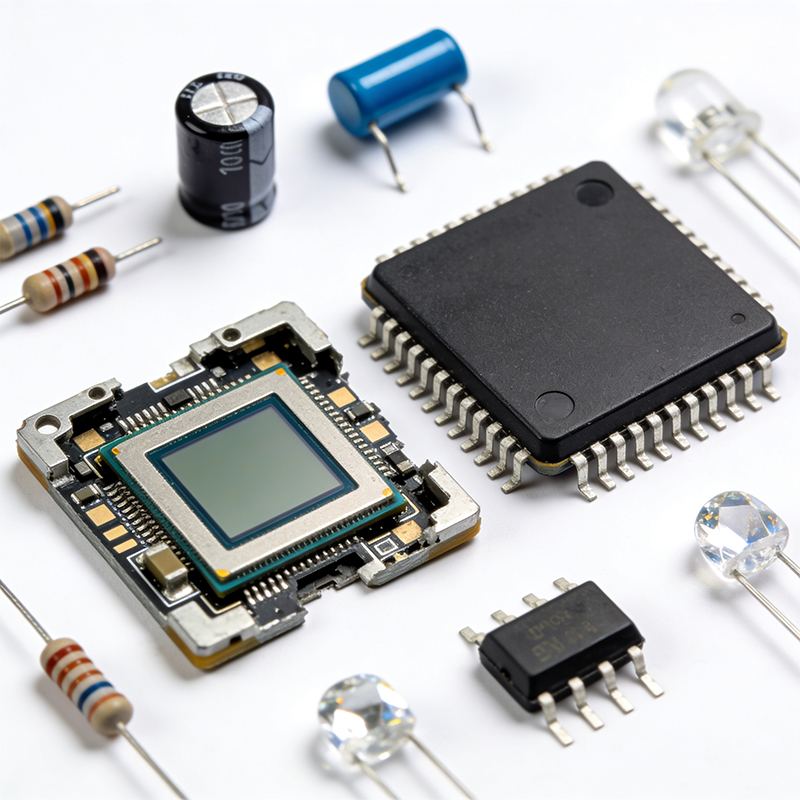
Here's something that doesn't always get talked about: the relationship between components and the PCB itself is a two-way street. The board affects the components, and the components affect the board.
Thermal management is a big one. Components generate heat, and that heat needs somewhere to go. Power transistors, voltage regulators, and high-power LEDs can get seriously hot. If the PCB can't conduct that heat away, components degrade and fail. That's why you see thermal vias under hot parts and why some boards use metal-core materials .
Signal integrity matters for high-speed designs. The physical placement of components affects how signals behave. Put a decoupling capacitor too far from an IC's power pin, and it won't do its job. Run high-speed traces too close to noisy components, and you'll get interference .
Mechanical considerations come into play with flexible and rigid-flex boards. You can't just put any component anywhere. Large, rigid parts need to sit on rigid sections. The flex areas need smaller, more flexible components .
Picking components isn't just about finding something that works on paper. Here's what experienced engineers and procurement folks think about:
Always check voltage and current ratings against what your circuit actually delivers. Good practice is to leave 20-30% headroom above the maximum expected values . If your circuit runs at 5V, a component rated for 6.3V might work, but 10V gives you a safer margin.
For precision circuits, you need tight tolerances—1% or better for resistors, stable dielectrics for capacitors . For general-purpose stuff, 5% is usually fine. Also consider temperature coefficients. If your product lives outside in the sun, components that drift with temperature will cause problems .
This sounds obvious, but you'd be surprised how often footprints don't match. Double-check package dimensions against your PCB layout. A 0603 resistor is 1.6mm × 0.8mm. An 0402 is 1.0mm × 0.5mm . Getting them mixed up means boards that don't work.
Where will your product live? A consumer gadget in an air-conditioned office has different requirements than an automotive module under the hood. Check operating temperature ranges, humidity tolerance, and any certifications like UL or RoHS .
Here's the reality check: the perfect component doesn't help if you can't buy it. Lead times for some parts stretch to 30-40 weeks. Before you finalize a design, check availability . Ask about second sources. Have alternatives in mind. The most brilliant circuit is useless if you can't build it.
Some components are designed to last years; others are commodity parts with short lifecycles. For medical, automotive, or industrial products that need to be supported for a decade, choose components with documented reliability and long-term availability . Check manufacturer lifecycle status before you commit.
Not all boards are the same, and the board type influences what components you can use.
For rigid boards, almost any component works. Focus on footprint compatibility and thermal management for power parts .
For flexible circuits, you need to be more careful. Avoid large, rigid packages in areas that will bend repeatedly. Use smaller, low-profile components where possible. The flex sections need parts that can move without cracking their solder joints .
For rigid-flex boards, keep components away from the boundaries where rigid and flexible sections meet. Heavy components should sit on rigid areas, maybe with stiffeners underneath for support .
For HDI and high-frequency boards, pay attention to package parasitics. BGAs with fine pitches need HDI technology just to escape all the signals. High-speed components need careful impedance matching .
Component quality varies wildly, and counterfeit parts are a real problem—especially for popular ICs. To protect your products:
Buy from authorized distributors whenever possible. Companies like Murata, Texas Instruments, ON Semiconductor, and Samsung Electronics have established supply chains and quality systems .
Check certifications. Reliable suppliers typically have ISO 9001 quality management certification and ISO 14001 environmental management . These aren't just pieces of paper—they mean the supplier has documented processes and regular audits.
Look at market reputation. Suppliers that have been around for years and serve major industries (automotive, medical, industrial) usually have their quality systems figured out .
If you're using a contract manufacturer, ask about their component sourcing process. Do they buy from authorized channels? Do they inspect incoming parts? How do they handle counterfeit prevention?
At Kaboer, we've been working with printed circuit board components since 2009. We're in Shenzhen, with our own PCBA factory, and we handle the whole range—from component selection to assembly to testing.
We work with all major component types:
Passives from 0201 to 1206 and beyond
ICs in SOIC, QFP, QFN, BGA, and custom packages
Discrete semiconductors and connectors
Specialty components for high-frequency, power, and flex applications
We also fabricate our own boards—flexible circuits, rigid-flex, HDI high-frequency boards, and rigid PCBs—so we understand how components and boards interact .
BOM review – We check component availability, lifecycle status, and footprint compatibility before production.
Sourcing assistance – We source from reliable suppliers and verify incoming components.
Fast prototyping – Need to validate a design quickly? We offer quick-turn assembly with components integrated exactly as specified.
Quality testing – Every board gets inspected. AOI, X-ray for hidden joints, functional testing—we catch problems before they ship.
We're certified to ISO 9001, IATF 16949 (automotive), and ISO 13485 (medical) . Our processes are documented, repeatable, and audited.
We're in Shenzhen, and we welcome overseas customers to visit our factory. Walk the floor, meet the team, see how we handle components from incoming inspection to final assembly.
Look, choosing the right printed circuit board components isn't rocket science. But it does take experience and attention to detail—especially when your boards get complex or need to meet specific performance requirements.
If you're working on a project and want to make sure you've got the right parts for the job, let's talk.
Send us your requirements or BOM. We'll take a look, give you honest feedback, and get back to you with a quote as soon as we can. No pressure, no hard sell—just straight talk from people who've been doing this for over 15 years.
And if you're ever in Shenzhen, come visit. See how we build boards, meet the team, ask whatever you want. We're an open book.

Kaboer manufacturing PCBs since 2009. Professional technology and high-precision Printed Circuit Boards involved in Medical, IOT, UAV, Aviation, Automotive, Aerospace, Industrial Control, Artificial Intelligence, Consumer Electronics etc..


 English



 Wechat
 +86 13670210335
 +86 13670210335
 E-mail