
Date: 2026-03-16
Let’s be real for a second. If you’re in the business of making electronic products, you’ve probably heard the term surface mount technology more times than you can count. It’s one of those industry basics that everyone throws around, but when you stop and actually ask "what is surface mount technology?" you don’t always get a straight answer.
I remember talking to a procurement manager a while back who’d been sourcing PCBs for years but couldn’t really explain how SMT worked or why it mattered. And honestly? That’s way more common than you’d think. The jargon flies so fast that the fundamentals get left behind.
So let’s cut through the noise. Whether you’re designing boards, sourcing components, or just trying to figure out why your supplier keeps talking about pick-and-place machines, here’s what you actually need to know about surface mount technology.
Surface mount technology (SMT) is basically the method of soldering electronic components directly onto the surface of a printed circuit board . That’s it. No leads poking through holes. No soldering on the opposite side. Components just sit flat on the board and get soldered right where they land.
This is different from the old-school way—through-hole technology—where components had long wire leads that you’d push through drilled holes and solder on the other side . Think of through-hole like nailing something through a board; SMT is like sticking a magnet on a fridge. It stays put, takes up less space, and you can put components on both sides of the board.
SMT didn’t really take off until the mid-1980s, but by the late 1990s, most high-tech electronics were using it . Today, it’s the standard. Your phone, your laptop, your car’s electronics—they’re all built with SMT.
There’s a reason through-hole is mostly a legacy technology now. SMT offers some serious advantages that matter for modern products.
Smaller components, denser boards. SMT components are tiny—we’re talking 0402 (1.0mm × 0.5mm) as a standard package, and 0201 or even 01005 for ultra-compact designs . That means you can pack way more functionality into the same board space. Without SMT, your smartphone would be the size of a tablet.
Better performance at high frequencies. Those short connections matter. Through-hole leads create parasitic inductance that messes up high-frequency signals . SMT components have minimal lead length, which means cleaner signals for 5G, high-speed data, and RF applications.
Faster assembly, lower cost. Pick-and-place machines can place tens of thousands of components per hour with incredible precision . Some high-speed lines hit 80,000 placements per hour . That level of automation means your per-board cost drops dramatically once you scale up.
Both sides of the board are usable. Because components sit on the surface, you can populate both sides of the PCB. That’s double the functionality in the same footprint.
If you’ve never seen an SMT line in action, here’s what happens step by step .
It starts with a stainless steel stencil—laser-cut with openings that match your PCB pads. The stencil aligns over the board, and solder paste (a grayish mixture of tiny solder spheres and flux) gets spread across it .
This step is critical. The stencil thickness is typically 0.12–0.15 mm . The goal is to deposit just the right amount of paste—about 0.10–0.20 mm thick . Too little, and you get weak joints. Too much, and you risk shorts between pins.
Engineers design these stencils carefully. Two key ratios matter :
Area ratio needs to be greater than 0.66 for reliable paste release
Aspect ratio should be greater than 1.5 to prevent paste from sticking to hole walls
Printing parameters also matter :
Print speed: typically 30–50 mm/s
Squeegee pressure: about 1.5–2.5 kgf/cm²
Separation speed: slow and controlled at 0.1–0.3 mm
Many SMT lines include SPI right after printing. This uses 3D measurement to check that every paste deposit has the right volume, height, and alignment . Catching problems here is way cheaper than finding them later.
High-speed pick-and-place machines grab components from reels and trays using vacuum nozzles . Modern machines can place components with accuracy down to ±0.01 mm . For tiny 0402 parts, that precision matters.
Different machines handle different jobs :
High-speed chip shooters place small passives at tens of thousands per hour
Multi-function placers handle complex parts like BGAs and QFPs with higher accuracy
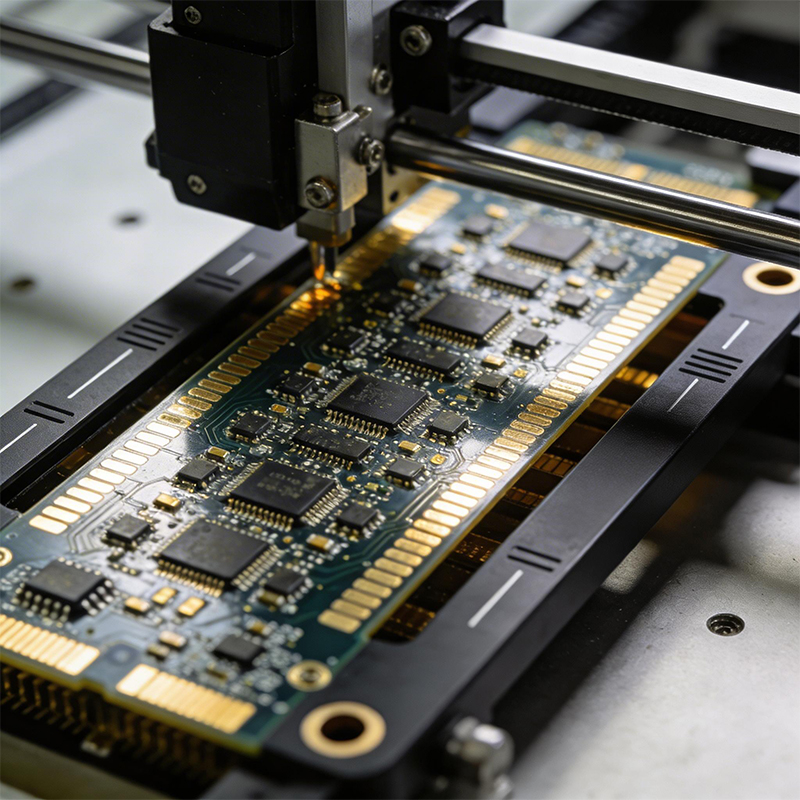
The board goes through a reflow oven—a long tunnel with multiple temperature zones. The temperature profile is carefully controlled :
Preheat: gradual heating to activate flux
Soak: allows the whole board to reach even temperature
Reflow: peaks above solder melting point (235–245°C for lead-free)
Cooling: controlled solidification to create strong joints
The time above liquidus is typically 30–90 seconds .
After reflow, boards get checked :
AOI (Automated Optical Inspection) looks for visible defects like missing parts or solder bridges
X-ray inspection checks hidden joints underneath BGAs and QFNs
In-circuit test (ICT) verifies electrical connectivity
Functional test powers up the board to confirm it actually works
Good inspection can push first-pass yield above 99.95% .
Even with all this automation, things can go wrong. Here are a few classic headaches:
Tombstoning. A small resistor or capacitor stands up on one end like a grave marker . This happens when one end of the part heats faster than the other, causing uneven surface tension. Fixing it usually means adjusting pad design or reflow profile.
Solder bridging. Solder connects adjacent pins that should be separate, creating a short circuit. Often caused by too much paste or pads spaced too closely .
Insufficient solder. Weak joints happen when too little paste deposits. This can trace back to clogged stencil apertures or incorrect printing parameters .
Voids. Hidden air pockets inside solder joints, especially under BGAs. Usually caused by outgassing during reflow. X-ray inspection is the only way to spot them.
The best way to avoid these? Work with a manufacturer who actually checks their work at every stage.
One thing people don't always realize: surface mount technology works across different kinds of PCBs, but the approach varies.
For rigid boards, SMT is straightforward and well-established. The stable substrate makes placement and reflow predictable.
For flexible circuits, SMT requires extra care . Flexible PCBs can shift during processing, so they need proper fixturing—often using carriers—to keep them stable during printing and placement . That's why not every EMS provider handles flex PCB assembly well .
For rigid-flex boards, SMT lets you populate components on the rigid sections before final assembly, streamlining production and reducing connectors between boards .
This matters because more products today are using flex and rigid-flex—wearables, medical devices, foldable phones . If your manufacturer doesn't understand how SMT behaves on these materials, you're going to have problems.
At Kaboer, we've been running SMT lines since 2009. We're in Shenzhen, with our own PCBA factory, and we handle the full range—from rigid boards to flexible circuits, rigid-flex, and HDI high-frequency boards.
Here's what that means for you:
We handle the tricky stuff. Flexible and rigid-flex PCBs need special handling during SMT . We've got the fixturing and processes to keep them stable, so you don't get misalignment or placement errors.
We work with tiny components. Modern designs use 0201 and 01005 packages. Our lines are equipped to place them accurately .
We check everything. SPI before placement, AOI after reflow, X-ray for hidden joints, and functional testing at the end . We don't ship boards we haven't verified.
We can prototype fast. Need to validate a design quickly? We offer quick-turn assembly so you can catch issues early, when they're cheap to fix.
We're certified. ISO 9001, IATF 16949 (automotive), ISO 13485 (medical)—we've got the credentials that matter for your industry.
And if you're ever in Shenzhen, you're welcome to visit our factory. Walk the floor, meet the team, see how we work.
Look, surface mount technology isn't rocket science. But it does take experience and attention to detail—especially when your boards get complex or need to bend.
If you're working on a project and want to make sure your SMT assembly is in good hands, let's talk.
Send us your requirements or Gerber files. We'll take a look, give you honest feedback, and get back to you with a quote as soon as we can. No pressure, no hard sell—just straight talk from people who've been doing this for over 15 years.
And if you're ever in Shenzhen, come visit. See how we build boards, meet the team, ask whatever you want. We're an open book.

Kaboer manufacturing PCBs since 2009. Professional technology and high-precision Printed Circuit Boards involved in Medical, IOT, UAV, Aviation, Automotive, Aerospace, Industrial Control, Artificial Intelligence, Consumer Electronics etc..


 English



 Wechat
 +86 13670210335
 +86 13670210335
 E-mail