
Date: 2026-03-19
If you've ever had a shipment stuck at customs, you know the feeling. The emails, the delays, the unexpected fees—all because of a few digits on a form. For electronics manufacturers, getting the printed circuit board HS code right is one of those boring details that can make or break your delivery timeline.
I've talked with enough procurement managers to know that HS codes aren't anyone's favorite topic. But here's the reality: a wrong code means delayed shipments, extra duties, and frustrated customers. A right code means your boards get where they're going, on time and on budget.
Let's walk through what you actually need to know about HS codes for PCBs—no jargon, just practical information.
First, the basics. HS stands for Harmonized System. It's a standardized numerical method of classifying traded products, used by customs authorities around the world to determine duties, taxes, and regulations .
Think of it as a universal language for products crossing borders. Over 98% of international trade uses the HS system for classification . Every product gets a code, and that code determines what happens when it reaches a border.
For PCBs, getting this code right matters because:
Wrong code = wrong duties. You might overpay or underpay, and underpaying gets you in trouble.
Wrong code = delays. Customs holds shipments for review when codes don't match the product.
Wrong code = audits. Frequent mistakes flag your company for closer inspection.
The primary HS code for printed circuit boards is 8534.00 . This is the six-digit global standard that covers "printed circuits" in Chapter 85 of the Harmonized System.
Within this code, different countries add extra digits for more specific classification. For example:
In China, 8534.00.9000 covers printed circuits of 4 layers or less
In the US, 8534.00.0040 covers 2-layer rigid PCBs, and 8534.00.0020 covers 4-layer rigid PCBs
The key takeaway: while the first six digits are standard worldwide, you always need to check the full code for your destination country.
Here's where many manufacturers make their first mistake. Bare PCBs and assembled PCBs (PCBAs) are classified differently .
Bare boards with no components fall under 8534.00
Assembled boards with components like resistors, capacitors, and ICs may still fall under 8534.00 if the assembly function dominates . However, boards with specific integrated circuits might shift to 8542 .
For complex assemblies, especially those with processors or memory chips, you need to be careful. Some customs authorities classify populated boards under the HS code for the device they're part of—for example, flexible PCBAs for mobile phones often use 8517.79.10 .
The rule of thumb: bare board = 8534.00. If components are the main feature, check if a different code applies.
Flexible PCBs can fall under different codes depending on their application :
8534.00.90 for bare flexible PCBs
8517.79.10 for flexible PCBAs used in mobile phones
8534.00.30 for unassembled multi-layer flexible PCBs
9405.99.00 for flexible LED PCBs used in lighting
This is why knowing your product's end use matters. A flexible PCB destined for a smartphone gets a different code than one destined for an LED strip.
HS codes aren't static. They change, and 2025 brings several updates that affect PCB shipments :
Starting September 1, 2025, all shipments require full HTS (Harmonized Tariff Schedule) classification. The de minimis exemption for shipments under $800 ends August 29, 2025 . This means more shipments will face duties, and accurate classification becomes even more critical.
Current US tariff rates for PCBs from China vary:
2-layer and 4-layer FR4 PCBs: effectively 10% after exemptions
6+ layer, flex, and non-FR4 PCBs: 35% total
From January 1, 2025, GCC countries require 12-digit HS codes for precise classification . This means more detail in your customs documentation.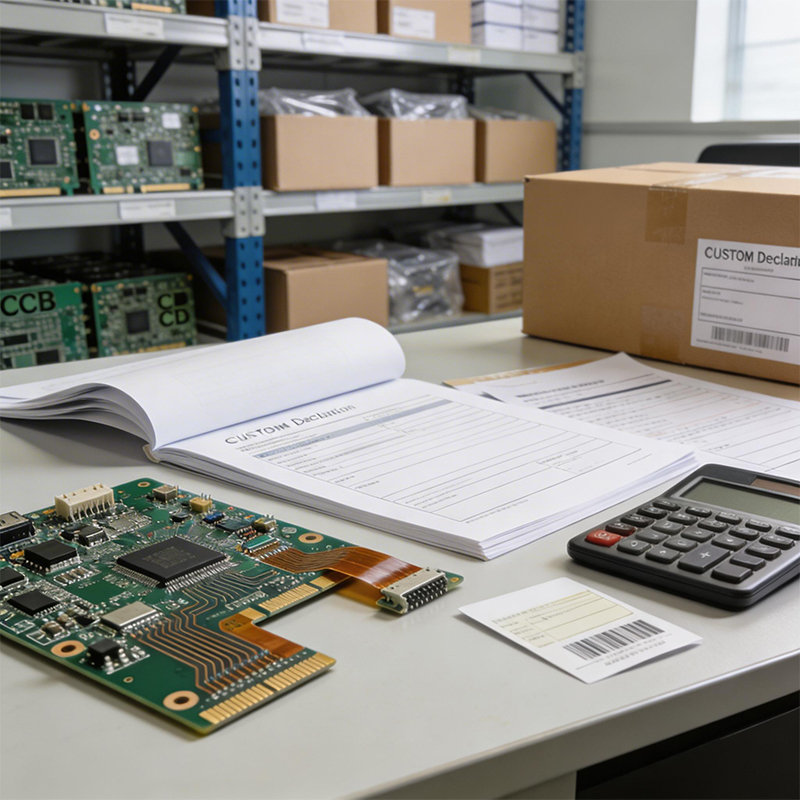
The EU's Combined Nomenclature for 2025 includes refined headings for electronics, with some SMT assemblies potentially reclassified .
National HS adjustments in 2025 may affect PCBs integrated with batteries, potentially crossing into HS 8507 territory .
If you're unsure about your product's classification, here's a practical approach :
Step 1: Examine the product. Is it a bare PCB or assembled with components? What's the layer count? What material is it made from?
Step 2: Navigate HS Chapter 85. This chapter covers electrical machinery and equipment. The printed circuits section is 8534.
Step 3: Select the base code. Start with 8534.00 for most PCBs.
Step 4: Apply regional extensions. Check your destination country's customs website for the full code. For China, use the 10-digit code. For GCC countries, you need 12 digits starting 2025.
Step 5: Verify with tools. Use the WCO HS database or national customs portals to confirm.
Step 6: Document your rationale. Keep records of why you chose a particular code in case of audits.
Based on what I've seen with clients, these are the most frequent errors :
Confusing bare and assembled boards. This is the biggest one. Bare PCBs (8534) and assembled PCBAs (sometimes 8542 or other codes) are different.
Ignoring regional digit expansions. Using only the six-digit code when your destination requires eight, ten, or twelve digits leads to delays.
Missing 2025 updates. The rules changed this year. Using outdated codes means problems.
Overlooking end-use. A flexible PCB for a phone (8517) is different from one for general instrumentation (8534).
Not checking battery integration. PCBs with attached batteries may shift to HS 8507.
To avoid delays, make sure your shipping documentation includes:
The complete HS code (all digits required by destination country)
Clear product description matching the code
Layer count (for rigid boards)
Whether it's flexible or rigid
Whether it's bare or assembled
Material composition (FR-4, polyimide, metal-core, etc.)
Intended use, if it affects classification
Accurate HS codes do more than just keep customs happy. They :
Reduce unexpected duties and taxes. You'll know what to budget.
Speed up customs clearance. Correctly classified shipments move faster.
Improve trade data accuracy. Better forecasting and planning.
Minimize penalties. Wrong classifications can mean fines.
Support e-commerce scalability. Especially important with 2025 US rule changes.
At Kaboer, we've been manufacturing printed circuit boards since 2009. Based in Shenzhen, we handle the full range—from standard rigid boards to flexible circuits, rigid-flex boards, HDI high-frequency PCBs, and metal-core boards. We also offer full PCBA assembly with our own factory.
We work with clients around the world and understand that shipping is as important as manufacturing. When you work with us:
We provide complete documentation for customs clearance
We can advise on HS code classification based on your product's specifications
We offer fast prototyping so you can validate designs quickly
If you're ever in Shenzhen, you're welcome to visit our factory and see how we work
If you have a project in the works and need assistance with PCB manufacturing or assembly—or just want to discuss the right HS code for your product—send us your requirements or Gerber files. We'll review your design, give you honest feedback, and get back to you with a quote as soon as we can. We've been at this for over 15 years, and we believe the best partnerships start with straightforward conversations.

Kaboer manufacturing PCBs since 2009. Professional technology and high-precision Printed Circuit Boards involved in Medical, IOT, UAV, Aviation, Automotive, Aerospace, Industrial Control, Artificial Intelligence, Consumer Electronics etc..


 English


 Wechat
 +86 13670210335
 +86 13670210335
 E-mail