
Date: 2026-03-19
You know the feeling. You've just finished a design, and you're itching to see if it actually works. Maybe you're on a tight deadline, or maybe you just want to validate that clever idea before committing to production quantities. Either way, waiting weeks for boards isn't an option.
That's where rapid PCB prototyping comes in. It's not just about speed—it's about getting functional boards in days, not weeks, while maintaining the quality you need for proper validation.
Let's walk through what rapid prototyping actually means, how the process works, and what you need to know to get your boards fast without compromising quality.
In the PCB world, rapid prototyping means compressing the standard manufacturing timeline from weeks to days. Instead of the typical 2-3 week turnaround for fabricated boards, rapid prototyping aims for 24-72 hours for bare boards and 5-7 days for fully assembled prototypes .
The demand for ultra-fast PCB prototyping has exploded in recent years. According to industry reports, the global PCB prototype market has grown by over 15% annually, with 24-hour services representing the fastest-growing segment . This growth is driven by shorter product development cycles, agile hardware development methodologies, and investor expectations for functional prototypes.
But here's the key: speed alone isn't enough. A fast prototype that doesn't work isn't a prototype—it's scrap. True rapid prototyping combines:
Rapid fabrication of bare PCBs (24-72 hours)
Quick-turn assembly with available components (5-7 days)
Accelerated testing to verify functionality
Iteration support for design revisions
The goal isn't just speed. It's speed that lets you iterate, validate, and move forward without breaking your development budget.
Time-to-market is everything. A product that launches three months late can lose significant lifetime revenue. Those weeks spent waiting for prototypes aren't just frustrating—they're expensive.
Rapid prototyping lets you:
Test earlier. The sooner you have hardware in your hands, the sooner you find problems. And problems found at prototype stage cost pennies to fix. Problems found at production stage cost thousands.
Iterate faster. First designs rarely work perfectly. Maybe the impedance is off. Maybe a component runs hotter than expected. Maybe the mechanical fit isn't quite right. Rapid prototyping means you can fix it and have a new version in days, not weeks.
Validate concepts before committing to production. A fast prototype lets you prove your idea works—to yourself, to investors, to early customers—without sinking months into development.
Meet market windows. Product launches have seasons. Trade shows have dates. Customers have expectations. Rapid prototyping keeps you on schedule.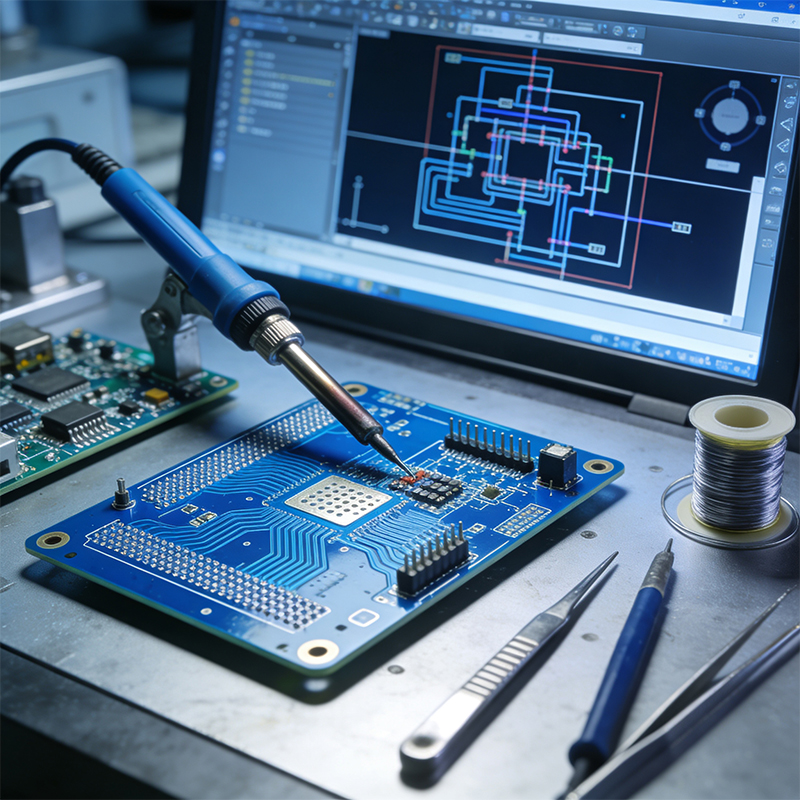
Working with a manufacturer that offers true rapid prototyping should feel different from standard production. Here's what it looks like:
You send your Gerber files and assembly requirements. Within hours, you get a quick DFM check—not a deep dive, but enough to catch show-stopping issues. The manufacturer confirms they can build your design within your timeline.
This step is critical. A good DFM check catches issues like trace widths that are too narrow, spacing violations, or drill sizes that don't match available tooling .
What good looks like: Acknowledgment within 2 hours, initial DFM feedback within 24 hours, clear communication about any potential delays.
For rapid prototyping, materials need to be on-hand. The manufacturer stocks common laminates like FR-4, high-Tg materials, and standard copper weights so there's no waiting for material orders.
What good looks like: No delays waiting for material procurement. If your design needs something exotic, they flag it immediately.
This is where the magic happens. The fab runs your boards on accelerated schedules, often dedicating specific production slots for quick-turn work. Processes are streamlined—no waiting in queue behind high-volume production runs.
Modern PCB prototype pricing in the 24-hour market is influenced by several factors: layer count, board size, minimum trace width and spacing requirements, and surface finish type .
What good looks like: Clear status updates. You know where your boards are in the process. If there's a delay, you hear about it before it becomes a crisis.
For assembled prototypes, components are the biggest variable. Long lead times kill fast prototyping. Good manufacturers stock common components or have relationships with distributors that allow quick procurement.
What good looks like: They check component availability before quoting. If a part has long lead time, they flag it and suggest alternatives.
Assembly for prototypes often happens on dedicated quick-turn lines. These are set up for fast changeovers, so your small batch doesn't have to wait behind a 10,000-unit production run.
What good looks like: Assembly completed within agreed timeline, with regular progress updates.
Even fast prototypes need testing. Good manufacturers have testing capabilities integrated into their quick-turn workflow—AOI, X-ray for hidden joints, and basic functional testing .
What good looks like: Test reports included with your prototypes. You know what was checked and what passed.
Not all quick-turn services are created equal. Here's what to look for:
The best rapid prototyping services don't just "try" to get your boards done quickly—they have dedicated production lines for quick-turn work. This means your small batch isn't waiting behind million-board orders.
Look for manufacturers who inventory common materials. If they have to order FR-4 when you place your order, you're already adding days to your timeline.
For assembled prototypes, ask about their component stock. Do they have common passives, connectors, and ICs on hand? Can they source quickly when needed?
Rapid prototyping needs fast engineering support. The manufacturer should be able to review your design quickly and flag issues without introducing days of delay.
You should know where your boards are at every stage. Look for partners who provide order tracking and proactive updates.
Speed doesn't have to mean sloppy. Look for manufacturers who maintain their quality standards even on quick-turn jobs—AOI, X-ray, electrical test .
When you're in a hurry, it's tempting to skip the manufacturing review and just get boards made. That's how you end up with boards that can't be assembled or fail in testing.
The fix: Even with fast turnaround, insist on a DFM check. A good manufacturer can do this quickly without sacrificing quality.
Nothing kills a rapid prototyping schedule like a 20-week lead time for a critical part. You spec a component, assume it's available, and then discover it's backordered.
The fix: Have your manufacturer review your BOM for availability before you commit. For fast prototyping, consider using parts that are known to be in stock.
Some manufacturers promise fast turnaround but cut corners to deliver. Thin plating, poor registration, missed inspections—problems that show up later as failures.
The fix: Work with manufacturers who have quality systems even for quick-turn work. Certifications like ISO 9001 matter, even for prototypes.
Fast prototyping requires constant communication. If you're waiting days for a response, you're not getting fast service.
The fix: Choose a partner who communicates proactively. You should know where your boards are without having to ask.
Several manufacturers offer 24-hour PCB prototype services. Here's what you can typically expect :
2-layer boards (50mm x 50mm, 5 pieces): $20-65 depending on quality level and manufacturer
4-layer boards (50mm x 50mm, 5 pieces): $55-120 depending on quality level
6-layer boards (75mm x 75mm, 5 pieces): $150-250 for standard quality
These prices typically include the boards themselves but not shipping. Express shipping can add $15-50 depending on your location.
Quality levels generally follow IPC Class 2 for standard prototypes, with IPC Class 3 available at higher cost for demanding applications .
At Kaboer, we've been providing rapid prototyping services since 2009. Based in Shenzhen, we understand that your timeline matters—and that speed without quality is useless.
Bare PCBs:
Standard quick-turn: 24-72 hours
Flexible PCBs: 3-5 days (1-20 layers, 0.075mm to 0.4mm thick)
Rigid-Flex: 5-7 days (2-30 layers)
HDI and high-frequency boards: 5-7 days
Assembled PCBA:
SMT assembly: 5-7 days
Mixed technology (SMT + through-hole): 7-10 days
Prototype quantities: 5-50 boards
We stock materials. Common FR-4, high-Tg, flexible polyimide, and even some high-frequency materials are kept on hand. No waiting for material orders.
We have dedicated quick-turn capacity. Our production lines are set up to handle small batches efficiently, without competing with high-volume runs.
We check components before quoting. When you send us your BOM, we verify availability immediately. If there's a long-lead part, we flag it and suggest alternatives before you commit.
We communicate constantly. You get regular updates on your order status. If something changes, you hear about it immediately—not after days of silence.
We maintain quality even at speed. Every prototype gets the same quality checks as production boards: AOI, X-ray when needed, electrical test. Our certifications (ISO 9001, IATF 16949, ISO 13485) apply to quick-turn work too.
We handle the full spectrum:
Flexible PCBs (FPC) : 1-20 layers, down to 0.075mm thick
Rigid-Flex Boards: 2-30 layers, combining rigid and flexible sections
Rigid PCBs: 1-30 layers, standard FR-4 to high-performance materials
HDI High-Density Boards: Microvias, fine lines down to 2mil
High-Frequency Boards: Rogers, PTFE, other low-loss materials
Full PCBA with SMT and through-hole assembly
We're in Shenzhen, and we welcome overseas customers to visit our factory. See how we do rapid prototyping—not as a special favor, but as a standard service. Walk the floor, meet the team, ask whatever you want.
Rapid prototyping isn't magic. It's the result of having the right processes, materials, and people in place. When you find a partner who delivers it consistently, product development gets a whole lot easier.
If you need fast, reliable PCB/PCBA prototyping for your next project, send us your requirements or Gerber files. We'll review your design, give you honest feedback, and get back to you with a quote as soon as we can. We've been at this for over 15 years, and we believe the best partnerships start with straightforward conversations.
And if you're ever in Shenzhen, we'd be happy to show you around.

Kaboer manufacturing PCBs since 2009. Professional technology and high-precision Printed Circuit Boards involved in Medical, IOT, UAV, Aviation, Automotive, Aerospace, Industrial Control, Artificial Intelligence, Consumer Electronics etc..


 English



 Wechat
 +86 13670210335
 +86 13670210335
 E-mail