
Date: 2026-06-13
You're an electronics engineer. You've probably used or seen QFN packages – those small black squares with no visible legs sticking out. They're everywhere: power management ICs, Bluetooth modules, RF front‑ends in phones, smartwatches, and TWS earbuds.
QFN stands for Quad Flat No‑lead. In this guide, I'll explain what QFN is, why it's popular, why soldering it is tricky, and what you must watch out for in PCB design. If you're a buyer or an R&D lead, you'll understand why choosing a qualified PCBA shop matters so much.
Traditional packages like SOP have legs that stick out to the sides. QFN has its pads hidden underneath the chip and on the side edges. Flip a QFN over, and you'll see a square ring of metal pads on the bottom, plus some exposed metal on the sides for visual inspection.
Comparison:
| Package | Lead Form | Inspection | Footprint |
|---|---|---|---|
| SOP | Outward legs | Easy (visible) | Large |
| QFP | Outward legs, fine pitch | Needs magnification | Medium |
| QFN | Pads on bottom and sides | Needs X‑ray or side view | Very small |
| BGA | Solder balls underneath | Needs X‑ray | Very small |
The biggest advantage of QFN: small and thin. A QFN can be half the size of an SOP with the same function, and thickness is typically 0.5mm to 1mm.
1. Saves board space
No protruding legs means 30‑50% smaller footprint than SOP. Perfect for smartphones, smartwatches, and TWS earbuds.
2. Better heat dissipation
A large exposed pad on the bottom (the thermal pad) is soldered directly to the PCB ground plane. Heat transfers quickly. For the same power, a QFN runs 10‑20°C cooler than an SOP.
3. Better electrical performance
Short leads under the chip mean lower parasitic inductance and capacitance. High‑speed signals (USB, MIPI, RF) perform better with QFN than SOP.
1. Difficult to visually inspect
SOP leads are exposed – you can see a bad joint instantly. QFN hides most of the solder joint under the chip. You can only see a tiny side wetting fillet. To really check, you need an X‑ray machine.
2. Prone to bridging and cold joints
The gap between the chip pads and PCB pads is tiny (0.05‑0.1mm). Too much solder paste causes bridges. Too little causes opens. Stencil thickness, print precision, and reflow profile must be perfect.
3. Thermal pad problems
The large thermal pad sucks heat away quickly. If the PCB thermal pad isn't designed right – or the stencil openings are wrong – the chip may tilt (head‑in‑pillow defect) or large voids may form under the pad.
Mistake 1 – Vias under the thermal pad not plugged
Many designers add thermal vias under the pad. If those vias aren't filled with resin or solder mask, molten solder can wick into the holes, leaving the thermal pad dry and creating voids. Solution: use resin‑filled and capped vias, or at least tented vias with solder mask.
Mistake 2 – PCB pad length too short
The side of a QFN offers a small wetting area. To get a visible side fillet for inspection, extend the PCB pad 0.3‑0.5mm beyond the chip body. This lets solder climb up into a concave "crescent".
Mistake 3 – Thermal pad stencil opening as one large block
A single large opening will float the chip during reflow – the chip sits on a blob of solder instead of settling down flat. Instead, split the thermal pad stencil into an array of small squares (e.g., 4x4 or 5x5) with 0.2mm gaps between them.
Mistake 4 – No inner‑step on perimeter pad stencil
For the perimeter pads, reduce the stencil aperture by 10‑15% from the pad size. This prevents bridging from paste shift. Also use 0.1mm or 0.12mm stencil thickness – 0.15mm is too thick for QFN.
Mistake 5 – Placing a QFN on a flex bend area (for rigid‑flex boards)
If you're using a rigid‑flex PCB, never place a QFN on the flexible section or right at the rigid‑flex transition. Bending will crack the solder joints. QFNs must be placed on rigid FR4 areas only.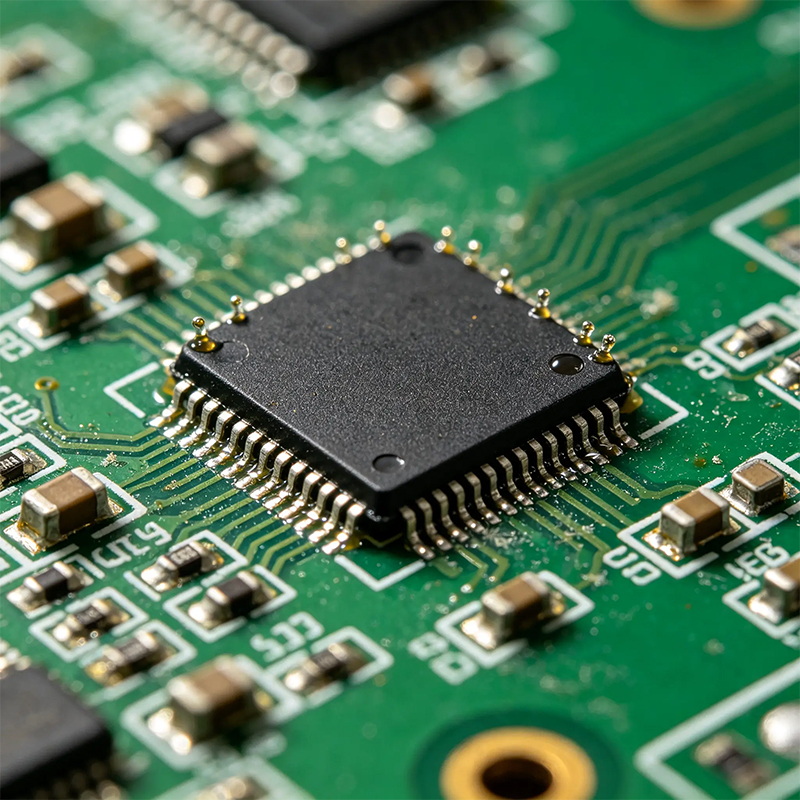
If you plan to outsource PCBA with QFNs, ask these questions:
Do you have X‑ray inspection? AOI and visual check are not enough for QFN – you need X‑ray for voids and bridging.
Have you done similar QFN projects before? Pitches matter – 0.4mm is much harder than 0.65mm. Ask for samples or case studies.
Who designs the stencil apertures? A good supplier will run DFM and suggest optimized stencil openings – not just copy your design.
What is your voiding control standard? Industry typical is <25% void area under the thermal pad. Ask for their process capability.
We are not just an SMT house. We are a one‑stop manufacturer that designs and makes flexible PCBs, rigid‑flex boards, HDI high‑frequency boards, and then does full PCBA. For QFN, we have extensive experience.
We have X‑ray inspection – Every batch or every unit as needed. We control voiding and bridging.
We design stencils in‑house – For 0.4mm, 0.5mm, and 0.65mm pitch QFNs, we have proven aperture patterns. We'll DFM your design and recommend improvements.
We know rigid‑flex QFN rules – We'll tell you exactly where you can and cannot place a QFN on a rigid‑flex board.
We've done many QFN projects – From power ICs to RF transceivers, consumer to medical to automotive. Typical yield above 98%.
Industries we serve: consumer electronics (TWS earbud main chips, smartwatch Bluetooth), automotive (sensor signal conditioners), medical (glucose monitor controllers), industrial (motor drivers).
Three simple steps:
Send your files – Gerbers, BOM, and note which ICs are QFN (include pitch if known).
We DFM review – Within 24 hours, we'll tell you: are thermal vias plugged? Are pad lengths sufficient? Any stencil improvements needed?
Sample and validate – We build 10‑20 samples, X‑ray them, and share inspection reports. Once approved, we move to volume.
QFN is not magic – but it's a great test of a PCBA shop's capability. A shop that can't handle SOP well will fail with QFN. A shop with X‑ray, stencil design expertise, and a track record of QFN projects will give you confidence.
If you're designing with QFN packages, send us your PCB files. We won't push a contract – we'll first run a DFM review and tell you if your design has hidden traps. Let the samples speak for themselves.
When you contact us, please include:
PCB design files (Gerber or source)
BOM (mark which parts are QFN)
Estimated annual quantity
We'll give you an honest answer – what we can do, what we can't, and how to fix it so we can.

Kaboer manufacturing PCBs since 2009. Professional technology and high-precision Printed Circuit Boards involved in Medical, IOT, UAV, Aviation, Automotive, Aerospace, Industrial Control, Artificial Intelligence, Consumer Electronics etc..


 English



 Wechat
 +86 13670210335
 +86 13670210335
 E-mail