
Date: 2026-07-23
You've definitely seen a light bulb before — one switch controlling one light, or one switch controlling several lights at once. You've also seen a power strip with multiple devices plugged into it — each device turns on and off independently. Behind these two different "connections" lie the two most fundamental concepts in electronics: series circuits and parallel circuits.
In this guide, I'll explain what series and parallel circuits are, how they differ, and where each one is used. No formulas, no jargon — just plain English.
Before we get into series and parallel, let's get one thing straight: what is a circuit?
A circuit is simply a complete path for current to flow. Current leaves the positive terminal of a power source, travels through wires and loads (bulbs, motors, resistors), and returns to the negative terminal — that's a complete loop. If that path is broken anywhere, current can't flow, and nothing works.
Now that we've got that out of the way, let's look at how loads are connected on that path: in series or in parallel.
A series circuit connects all loads end-to-end in a single line. Current has only one path to follow. It leaves the power source, goes through bulb 1, then bulb 2, then bulb 3… and finally returns to the power source.
Think of a series circuit like a single water pipe with three valves in a row. Water flows in one end and must pass through all three valves to get out. If any one valve is closed, the whole flow stops.
Key characteristics of series circuits:
Only one current path: No matter how many components you string together, the current is the same everywhere. Same current through bulb 1, bulb 2, and bulb 3.
Voltage is divided: Total voltage from the power source is split across each load. Each bulb gets only a fraction of the total voltage.
One breaks, all go out: This is the biggest downside. If any component in the series path fails (a bulb burns out, a wire breaks), the entire loop breaks and everything turns off.
Where are series circuits used?
Series circuits aren't very common in daily life, but there are a few classic examples:
Old-fashioned Christmas lights: One bulb burns out, the whole string goes dark. You have to find the one bad bulb.
Batteries in series: One 1.5V battery isn't enough — connect two in series and you get 3V, three gives you 4.5V. Voltage adds up, capacity stays the same.
Applications that need "even" current: Multiple LEDs in series share the same current, giving them consistent brightness.
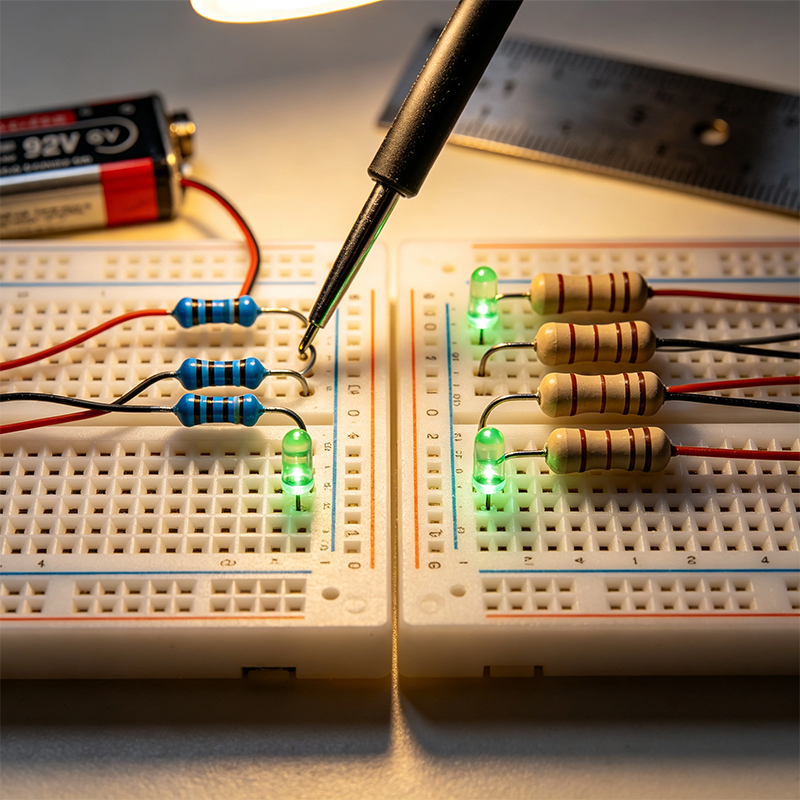
A parallel circuit connects all loads side-by-side across the power source. Current has multiple paths to follow. It can go through bulb 1 and back, or bulb 2 and back, or bulb 3 and back — all independently.
Think of a parallel circuit like several separate pipes sharing one inlet and one outlet. Each pipe flows independently — turn off one, and the others keep flowing. The water pressure (voltage) is the same in every pipe.
Key characteristics of parallel circuits:
Multiple current paths: Total current from the power source splits across each branch. More branches = more total current.
Voltage is the same everywhere: Every load gets the full power source voltage. Each bulb operates at full brightness.
One breaks, others keep working: This is the biggest advantage. If one branch breaks, the others are completely unaffected.
Where are parallel circuits used?
Parallel circuits dominate daily life:
Wall outlets in your home: Every outlet is connected in parallel. Plug in a microwave, a fridge, or a phone charger — they all work independently.
Household lights: The living room light and the bedroom light are in parallel. Turn off the living room light, and the bedroom light still works.
Batteries in parallel: Connect positive to positive and negative to negative — voltage stays the same, but capacity doubles. Lasts longer.
Most electronic devices: The power supply in a PCB is wired in parallel, with each chip drawing what it needs independently.
| Feature | Series Circuit | Parallel Circuit |
|---|---|---|
| Current path | One path only | Multiple paths |
| Current | Same everywhere | Total = sum of branches |
| Voltage | Total = sum of loads | Same across all loads |
| One component fails | Everything stops | Others keep working |
| Typical use | Battery series, old light strings | Wall outlets, all appliances |
| Adding more loads | Total resistance increases, current drops | Total resistance drops, total current increases |
Misconception #1: “Series circuits are simpler, so electronics use series.”
Wrong. Most electronics use parallel circuits — because parallel is the only way to let each component work independently. Series is only used in specific situations (like when you need to boost voltage).
Misconception #2: “Series circuits save energy.”
No. The total power consumed depends on the source voltage and load resistance, not whether they're connected in series or parallel. Series bulbs are dimmer, but that's not "saving energy."
Misconception #3: “Batteries in parallel increase voltage.”
No. Parallel batteries — positive to positive, negative to negative — keep voltage the same, but increase total capacity. To increase voltage, you need series.
Series circuit: components are connected end-to-end, current follows one path. One break and everything stops. Used for boosting voltage with series batteries, old light strings, and applications needing consistent current.
Parallel circuit: components are connected side-by-side, current has multiple paths. One break and others keep working. Used for wall outlets, almost all electronics, and parallel batteries to increase capacity.

Kaboer manufacturing PCBs since 2009. Professional technology and high-precision Printed Circuit Boards involved in Medical, IOT, UAV, Aviation, Automotive, Aerospace, Industrial Control, Artificial Intelligence, Consumer Electronics etc..


 English



 Wechat
 +86 13670210335
 +86 13670210335
 E-mail