
Date: 2026-03-24
If you've ever looked at a circuit board and noticed those little beige or gray blocks scattered around—especially near chips—you've seen an SMD capacitor. They're everywhere. On your phone, your laptop, your car's electronics. And while they look simple, they're doing some of the most important work in your circuit.
Here's the thing about capacitors: they store and release electrical energy. That's it. But that simple job is what keeps your power supply stable, filters out noise, and makes sure your chips don't glitch. Get the capacitor wrong, and your circuit might work on the bench but fail in the field.
Let's talk about what SMD capacitors actually are, how to pick the right one, and why that little beige block matters more than you think.
An SMD capacitor (Surface Mount Device capacitor) is a tiny electronic component that stores and releases electrical energy . It's the passive component you'll find near every IC, every power rail, every signal line that needs to stay clean.
Unlike through-hole capacitors with long leads, SMD capacitors sit flat on the board and solder directly to pads on the surface. They come in standardized sizes that pick-and-place machines handle by the thousands.
The most common type you'll see is the multilayer ceramic capacitor (MLCC) —those little beige or gray blocks. They're cheap, reliable, and work for most applications. But there are other types too, each with its own strengths.
SMD capacitors use the same size codes as resistors. You've seen them: 0402, 0603, 0805. Those numbers tell you the physical size in inches.
| Code | Dimensions (mm) | Common Use |
|---|---|---|
| 0201 | 0.6 × 0.3 | Ultra-compact, smartphones, wearables |
| 0402 | 1.0 × 0.5 | High-density, common in mobile devices |
| 0603 | 1.6 × 0.8 | General-purpose workhorse |
| 0805 | 2.0 × 1.25 | Easier to handle, prototyping |
| 1206 | 3.2 × 1.6 | Higher capacitance, power applications |
| 1210 | 3.2 × 2.5 | Larger capacitance, higher voltage |
The trade-off: smaller capacitors save space but have lower capacitance and voltage ratings. Larger capacitors take up more room but can store more energy.
For most general-purpose decoupling, 0603 is the sweet spot. For high-density designs, 0402 is common. For power circuits, you'll see 0805 and up.
Here's where a lot of designers get tripped up. Two capacitors can look identical—same size, same capacitance value—but behave completely differently. The difference is the dielectric material.
These are the precision capacitors. They're stable across temperature, voltage, and frequency. Capacitance doesn't drift much. They have low loss and low distortion.
Best for: Timing circuits, oscillators, filters where stability matters. Also good for RF and high-frequency applications.
Trade-off: Lower capacitance values. You won't find a 10µF C0G in a 0402 package. They're physically larger for the same capacitance.
These are the workhorses. They offer decent stability and good capacitance density. X7R is stable from -55°C to +125°C. X5R covers -55°C to +85°C.
Best for: Decoupling, power supply filtering, general-purpose use.
Trade-off: Capacitance changes with voltage and temperature. A 10µF X7R capacitor might be 8µF at rated voltage. Always derate.
These have high capacitance in small packages but terrible stability. Capacitance can drop 80% over temperature or with applied voltage.
Best for: Bypass applications where accuracy doesn't matter. Cheap consumer goods.
Trade-off: Not for timing circuits or anything that needs precision. The capacitance you get isn't the capacitance you ordered.
Here's a quick comparison:
| Dielectric | Stability | Best For | Avoid For |
|---|---|---|---|
| C0G (NP0) | Excellent | Timing, RF, filters | High capacitance needs |
| X7R | Good | Decoupling, filtering | Precision timing |
| X5R | Moderate | General-purpose | Wide temperature range |
| Y5V | Poor | Cheap bypass | Anything critical |
Here's the frustrating part: SMD capacitors usually don't have printed values. Unlike resistors, they're often blank. You need to rely on the packaging, the BOM, or a multimeter.
When values are printed, they use the same numeric code as resistors:
104 = 10 × 10⁴ pF = 100,000 pF = 100 nF = 0.1 µF
473 = 47 × 10³ pF = 47,000 pF = 47 nF
220 = 22 × 10⁰ pF = 22 pF
The unit is always picofarads (pF). So "104" means 100,000 pF, which is 0.1 microfarads.
Some manufacturers also add a voltage rating code, but there's no universal standard. You really need the datasheet or the original packaging.
Pro tip: If you're prototyping, buy capacitors in labeled reels or cut tape. Trying to identify loose capacitors by sight is a fool's errand.
Capacitors have a maximum voltage rating. Exceed it, and they can fail—sometimes spectacularly. For ceramic capacitors, exceeding the voltage rating can cause micro-cracking or catastrophic short circuits.
The rule: derate by at least 20%. If your circuit runs at 5V, use a 6.3V or 10V capacitor. If it runs at 12V, use 16V or 25V.
For X7R and X5R capacitors, voltage derating is especially important because their capacitance drops as voltage increases. A 10µF capacitor rated at 6.3V might only be 5µF at 5V. Always check the datasheet.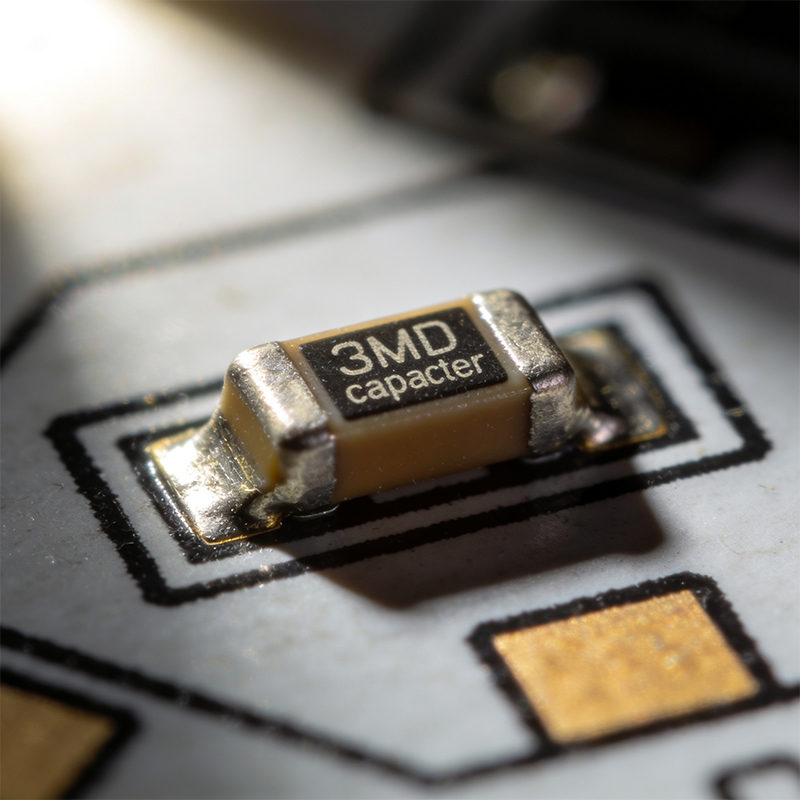
Decoupling (bypass) capacitors: These are the small capacitors placed near IC power pins. Their job is to provide a local reservoir of charge, smoothing out voltage dips when the IC switches. Typical values: 0.1µF, 1µF, 10µF.
Bulk capacitors: Larger capacitors (10µF to 100µF or more) placed near power inputs. They handle larger current transients and smooth ripple from switching regulators.
Filtering capacitors: Used in analog circuits to remove noise or set frequency response. Often paired with resistors to create low-pass or high-pass filters.
Timing capacitors: Used with resistors to set time delays. These need stable dielectrics—C0G or NP0 are the go-to choice.
Coupling capacitors: Block DC while passing AC signals. Used in audio circuits and signal chains.
You design with 10µF X7R capacitors for power supply filtering. The board comes back and the power supply is noisy. You measure the caps and they're only 4µF at operating voltage.
Prevention: Read the datasheet. Capacitance derating graphs show you what you'll actually get. If you need 10µF at 5V, you might need a 22µF rated at 10V.
Ceramic capacitors are piezoelectric. They vibrate when voltage changes. In audio circuits or power supplies, they can literally hum or ring.
Prevention: Use higher voltage ratings (which reduces the effect). Use different dielectrics. Or switch to tantalum or film capacitors for sensitive paths.
Ceramic capacitors can crack if the board flexes during assembly or in use. A cracked cap might short or open, taking your circuit with it.
Prevention: Don't place ceramic caps near board edges or stress points. Use flexible termination capacitors (special MLCCs designed to withstand flex) for critical applications.
Tantalum and aluminum electrolytic capacitors are polarized. Install them backward and they fail. Aluminum caps bulge and leak. Tantalum caps can catch fire.
Prevention: Double-check orientation on your PCB layout. Mark polarity clearly on silkscreen. Use tantalum only when you absolutely need its stability and size.
When you're picking capacitors for your design, run through this:
Capacitance value: What does the circuit need?
Dielectric: Do you need stability (C0G) or density (X7R/X5R)?
Voltage rating: Derate by 20-50% for reliability.
Package size: Does your board have space? Can your assembly line handle it?
Temperature range: Will it operate in a hot environment? X7R is better than X5R for high temps.
Application: Decoupling, filtering, timing? Each has different requirements.
Availability: Is the part in stock? Are there alternatives?
At Kaboer, we've been building custom PCBs since 2009. Based in Shenzhen with our own PCBA factory, we see SMD capacitors go onto boards every day. We know that picking the right capacitor isn't just about capacitance—it's about dielectric, voltage, size, and application.
What we do:
BOM review: We check your capacitor selections against your circuit requirements. If we see a Y5V cap in a timing circuit or a capacitor voltage rating too close to your rail, we flag it.
Dielectric guidance: Not sure whether you need X7R or C0G? We'll help you choose based on your application.
Footprint verification: We ensure your PCB footprints match the actual components. A mismatch between a 0603 footprint and an 0402 part is a recipe for assembly problems.
Assembly care: Our technicians handle ceramic capacitors carefully to avoid flex cracking. We use proper stencil design and placement parameters to prevent issues.
Fast prototyping: Need to test your capacitor selection quickly? We can assemble prototypes in days, so you can validate your design before committing to volume.
We work across the full range of boards—rigid, flexible, rigid-flex, HDI—and we understand that capacitor selection changes with the board type. A flex circuit needs capacitors that can handle bending. A high-frequency board needs capacitors with low parasitic inductance.
If you're designing a board and want to make sure your SMD capacitors are right—or if you need help with capacitor selection—send us your requirements or Gerber files. We'll review your design, give you honest feedback, and get back to you with a quote. We've been at this for over 15 years, and we believe the best partnerships start with straightforward conversations.
And if you're ever in Shenzhen, we'd be happy to show you around our factory and walk you through how we handle these tiny components.

Kaboer manufacturing PCBs since 2009. Professional technology and high-precision Printed Circuit Boards involved in Medical, IOT, UAV, Aviation, Automotive, Aerospace, Industrial Control, Artificial Intelligence, Consumer Electronics etc..


 English



 Wechat
 +86 13670210335
 +86 13670210335
 E-mail