
Date: 2026-03-24
If you've ever looked at a circuit diagram and seen those two parallel lines, or a straight line next to a curved one, you've looked at a symbol capacitance. It's one of the most basic symbols in electronics, and yet it's one of the most important to get right.
Here's the thing: that little symbol isn't just decoration. It tells you exactly what kind of capacitor to use and, just as critically, which way to install it. Get it wrong, and your circuit might not work. Get it really wrong, and that capacitor could actually blow up.
Let's talk about what those symbols mean, why they matter, and how to read them so your boards work the first time.
A capacitance symbol is the graphical representation of a capacitor on a schematic diagram. It tells you that a capacitor exists in the circuit, and—depending on how it's drawn—it tells you what kind of capacitor to use.
There are two main versions you'll encounter:
Non-polarized capacitor symbol: Two straight, parallel lines of equal length. This means the capacitor has no positive or negative terminal. You can install it either way.
Polarized capacitor symbol: A straight line (positive) and a curved line (negative). Sometimes it's two straight lines with a "+" sign on one side. This means the capacitor has a positive and negative terminal, and you absolutely must install it correctly.
Why does this matter? Because mixing them up isn't like swapping a resistor. A non-polarized ceramic capacitor in a polarized circuit? Might work, might not. A polarized electrolytic capacitor installed backward? That can get dramatic. They can overheat, bulge, leak, or even explode.
The symbol is your warning sign. Learn to read it.
When you send a design to manufacturing, the capacitance symbols on your schematic translate directly into physical parts. A symbol that's ambiguous or wrong means the wrong part could be placed—or the right part placed backward.
Here's what happens on the factory floor:
For non-polarized symbols (two straight lines), the assembler can place the capacitor in either orientation. Faster assembly, fewer errors.
For polarized symbols (straight line + curved line or straight lines with a "+"), someone has to check orientation. During placement. During inspection. Sometimes during testing. That's extra attention, which means extra care—and if it's missed, the board fails.
For variable or trimmer capacitor symbols, they might need hand assembly, since these parts aren't always compatible with high-speed pick-and-place machines.
This is why getting the symbol right isn't just about being correct—it's about making your boards manufacturable.
The simplest symbol. Two parallel lines, usually the same length. Sometimes drawn with a small gap between them. This represents capacitors that don't care about orientation:
Ceramic capacitors: The little beige or gray blocks. Great for high-frequency decoupling, filtering, and general-purpose use.
Film capacitors: Often used in audio circuits and power applications.
Mica capacitors: For precision, high-stability circuits.
These are the workhorses. You can't put them in backward, so assembly is simple.
This symbol tells you orientation matters. There are two common styles, depending on which standard you're using:
IEC style (common in Europe and much of Asia): A straight line (positive) and a curved line (negative). The curved line is usually shorter. Sometimes they add a "+" sign on the positive side for clarity.
ANSI style (common in the US): Two straight lines with a "+" sign marking the positive terminal.
Polarized capacitors are typically:
Aluminum electrolytic capacitors: The can-shaped ones. High capacitance in a small package, used for power supply filtering.
Tantalum capacitors: More stable than aluminum electrolytics, used where size and reliability matter.
Supercapacitors: Very high capacitance for energy storage applications.
If you see a polarized symbol, double-check orientation. Every time.
A non-polarized capacitor symbol with a diagonal arrow passing through it. The arrow means the capacitance can be adjusted—by the user during normal operation or by a technician during calibration.
You'll find these in tuning circuits like old radios, antenna tuners, and oscillators.
Similar to a variable capacitor, but with a "T" shape or a small adjustment symbol instead of an arrow. Sometimes labeled "Tr." These are designed for one-time calibration during manufacturing. Set it once and leave it alone.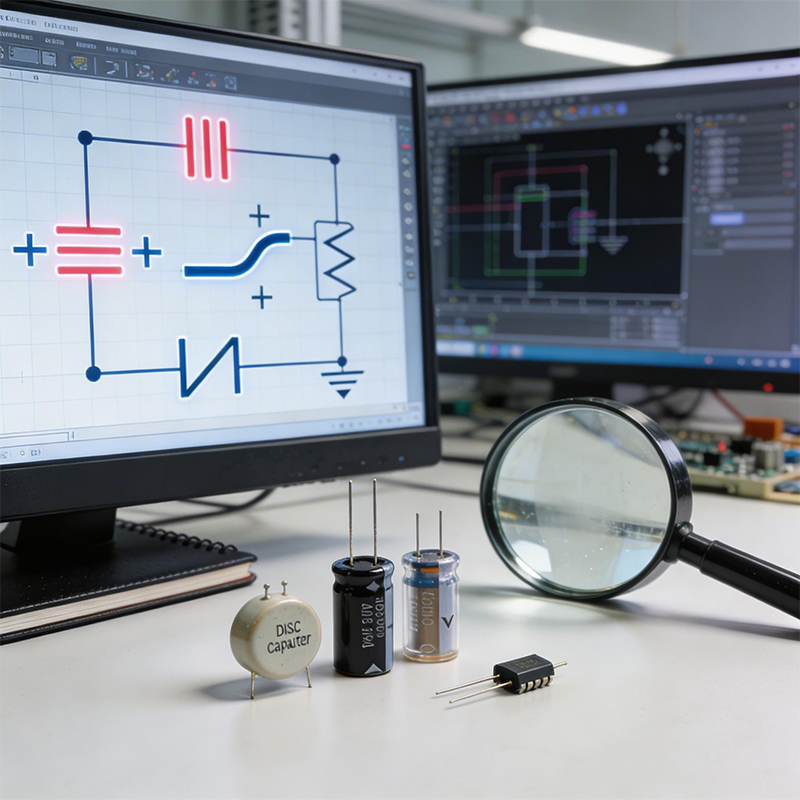
You might run into a few others:
Feed-through capacitor: Two parallel plates with a line through the center. Used for filtering RF noise on DC power lines.
Bipolar capacitor: Two polarized symbols facing opposite directions. Indicates it can handle AC or reverse voltage.
Split stator capacitor: A variable capacitor with two sets of stators. Used in symmetrical tuning circuits.
Temperature-dependent capacitor: Basic symbol with a "T" added. Capacitance changes with temperature.
Voltage-dependent capacitor: Symbol with a small "V" or arrow. Used in voltage-controlled oscillators.
The symbol tells you what type of capacitor. The value tells you how much capacitance. You need both.
Capacitance is measured in farads (F), but in practice, you'll mostly see:
Microfarads (µF): Common for electrolytic capacitors. 10µF, 100µF, etc.
Nanofarads (nF): Ceramic caps often use nF. 10nF = 0.01µF.
Picofarads (pF): Very small values. 10pF, 22pF, etc.
The value is usually written right next to the symbol. A polarized symbol with "10µF 16V" next to it means a 10 microfarad aluminum electrolytic capacitor rated for 16 volts. A non-polarized symbol with "100nF" means a 0.1 microfarad ceramic capacitor.
Sometimes you'll see a numeric code instead of a direct value, especially on ceramic capacitors:
104 = 10 × 10⁴ pF = 100,000 pF = 100 nF
473 = 47 × 10³ pF = 47,000 pF = 47 nF
220 = 22 × 10⁰ pF = 22 pF (not 220 pF!)
You need an electrolytic capacitor in your circuit, but you draw the non-polarized symbol. The assembler sees no polarity indicator and installs it in whichever direction is easier. Half your boards work; half don't.
Fix: Use the correct symbol. If your part has polarity, your symbol should show it.
Even if the schematic shows polarity, the physical PCB layout needs to match. A "+" mark on the silkscreen, a flat side indicator, a square pad for positive—whatever your convention is, be consistent.
Fix: Check that your PCB footprint matches the schematic symbol. The physical board should tell the assembler which way the part goes.
One engineer uses IEC symbols (straight line + curved line). Another uses ANSI (two straight lines with a "+"). The assembler has to guess which is which.
Fix: Pick one standard and stick to it. If you're sending designs to a manufacturer, include a note about which convention you're using.
You need 100pF but the BOM says "100" which gets interpreted as 100µF. Or you need 100nF and you order 100pF.
Fix: Double-check your BOM against your schematic. For critical values, add units explicitly (100pF, 100nF, 100µF).
At Kaboer, we've been building custom PCBs since 2009. Based in Shenzhen with our own PCBA factory, we see schematics from all over the world—every symbol convention, every style. We know that the little marks matter.
What we do:
DFM review: Before production, our engineers check your schematic symbols against your BOM. If we see a polarized symbol with no polarity marking on the PCB layout, we flag it. If a non-polarized symbol is paired with an electrolytic capacitor, we ask questions.
Footprint verification: We verify that your PCB footprints match the components you've specified. A polarized capacitor footprint without a polarity mark is a problem waiting to happen.
Assembly care: Our technicians check orientation on every polarized component during placement and again during inspection. We don't assume.
Documentation: We can provide as-built drawings that show exactly how your capacitors were installed.
We work with all types of boards—rigid, flexible, rigid-flex, HDI—and we understand that the same capacitance symbols apply across them all. But a polarized capacitor on a flexible circuit needs the same orientation care as one on a rigid board.
If you're designing a board and want to make sure your capacitance symbols are right—or if you need help catching polarity issues before they become expensive problems—send us your requirements or Gerber files. We'll review your design, give you honest feedback, and get back to you with a quote. We've been at this for over 15 years, and we believe the best partnerships start with straightforward conversations.
And if you're ever in Shenzhen, we'd be happy to show you around our factory and walk you through how we turn schematic symbols into real, working boards.

Kaboer manufacturing PCBs since 2009. Professional technology and high-precision Printed Circuit Boards involved in Medical, IOT, UAV, Aviation, Automotive, Aerospace, Industrial Control, Artificial Intelligence, Consumer Electronics etc..


 English



 Wechat
 +86 13670210335
 +86 13670210335
 E-mail