
Date: 2026-03-25
If you've ever opened up a smartphone, a laptop, or even a simple remote control, you've seen them. Those tiny black rectangles, little beige blocks, miniature silver chips—they're everywhere. They're SMDs—Surface Mount Devices—and they're the reason your devices can be so small, so powerful, and so reliable.
Here's the thing: most people don't think about SMDs. They just exist. But when you're designing or sourcing electronic products, understanding what SMDs are, how to pick the right ones, and how they affect your assembly matters.
Let's talk about SMDs—what they are, the different types you'll encounter, and how to choose them without getting lost in the alphabet soup of package codes.
SMD stands for Surface Mount Device. It's any electronic component designed to be mounted directly onto the surface of a printed circuit board. Unlike old-school through-hole components that have long leads poking through drilled holes, SMDs sit flat on the board and solder directly to pads on the same side.
This simple difference changed everything. Because they don't need holes, boards can be smaller. Because leads are shorter or nonexistent, high-frequency performance improves. Because assembly is automated, costs drop dramatically at scale.
SMDs come in all shapes and sizes:
Passive components: Resistors, capacitors, inductors
Active components: ICs, transistors, diodes
Connectors, LEDs, sensors—pretty much anything you'd find on a modern board has an SMD version
If you've been in electronics for a while, you know this comparison. But it's worth repeating.
| Factor | SMD | Through-Hole |
|---|---|---|
| Size | Tiny, compact | Large, bulky |
| How they mount | Sit on surface | Leads go through holes |
| Board space | Both sides usable | Needs holes, one side primarily |
| Assembly speed | Fast, automated | Slower, more manual |
| Cost at scale | Low | Higher |
| High-frequency performance | Excellent | Poor (long leads cause issues) |
| Mechanical strength | Good for normal use | Excellent for high-stress |
| Rework | Tricky (needs hot air) | Easier (regular iron works) |
SMD wins for most modern electronics. But through-hole isn't dead—connectors, power components, and anything that needs extra mechanical strength still use it.
If you've ever ordered resistors or capacitors, you've seen codes like 0402, 0603, 0805. Those numbers tell you the physical size in inches.
| Code | Dimensions (mm) | Common Use |
|---|---|---|
| 0201 | 0.6 × 0.3 | Ultra-compact, smartphones, wearables |
| 0402 | 1.0 × 0.5 | High-density, common in mobile devices |
| 0603 | 1.6 × 0.8 | General-purpose workhorse |
| 0805 | 2.0 × 1.25 | Easier to handle, prototyping |
| 1206 | 3.2 × 1.6 | Higher power, easier to inspect |
| 1210 | 3.2 × 2.5 | Larger capacitance, higher voltage |
The trade-off is straightforward: smaller packages save space but are harder to handle, harder to inspect, and have lower power ratings. Larger packages are easier to work with and handle more power, but take up more real estate.
For most general-purpose designs, 0603 is the sweet spot. It's small enough for density but large enough to handle by hand if needed.
SMD resistors are those tiny black rectangles with numbers printed on them. They limit current, divide voltages, and set bias conditions.
Three-digit codes: "102" = 1kΩ (10 with two zeros)
Four-digit codes: "1002" = 10kΩ (100 with two zeros)
"R" code: "4R7" = 4.7Ω
The package size determines power rating. A 0603 resistor handles about 1/10W. A 1206 handles 1/4W. Choose based on how much heat your circuit generates.
SMD capacitors are often beige or gray blocks. They store and release energy, filter noise, and stabilize power supplies.
The dielectric matters as much as the value:
C0G (NP0): Stable, low loss, for timing and RF
X7R, X5R: Good general-purpose, but capacitance drops with voltage
Y5V: High capacitance in small packages, but terrible stability
For decoupling, X7R or X5R is fine. For timing circuits, use C0G.
SMD inductors look like small blocks or coils. They store energy in magnetic fields, filter signals, and are essential in power supplies.
Key specs: inductance (µH), current rating, DC resistance (DCR). Choose based on your power requirements.
SMD ICs come in many packages:
SOIC: Gull-wing leads on two sides. Good for many general-purpose ICs.
QFP: Leads on all four sides. Common for microcontrollers.
QFN: No visible leads; pads underneath. Better thermal performance.
BGA: Solder balls underneath. Highest density, used for advanced processors.
Each has trade-offs. QFPs are easier to inspect. QFNs and BGAs need X-ray to verify solder joints.
These come in small packages like SOT-23 (three leads) or SOD-123 (two leads). They're used for switching, amplification, and protection.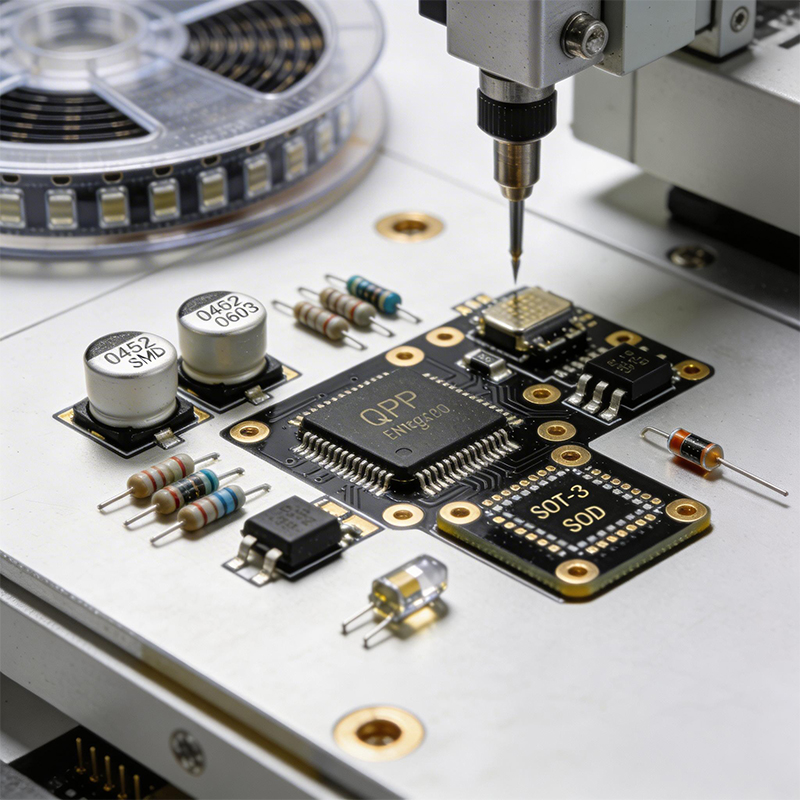
The process of putting SMDs onto boards is called SMT—Surface Mount Technology. Here's what happens:
Solder paste printing: A stencil deposits solder paste exactly where components will go.
Pick and place: High-speed machines grab components from reels and place them onto the paste with incredible accuracy.
Reflow soldering: The board goes through a carefully controlled oven. The paste melts, flows, and forms permanent connections.
Inspection: AOI checks for visible defects. X-ray looks at hidden joints under BGAs and QFNs.
This whole process is automated, which is why you can get boards assembled faster and cheaper than hand-soldering.
Picking SMDs isn't just about grabbing the smallest package. Here's what to think about:
Space constraints. If your board is cramped, you need small packages. But remember: smaller means harder to handle and inspect.
Power and heat. Tiny resistors can't handle much power. If you're pushing current, you need larger packages like 1206 or special power SMDs with thermal pads.
Signal speed. For high-frequency stuff—5G, high-speed data, RF—SMDs are the only choice. Those short connections matter.
Assembly capability. Not every factory can place 01005 parts or handle 0.35mm pitch BGAs. If your design uses advanced packages, make sure your manufacturer has the equipment.
Cost. Smaller packages and advanced IC packages cost more to assemble. Balance performance against budget.
If you're sourcing boards, the SMDs on them affect your cost, your timeline, and your product's reliability.
Component availability matters. If a part has a 30-week lead time, your whole project stalls.
Quality matters. Counterfeit components are a real problem. Work with manufacturers who source from authorized distributors.
Assembly matters. Fine-pitch BGAs need X-ray inspection. If your manufacturer doesn't have it, you're flying blind.
Rework matters. SMDs are harder to replace than through-hole parts. If you expect to need repairs, design accordingly.
At Kaboer, we've been working with surface mount devices since 2009. Based in Shenzhen with our own PCBA factory, we handle SMDs every day—from tiny 0201 passives to complex BGAs.
What we offer:
Component sourcing: We buy from authorized distributors, track lots, and verify incoming parts.
BOM review: We check your component choices against your requirements and flag potential issues before production.
Precision assembly: Our SMT lines place fine-pitch components accurately, with AOI and X-ray inspection to verify.
Fast prototyping: Need to validate your SMD selection quickly? We can assemble prototypes in days.
Full traceability: We track which components went into which boards, so if something fails, you can trace it back.
We work with all types of boards—rigid, flexible, rigid-flex, HDI—and we understand that the same SMDs behave differently on different substrates.
If you're designing a board and need help with SMD selection, or if you're looking for a manufacturing partner who understands surface mount assembly, send us your requirements or Gerber files. We'll review your design, give you honest feedback, and get back to you with a quote. We've been at this for over 15 years, and we believe the best partnerships start with straightforward conversations.
And if you're ever in Shenzhen, we'd be happy to show you around our factory and walk you through how we handle SMDs from reel to board.

Kaboer manufacturing PCBs since 2009. Professional technology and high-precision Printed Circuit Boards involved in Medical, IOT, UAV, Aviation, Automotive, Aerospace, Industrial Control, Artificial Intelligence, Consumer Electronics etc..


 English



 Wechat
 +86 13670210335
 +86 13670210335
 E-mail