
Date: 2026-03-25
Let's be honest. When you're sourcing circuit boards, the price is always on your mind. You want a cheap board. Who doesn't? But here's the thing: "cheap" can mean two very different things. It can mean getting good value—paying a fair price for a board that works. Or it can mean buying the lowest-priced option and hoping for the best.
I've seen too many engineers learn the difference the hard way. A batch of boards that looked like a bargain ends up costing three times as much in rework, delays, and lost reputation. The cheap board wasn't cheap at all.
Let's talk about what actually drives PCB pricing, where you can save money without cutting corners, and how to spot the difference between a good deal and a disaster waiting to happen.
The price of a circuit board comes down to a few key factors. Understanding them helps you know where to push for savings and where to hold the line.
Layer count. This is the biggest driver. A 2-layer board is significantly cheaper than a 4-layer board. Every extra layer adds material, processing time, and cost. If your design can work with fewer layers, that's an easy win.
Board size and panel utilization. You're not paying for your board alone. You're paying for its share of a manufacturing panel. Smaller boards fit more on a panel, which lowers the cost per board. A board that's 50mm × 50mm might fit 50 per panel. A board that's 150mm × 150mm might fit only 6. That's why bigger boards cost more.
Material choice. Standard FR-4 is the baseline. It's cheap, widely available, and works for most applications. If you need high-Tg materials, flexible polyimide, or high-frequency laminates like Rogers, the price goes up. Stick with standard materials unless you absolutely need something else.
Trace width and spacing. Standard 6 mil (0.15mm) trace and space is easy and cheap. Tighter tolerances—4 mil, 3 mil—require more precise equipment and slower processing. The cost goes up. Use standard specifications unless your design demands tighter.
Surface finish. HASL is the cheapest. It's been around forever, it works, and it's fine for most through-hole and larger SMT components. ENIG costs more but is worth it for fine-pitch parts and boards that need a long shelf life. If you don't need ENIG, don't pay for it.
Quantity. This is where volume matters. A single 2-layer board might cost $50. A hundred of the same board might cost $200 total ($2 each). Prototypes are expensive per board. Production is cheap per board. If you're ordering prototypes, accept that the per-board price will be higher.
Here's where people get burned. You find a supplier offering boards for half of what others quote. It seems like a great deal. Until the boards arrive.
Thin plating. The vias look fine, but the copper inside is thinner than it should be. A few thermal cycles later, cracks develop. Boards fail in the field.
Poor registration. The top layer doesn't line up with the bottom layer. Pads are partially missing. Fine-pitch components don't align. Boards that should work don't.
Wrong materials. You specified FR-4. They used something cheaper. It might work initially, but the board warps during reflow or fails after a few months in the field.
Sloppy solder mask. It's misaligned, covering pads it shouldn't. Or it's too thin, letting copper oxidize. Or it's missing entirely in places.
No testing. They skipped electrical test to save time. Some boards have shorts. Some have opens. Some work. You don't know which until you test them yourself—and by then, you've already wasted time and money.
The cheap board that fails isn't cheap. It's expensive.
You don't have to pay premium prices for every board. Here are legitimate ways to reduce cost:
Use standard specifications. 6 mil trace/space, 0.3mm minimum drill, 1oz copper, standard FR-4, HASL finish. These are the industry defaults. If your design can use them, you'll get the best price.
Optimize your panel utilization. Work with your manufacturer to panelize efficiently. Sometimes a small change in board dimensions can dramatically improve how many fit on a panel.
Combine orders. If you have multiple designs, ask about panelizing them together. One panel with two designs costs less than two separate orders.
Be flexible on lead time. Standard 5-7 business days costs less than 24-hour or 48-hour expedite. If you can plan ahead, you save money.
Design for manufacturability. Avoid features that complicate production. Tight tolerances, exotic materials, complex shapes—all add cost. If you don't need them, don't spec them.
Order in appropriate quantities. Prototypes are expensive per board. Small production runs (50-100 boards) bring the per-board price down significantly. Larger runs bring it down further.
A legitimate good deal comes from a manufacturer who:
Asks questions. They review your design and suggest improvements. They don't just take your files and run.
Offers transparent pricing. They explain what you're paying for. If a price seems too good to be true, they tell you why.
Has quality systems. ISO 9001 certification matters. It means they have documented processes and regular audits.
Tests their boards. Electrical test on every board isn't optional. It's how you know your boards work.
Can show you their facility. A manufacturer who welcomes visitors has nothing to hide. If they won't let you visit, ask yourself why.
A bad deal comes from a supplier who:
Promises everything with no questions. "Sure, we can do that" without checking your design is a red flag.
Has the lowest price by a wide margin. If everyone else is at $500 and they're at $200, something is being cut. Usually quality.
Is vague about their process. They can't tell you how they test boards, what materials they use, or what certifications they hold.
Has no quality systems. No ISO certification. No documented processes. Just promises.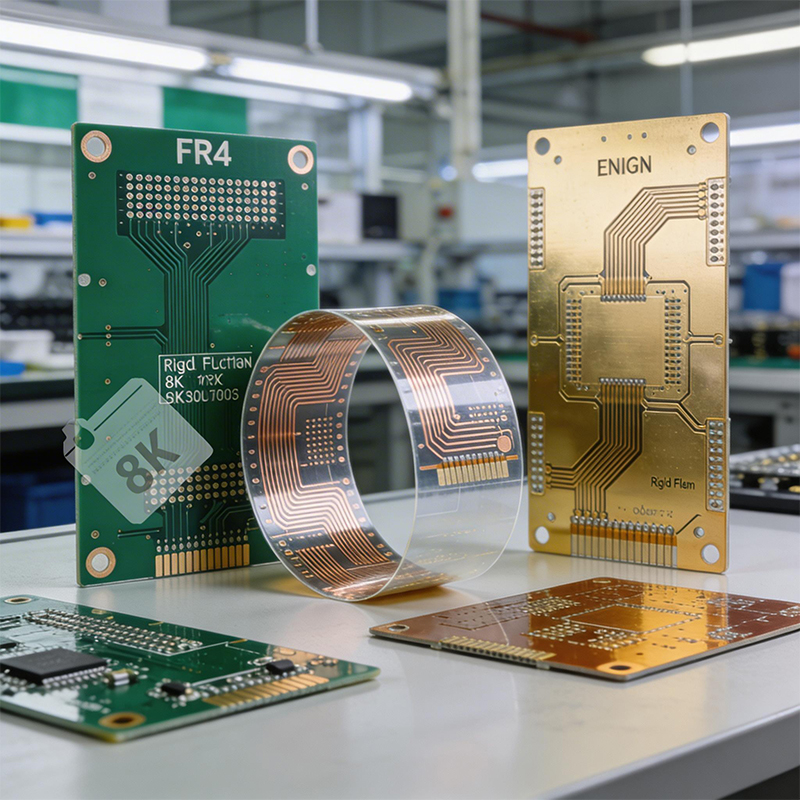
At Kaboer, we've been manufacturing custom PCBs since 2009. Based in Shenzhen with our own PCBA factory, we understand that price matters. But we also know that a board that doesn't work is never a bargain.
What we offer:
Transparent pricing. We'll explain what you're paying for and why.
Design review. Before we build, our engineers review your design for cost-saving opportunities. We'll suggest standard specifications where they work, and flag areas where tighter tolerances are unnecessary.
Standard materials in stock. FR-4, high-Tg, flexible polyimide—we keep common materials on hand so you're not paying for expedited material orders.
Multiple surface finish options. HASL for cost-sensitive projects, ENIG when you need it.
Electrical test on every board. We don't guess. We know every board works before it ships.
Fast prototyping when you need to validate quickly.
Full PCBA services so you don't pay for shipping between suppliers.
We work across the full range—rigid boards, flexible circuits, rigid-flex, HDI high-frequency boards—and we apply the same approach to all of them: fair pricing, honest communication, and boards that work.
If you're looking for affordable PCBs that actually work—not just cheap boards that cause headaches—send us your requirements or Gerber files. We'll review your design, give you honest feedback on cost-saving opportunities, and get back to you with a quote. We've been at this for over 15 years, and we believe the best partnerships start with straightforward conversations.
And if you're ever in Shenzhen, we'd be happy to show you around our factory and walk you through how we build boards that deliver value, not just low prices.

Kaboer manufacturing PCBs since 2009. Professional technology and high-precision Printed Circuit Boards involved in Medical, IOT, UAV, Aviation, Automotive, Aerospace, Industrial Control, Artificial Intelligence, Consumer Electronics etc..


 English



 Wechat
 +86 13670210335
 +86 13670210335
 E-mail