
Date: 2026-03-23
If you've been in electronics manufacturing for any length of time, you've probably heard the terms SMD and SMT thrown around. Sometimes people use them interchangeably. Sometimes they get confused. But here's the thing: they're not the same thing, and understanding the difference matters for your boards.
Let's clear this up once and for all.
SMD stands for Surface Mount Device. That's the actual component—the tiny resistor, the chip, the LED that sits on your board .
SMT stands for Surface Mount Technology. That's the process—the method of placing and soldering those components onto the board .
Think of it this way: SMD is the part. SMT is how you attach it. You can't have one without the other in modern electronics, but they're different pieces of the puzzle.
A Surface Mount Device (SMD) is any electronic component designed to be mounted directly onto the surface of a printed circuit board . Unlike through-hole parts with long leads that poke through holes, SMDs have small metal terminals or pads that sit flat against the board .
SMDs come in all shapes and sizes :
Passive components: Resistors, capacitors, inductors. You'll see packages like 0402, 0603, 0805—those numbers tell you the size. An 0402 is 1.0mm × 0.5mm. An 0201 is even smaller.
Active components: ICs, transistors, diodes. Packages like SOIC, QFP, QFN, BGA. Each has its own pros and cons for size, heat dissipation, and ease of assembly.
Connectors, LEDs, sensors—pretty much any modern component comes in an SMD version.
The beauty of SMDs is that they're tiny, which means you can pack more functionality into less space. That's why your phone can be so thin and still do everything it does .
Surface Mount Technology (SMT) is the process of attaching those SMDs to the circuit board . It's the method, the equipment, the workflow that turns a bare PCB into a populated assembly .
The SMT process typically involves :
Solder paste printing: A stencil deposits solder paste exactly where components will go. This step is critical—too little paste gives weak joints, too much causes shorts .
Pick and place: High-speed machines grab components from reels and trays and place them onto the paste with incredible accuracy—down to ±0.01mm for modern equipment .
Reflow soldering: The board goes through a carefully controlled oven. The paste melts, flows, and forms permanent solder joints as it cools .
Inspection: AOI (automated optical inspection) checks for visible defects. X-ray looks at hidden joints under BGAs and QFNs .
So when someone asks if you do SMT, they're asking if you have the capability to assemble boards with surface mount components. When they ask about SMDs, they're talking about the parts themselves .
Here's why this difference isn't just academic:
Component selection affects your assembly. If you're designing a board, you need to choose the right SMDs for your application. But those choices directly impact the SMT process. A 0402 resistor requires different placement precision than a 1206. A BGA needs X-ray inspection; a QFP doesn't.
Assembly capability determines what SMDs you can use. Not every factory can place 01005 parts or handle 0.35mm pitch BGAs. If your design uses components that push the limits, you need an SMT partner with the right equipment .
Cost scales with complexity. Smaller SMDs and advanced packages cost more to assemble. The SMT process for a board full of 0402s is different from one with 0805s. Understanding this helps you make informed trade-offs .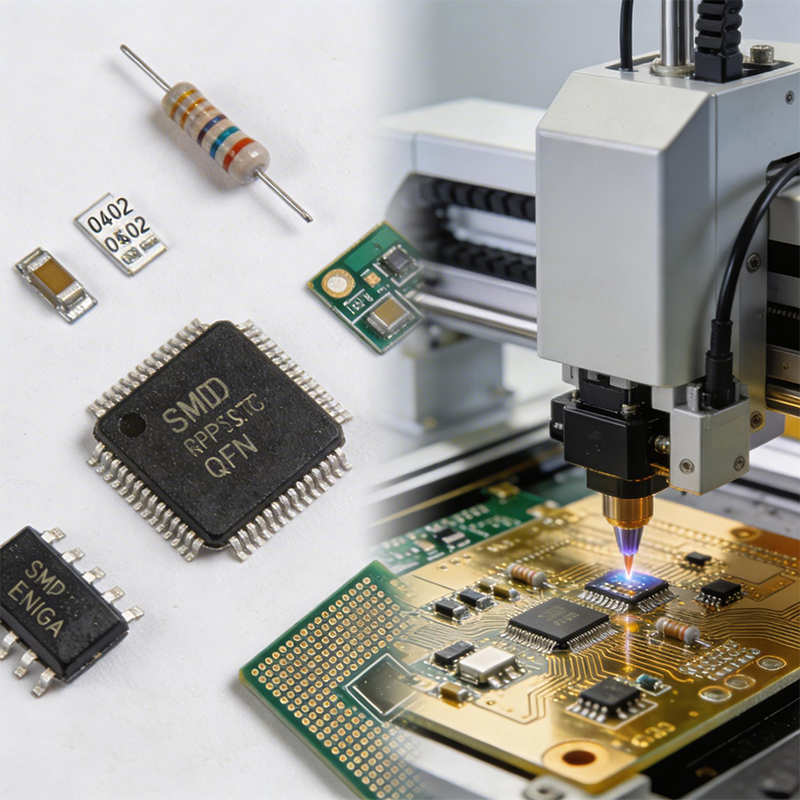
To really understand SMDs, it helps to know how they compare to the alternative:
| Factor | SMD | Through-Hole |
|---|---|---|
| Size | Tiny, compact | Large, bulky |
| Board space | Both sides usable | Needs holes, one side primarily |
| Assembly speed | Fast, highly automated | Slower, more manual |
| Mechanical strength | Good for normal use | Excellent for high-stress |
| High-frequency performance | Excellent | Poor |
| Cost at scale | Lower | Higher |
| Rework | Tricky (needs hot air) | Easier (regular iron) |
Most modern boards use SMDs for the majority of components, reserving through-hole for connectors and parts that need extra mechanical strength .
When you design a board, you're making decisions that affect both the components (SMD) and the assembly process (SMT). Here's how they connect:
Stencil design is driven by your SMD choices. Fine-pitch components need precise stencil openings. The stencil thickness, aperture size, and shape all depend on what you're placing .
Placement programming requires accurate data about each SMD's package. The pick-and-place machine needs to know the component size, shape, and orientation to place it correctly .
Reflow profiles vary based on the components. Large components with thermal pads need different profiles than tiny passives. A good SMT process tailors the profile to your specific mix of SMDs .
Inspection criteria depend on the component types. AOI can check most SMDs visually, but BGAs and QFNs need X-ray .
If you're specifying components, here are the packages you'll see most often:
Chip components (resistors, capacitors):
0402 (1.0mm × 0.5mm) – High-density, common in mobile devices
0603 (1.6mm × 0.8mm) – The workhorse, good balance of size and handleability
0805 (2.0mm × 1.25mm) – Larger, easier to place, handles more power
IC packages:
SOIC – Gull-wing leads on two sides. Good for many general-purpose ICs.
QFP – Leads on all four sides. Common for microcontrollers.
QFN – No visible leads; pads underneath. Better thermal performance.
BGA – Solder balls underneath. Highest density, used for advanced processors.
Discretes (transistors, diodes):
SOT-23 – Small outline transistor, three leads. Very common.
SOD-123 – Small outline diode, two leads.
When you're choosing a manufacturer to assemble your boards, here's what matters:
Component capability. Can they handle the SMD packages you're using? Fine-pitch BGAs? 0402s? 0201s?
Equipment and process control. Do they use modern pick-and-place machines? Do they monitor reflow profiles? Do they have AOI and X-ray?
Quality systems. Are they ISO 9001 certified? For automotive or medical, do they have IATF 16949 or ISO 13485?
Design support. Do they review your design before production? Will they flag potential issues with your SMD choices or SMT process?
Traceability. Can they track which components went into which boards? If something fails, can you find out quickly?
At Kaboer, we've been working with surface mount components and assembly since 2009. Based in Shenzhen with our own PCBA factory, we handle the full range:
SMD capabilities:
Passives from 0201 up to large sizes
ICs in SOIC, QFP, QFN, BGA packages
Discrete semiconductors, connectors, LEDs
Specialized components for flexible and rigid-flex boards
SMT capabilities:
High-speed pick-and-place with precision placement
Multi-zone reflow ovens with profile control
AOI, X-ray, and functional testing
Fast prototyping for design validation
Full traceability with laser-etched DataMatrix codes
We work with you to select the right components for your application, and we have the equipment and processes to assemble them reliably—whether it's a simple 2-layer board or a complex HDI design with fine-pitch BGAs.
If you're working on a project and need help with SMD selection or SMT assembly, send us your requirements or Gerber files. We'll review your design, give you honest feedback, and get back to you with a quote. We've been at this for over 15 years, and we believe the best partnerships start with straightforward conversations.
And if you're ever in Shenzhen, we'd be happy to show you around our factory and walk you through how we handle SMDs and SMT—from component placement to final inspection.

Kaboer manufacturing PCBs since 2009. Professional technology and high-precision Printed Circuit Boards involved in Medical, IOT, UAV, Aviation, Automotive, Aerospace, Industrial Control, Artificial Intelligence, Consumer Electronics etc..


 English



 Wechat
 +86 13670210335
 +86 13670210335
 E-mail