
Date: 2026-03-23
Let's be honest. When you're sourcing custom PCBs, the pricing can feel like a black box. You send the same design to three different manufacturers and get quotes ranging from $50 to $500. What's going on? Is the expensive one ripping you off? Is the cheap one going to deliver junk?
Here's the truth: custom PCB price isn't random. It's driven by a handful of factors that actually make sense once you know what to look for. And once you understand them, you can make smarter decisions about where to spend and where to save.
Let's break down what actually determines the cost of a custom circuit board.
This is the number one factor. More layers mean more material, more processing steps, and more time on the production line.
2-layer boards: The baseline. Simple, fast to produce, and the most cost-effective option. Most prototypes and simple consumer products use 2-layer boards.
4-layer boards: Add a dedicated power and ground plane. This costs about 2-3 times more than 2-layer, but the improvement in signal integrity and EMI performance is often worth it.
6-layer and above: Each additional layer adds significant cost. An 8-layer board can easily cost double what a 4-layer board costs. You only go here when you have dense BGAs or high-speed signals that absolutely need the extra routing channels.
A good rule: use the fewest layers your design can get away with. Every extra layer you add to make routing easier is a layer you pay for.
You're not paying for your board alone. You're paying for its share of a manufacturing panel.
PCB fabrication starts with standard-sized panels—typically around 18" x 24" (457mm x 610mm) or similar. Your board is one of many on that panel. The more boards that fit on a panel, the lower the cost per board.
A board that's 50mm x 50mm might fit 50 per panel. A board that's 150mm x 150mm might fit only 6. That's why bigger boards cost more—not just because they use more material, but because you're spreading the fixed costs of the panel over fewer boards.
Pro tip: When you're designing, consider whether your board shape and size allow efficient panel utilization. Sometimes a small change in dimensions can dramatically improve how many fit on a panel.
Standard FR-4 is the baseline. It's cheap, widely available, and works for most applications. But if your board needs something else, the price goes up.
High-Tg FR-4 (for high-temperature applications) adds 15-30% to material cost.
Flexible polyimide (for flex circuits) is 2-3 times more expensive than rigid FR-4.
High-frequency materials like Rogers or PTFE can be 3-10 times more expensive.
Metal-core boards (aluminum or copper) add cost but are essential for LED and power applications.
The material you choose also affects fabrication yield. Exotic materials are harder to process, which means more waste and higher cost.
Standard boards use 6 mil (0.15mm) trace and space. That's easy, fast, and cheap.
When you go to 4 mil or 3 mil, the fabrication gets harder. Tighter tolerances mean slower etching, more inspection, and higher chance of defects. Costs go up.
If you need 2 mil lines or microvias, you're in HDI territory. That's a different process entirely, with significantly higher cost.
Pro tip: Don't specify tighter tolerances than you actually need. If your design can use 6 mil traces, don't spec 4 mil just because you can.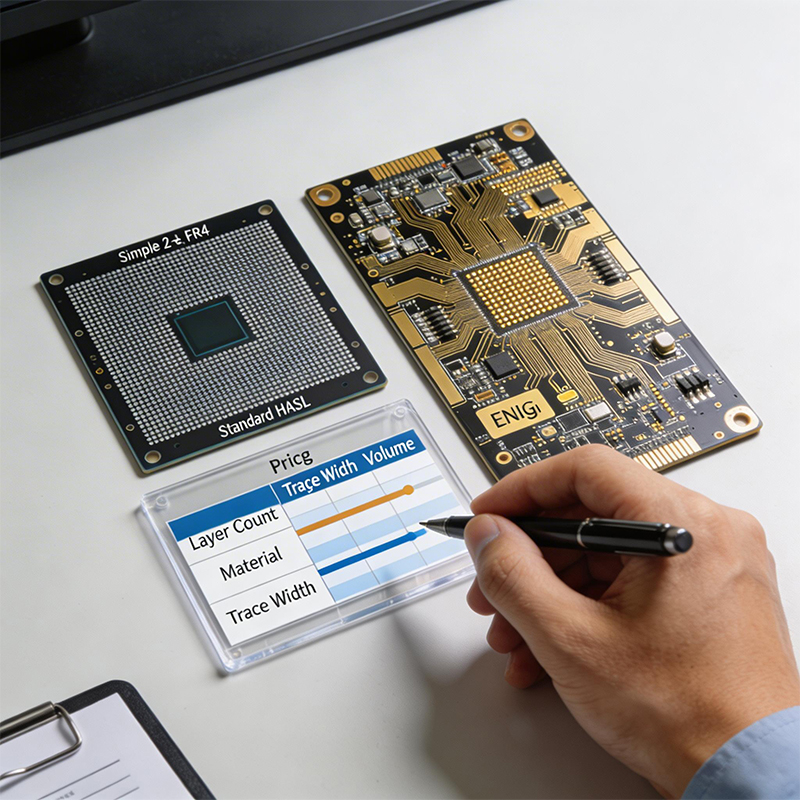
Small holes cost more. Deep holes cost more. Aspect ratio (board thickness divided by hole diameter) matters.
Standard drills are 0.3mm to 0.4mm. That's cheap. Go down to 0.2mm, and the cost increases because you need more precise equipment and slower drilling speeds.
For holes smaller than 0.15mm, you need laser drilling. That's HDI territory, and the price jumps significantly.
Aspect ratio also matters. A 1.6mm board with 0.3mm holes has an aspect ratio of about 5:1—standard and cheap. A 3.2mm board with 0.2mm holes has an aspect ratio of 16:1—difficult and expensive.
The finish on your pads affects solderability and shelf life. The cheapest option is HASL (Hot Air Solder Leveling). It's been around forever, it's reliable, and it's cheap.
ENIG (Electroless Nickel Immersion Gold) costs 20-40% more than HASL. It's worth it for fine-pitch components (BGAs, QFNs) and boards that need a long shelf life.
OSP (Organic Solderability Preservative) is in between—cheaper than ENIG but more expensive than HASL. It's water-based and environmentally friendly, but the shelf life is shorter.
Immersion Silver and Immersion Tin are alternatives with their own trade-offs.
This one's obvious but important. Prototypes are expensive per board. Production is cheap per board.
A single 2-layer board might cost $50. A hundred of the same board might cost $200 total ($2 each). The fixed costs—engineering, setup, stencils—get spread across more units.
The break-even point varies by design, but generally, prototypes under 10 pieces are expensive per board. Once you hit 100 pieces, costs drop significantly. At 1,000 pieces, they drop again.
Need it fast? You'll pay for it.
Standard lead time is 5-7 business days. That's the baseline.
24-hour turnaround: Add 50-100% to the price.
48-hour turnaround: Add 30-50%.
The factory has to push your job ahead of others. That premium reflects the schedule disruption.
For assembly (PCBA), you'll pay for a stencil. A laser-cut stencil costs $50-150, depending on size and complexity. This is a one-time cost per design, not per board.
For very high-volume production, there might be tooling charges for fixtures and test jigs. These are amortized over the production run.
Here's what actually works:
Optimize your design for manufacturability. Use standard trace widths, standard hole sizes, and the fewest layers possible. Design for the cheapest material that meets your requirements.
Combine orders. If you need multiple designs, see if you can panelize them together. One panel with multiple designs costs less than separate orders.
Be flexible on lead time. If you don't need boards tomorrow, don't pay for expedite.
Ask for DFM feedback. Good manufacturers will review your design and tell you where you can save money without compromising performance. That's free expertise—use it.
Consider the total cost, not just the per-board price. A slightly more expensive board that assembles reliably is cheaper than a cheap board that fails in the field.
At Kaboer, we've been manufacturing custom PCBs since 2009. Based in Shenzhen with our own PCBA factory, we understand that price is important—but value is what matters.
What we offer:
Transparent pricing. We'll explain what you're paying for and why.
Design review. Our engineers review your design and suggest cost-saving improvements before we build.
Flexible options. From 2-layer rigid boards to complex HDI and flex circuits, we can build what you need.
Fast prototyping. Need to validate a design quickly? We can turn prototypes in days.
One-stop service. We fabricate and assemble, so you don't pay for shipping boards between suppliers.
Send us your requirements or Gerber files. We'll review your design, give you honest feedback on cost-saving opportunities, and get back to you with a quote. We've been at this for over 15 years, and we believe the best partnerships start with straightforward conversations.
And if you're ever in Shenzhen, we'd be happy to show you around our factory.

Kaboer manufacturing PCBs since 2009. Professional technology and high-precision Printed Circuit Boards involved in Medical, IOT, UAV, Aviation, Automotive, Aerospace, Industrial Control, Artificial Intelligence, Consumer Electronics etc..


 English



 Wechat
 +86 13670210335
 +86 13670210335
 E-mail