
Date: 2026-03-18
If you've been in electronics manufacturing for any length of time, you've heard these two terms thrown around constantly. SMT vs through hole—it's one of those debates that comes up every time you start a new design.
I remember sitting in meetings years ago, watching engineers argue about which method was "better." The truth is, neither one is universally better. They're just different tools for different jobs.
Let's break down what each technology actually is, where they shine, where they struggle, and how to choose the right one for your next project.
Through-hole technology is the older method. Components have long wire leads that get inserted into holes drilled through the PCB and soldered on the opposite side . Think of it like nailing something through a board—it's mechanically strong, but it takes up space on both sides.
Surface mount technology (SMT) is newer. Components sit directly on the surface of the board and solder to pads on the same side. No holes needed. It's like sticking magnets on a fridge—fast, compact, and you can put stuff on both sides.
Both methods have been around for decades. Through-hole was king from the 1950s through the 1980s. SMT started taking over in the late '80s and is now the dominant technology for most electronics. But through-hole never really died—it just found its niche.
Let's put them side by side and see how they stack up.
SMT wins this one hands down. Surface mount components are tiny. We're talking 0402 packages (1.0mm × 0.5mm) as standard, and even smaller for ultra-compact designs. Because they mount on the surface, you can populate both sides of the board. This is how your smartphone packs so much into such a small space.
Through-hole components are big and bulky. Those leads need clearance around the holes, and you can't put anything on the opposite side where the solder joints are. If board space is tight, SMT is your friend.
Through-hole takes the crown here. When you solder a component with leads going through the board, it's mechanically locked in place. This matters for things that get plugged and unplugged repeatedly—connectors, terminals, anything that takes physical abuse.
SMT joints rely entirely on the solder pad's adhesion to the board. Under severe vibration or mechanical stress, they can crack or lift. That's why you still see through-hole used in automotive, aerospace, and military applications where things need to survive harsh environments.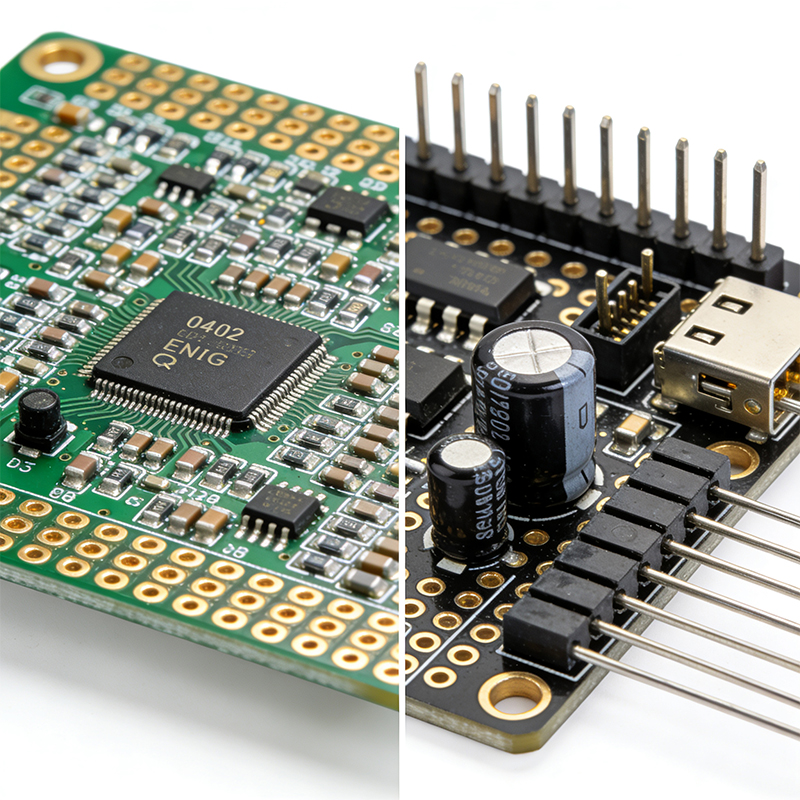
SMT is the clear winner. Those short connections matter—a lot. Through-hole leads create parasitic inductance (about 10-15 nH) that wreaks havoc on high-frequency signals. SMT joints are under 1 nH, making them essential for anything running at GHz speeds: 5G, high-speed data, RF circuits.
Through-hole parts at high frequencies act like little antennas. Not good.
SMT wins for volume production. Pick-and-place machines can place tens of thousands of SMT components per hour with surgical precision. This automation drops your per-board cost dramatically once you scale up.
Through-hole assembly is slower and often involves more manual work or wave soldering. It's harder to automate, which means higher labor costs at volume.
Through-hole is easier to work on. A soldering iron and a solder sucker can remove and replace a through-hole part in minutes. No special equipment needed.
SMT rework is trickier. Fine-pitch parts need hot air, tweezers, steady hands. BGAs and QFNs with hidden leads are even harder—they often require X-ray inspection to verify the repair.
Through-hole has an advantage for power components. Those leads going through the board can conduct heat away from the part. Big through-hole transistors and diodes often have metal tabs for heatsinks.
SMT power components have gotten better with thermal pads and vias, but if you're moving serious current, through-hole is still common.
| Factor | SMT | Through-Hole |
|---|---|---|
| Component size | Tiny, compact | Large, bulky |
| Board space | Saves space, both sides usable | Eats space, needs holes |
| Mechanical strength | Good for normal use | Excellent for high-stress |
| High-frequency performance | Excellent | Poor (long leads cause issues) |
| Assembly speed | Fast, highly automated | Slower, more manual |
| Volume cost | Low | Higher |
| Rework difficulty | Tricky (needs hot air) | Easy (regular iron works) |
| Best for | ICs, passives, high-density boards | Connectors, power parts, rugged gear |
Go with SMT if:
Board space is tight. Wearables, smartphones, compact gadgets—anything where size matters.
You're running high-speed signals. Above 50MHz, SMT is really your only option.
You need low cost at scale. The automation advantage kicks in once you're making hundreds or thousands of boards.
You're using modern ICs. Most microcontrollers, memory chips, and advanced components only come in SMT packages now.
Through-hole still makes sense when:
Mechanical strength is critical. Connectors that get plugged and unplugged repeatedly, terminal blocks, anything that will see physical stress.
You're dealing with high power. Large capacitors, power transistors, voltage regulators that need heatsinks.
The product will see extreme vibration. Aerospace, automotive under-hood, military gear.
You're prototyping or doing low-volume runs. Hand-soldering through-hole is easier than placing tiny SMT parts.
Here's a secret: you don't have to choose just one. Mixed assembly is common in modern electronics. Most of the board uses SMT for density and automation, while a few critical spots use through-hole for strength.
Think of a power supply board: SMT for all the control circuitry and small passives, through-hole for the big electrolytic capacitors and the connector where the AC power comes in. Best of both worlds.
Let's look at some real examples:
Smartphones and tablets: Almost 100% SMT. There's simply no room for through-hole parts. Everything is miniaturized, including the connectors.
Desktop computer motherboards: Mostly SMT, but you'll see through-hole connectors (USB, audio jacks, PCIe slots) and big electrolytic capacitors around the CPU. The connectors need the mechanical strength; the caps need the current handling.
Industrial control panels: Lots of mixed assembly. SMT for the processing and logic, through-hole for terminal blocks, relays, and anything that connects to the outside world.
Military and aerospace gear: Often leans toward through-hole for critical connections, though they've been adopting SMT for density with careful reinforcement.
The SMT vs through hole debate isn't about which is "better." It's about matching the technology to what your product actually needs.
SMT wins for size, speed, and high-frequency performance. Through-hole wins for strength, power handling, and ease of rework. Most modern products use a mix of both.
At Kaboer, we've been working with both technologies since 2009. We're in Shenzhen, with our own PCBA factory, and we handle the full range—from all-SMT boards for compact devices to mixed-assembly boards for rugged industrial gear. We build flexible circuits, rigid-flex boards, HDI high-frequency boards, and everything in between.
If you're ever unsure which approach is right for your project, that's exactly the kind of conversation we love having. We'll help you figure out the best balance for your specific needs.
If you're designing a board and wondering whether SMT or through-hole (or a mix) is the right call, we're happy to help.
Send us your requirements or Gerber files. We'll review your design, give you honest feedback, and get back to you with a quote. We've been at this since 2009, and we believe the best partnerships start with straightforward conversations.
And if you're ever in Shenzhen, we'd be happy to show you around.

Kaboer manufacturing PCBs since 2009. Professional technology and high-precision Printed Circuit Boards involved in Medical, IOT, UAV, Aviation, Automotive, Aerospace, Industrial Control, Artificial Intelligence, Consumer Electronics etc..


 English



 Wechat
 +86 13670210335
 +86 13670210335
 E-mail