
Date: 2026-03-17
If you're in the business of making electronic products, you've probably heard the term ISO 9001 certification more times than you can count. Maybe you've even lost a potential client because you didn't have it.
Here's the reality: in electronics manufacturing, ISO 9001 isn't just a nice-to-have anymore. It's the baseline. It's what customers look for when they're trying to figure out if you're a serious player or just someone with a soldering iron and a garage.
But getting certified can feel overwhelming. There's paperwork, audits, consultants, and a whole lot of jargon. The good news? It's actually a pretty straightforward process once you break it down.
Let's walk through what you actually need to do to get ISO 9001 certified, how long it takes, what it costs, and whether it's worth the effort.
Let's cut through the marketing speak. ISO 9001 is the international standard for Quality Management Systems (QMS). It's published by the International Organization for Standardization (ISO), and it provides a framework for companies to deliver consistent quality, meet customer expectations, and actually improve over time .
Think of it this way: ISO 9001 isn't about making perfect products. It's about having a system that ensures you do things the same way every time, catch problems before they get out of hand, and fix them permanently when they happen .
For electronics manufacturers, this matters because:
Consistency is everything. Your customers need to know that board #1000 will work exactly like board #1.
Defects are expensive. Catching problems early saves money and reputation.
Traceability matters. When something goes wrong, you need to know which batch, which material, which operator .
The journey to ISO 9001 certification follows a pretty standard path. Here's what you need to do.
Before you do anything, you need to know what you're aiming for. ISO 9001:2015 (the current version) is built around seven quality management principles: customer focus, leadership, engagement of people, process approach, improvement, evidence-based decision making, and relationship management .
Spend some time reading through the requirements. Many companies invest in a training course or bring in a consultant at this stage. It's money well spent .
This is where you compare your current processes against what ISO 9001 requires. You'll identify what's missing, what needs improvement, and what you're already doing right .
A structured gap analysis will produce a clear remediation map showing exactly what you need to fix. Don't skip this step—it's your roadmap for everything that follows .
Now you know what needs to be done. Develop a project plan with clear milestones, deadlines, and responsibilities. Assign a quality manager to lead the effort internally. If you're working with a consultant, they'll help you structure this .
This is the heavy lifting. You need to document how your company meets ISO 9001 requirements. This includes :
Quality Manual – An overview of your QMS (some standards no longer require a manual, but most companies keep one)
Quality Policy and Objectives – What you're aiming for and how you'll measure it
Process Maps and Flowcharts – Visual guides to how work gets done
Procedures – Documented ways of doing things (document control, record control, internal audit, non-conformity management, corrective action, etc.)
Supporting Records – Forms, templates, logs that show you're actually following your procedures
The key is to document what you actually do, not what you think an auditor wants to see. Your system needs to work for your business, not just look good on paper .
This is where documentation meets reality. Train your employees on the new procedures. Start using the forms. Collect the records. Make quality part of everyday work, not just something you think about during audits .
Before you bring in external auditors, audit yourself. Trained internal auditors should go through every department and process to check if you're actually following your QMS .
Identify non-conformities, fix them, and document what you did. This is a mandatory part of the standard—you can't skip it .
Your leadership team needs to review the QMS. Look at audit findings, customer feedback, performance metrics, and decide if the system is working. This isn't a rubber stamp—it's where you make strategic decisions about quality .
Choose an accredited certification body to perform your external audit. Make sure they're recognized internationally and have experience in electronics manufacturing . The certification body will provide a quote based on your company size and complexity .
The first part of the external audit is a documentation review. The auditor checks your QMS documents to make sure they meet ISO 9001 requirements. If they find issues, you'll need to fix them before moving to Stage 2 .
The auditor visits your site to verify that you're actually doing what you documented. They'll interview employees, review records, and observe processes. If you pass, you'll be recommended for certification .
Once any non-conformities from Stage 2 are resolved, the certification body issues your ISO 9001 certificate. It's valid for three years .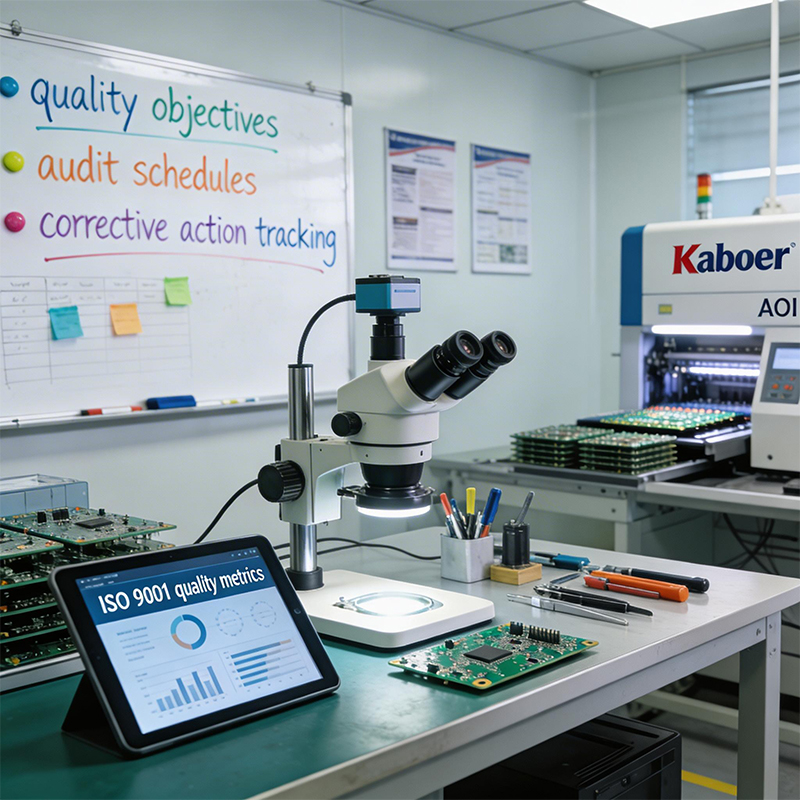
Most companies complete ISO 9001 certification in 3 to 12 months . The range depends on:
How prepared you are – If you already have documented processes, you'll move faster .
Company size and complexity – A small shop might finish in 4-6 months. A multi-site operation could need 12-18 months .
Resources dedicated – If you have a full-time quality manager and team support, you'll move faster than if one person does it in their spare time.
Some certification bodies suggest 3-6 months is typical . Plan for 6-12 months to be safe.
ISO 9001 certification costs typically range from $5,000 to $25,000+ for the complete project . Here's where the money goes:
Consulting fees: $2,000 to $15,000+, depending on how much support you need. Some companies do it entirely in-house; others want hand-holding .
Internal costs: Often the biggest expense. Your quality manager might spend 10-20 hours per week for 6-12 months. Team members add another 5-10 hours each. Budget $3,000 to $10,000 for training materials, software, and employee time .
Certification body fees: $2,000 to $8,000 for the external audit and certificate. This varies by company size and complexity .
Ongoing costs: Annual surveillance audits run $1,000 to $3,000 per year. Full recertification every three years costs similar to the initial audit .
This depends on your team and comfort level. Many companies achieve certification with internal staff and guidance from their certification body . Others find consultants valuable for navigating the process efficiently.
If you're feeling overwhelmed or unsure, a consultant can provide expertise and keep you on track . The key is finding someone who understands electronics manufacturing, not just generic ISO theory.
ISO 9001 isn't a one-and-done deal. To keep your certificate:
Annual surveillance audits – Your certification body visits once a year to ensure you're maintaining the system .
Recertification every three years – A full audit to renew your certificate .
Continuous improvement – The whole point of ISO 9001 is to keep getting better. You'll need to show progress over time.
In our industry, quality isn't optional. A single bad board can delay a production run, cost thousands in rework, or worse—fail in the field and damage your reputation.
ISO 9001 certification gives you:
Market credibility. Customers and partners trust an ISO 9001 certified company .
Process efficiency. Streamlined operations, less waste, better workflows .
Customer satisfaction. When you consistently deliver quality, customers notice .
Global recognition. ISO 9001 opens doors to international markets .
Risk reduction. A structured QMS helps you catch problems early .
At Kaboer, we've been ISO 9001 certified since our early days. Based in Shenzhen, with our own PCBA factory, we apply these quality principles to everything we build—from flexible circuits and rigid-flex boards to HDI high-frequency PCBs and full PCBA assembly.
Our ISO 9001 certification means our processes are documented, repeatable, and audited. We review every design before production, check components on arrival, inspect at multiple stages, and test every board before it ships. If you're ever in Shenzhen, we're happy to show you around and walk you through how our quality system works in practice.
If you're looking for a manufacturing partner who takes quality as seriously as you do—someone with certified systems, not just promises—let's talk.
Send us your requirements or Gerber files. We'll review your design, give you honest feedback, and get back to you with a quote. We've been at this since 2009, and we believe the best partnerships start with straightforward conversations.
And if you're ever in Shenzhen, we'd be happy to show you around.

Kaboer manufacturing PCBs since 2009. Professional technology and high-precision Printed Circuit Boards involved in Medical, IOT, UAV, Aviation, Automotive, Aerospace, Industrial Control, Artificial Intelligence, Consumer Electronics etc..


 English



 Wechat
 +86 13670210335
 +86 13670210335
 E-mail