
Date: 2025-12-23
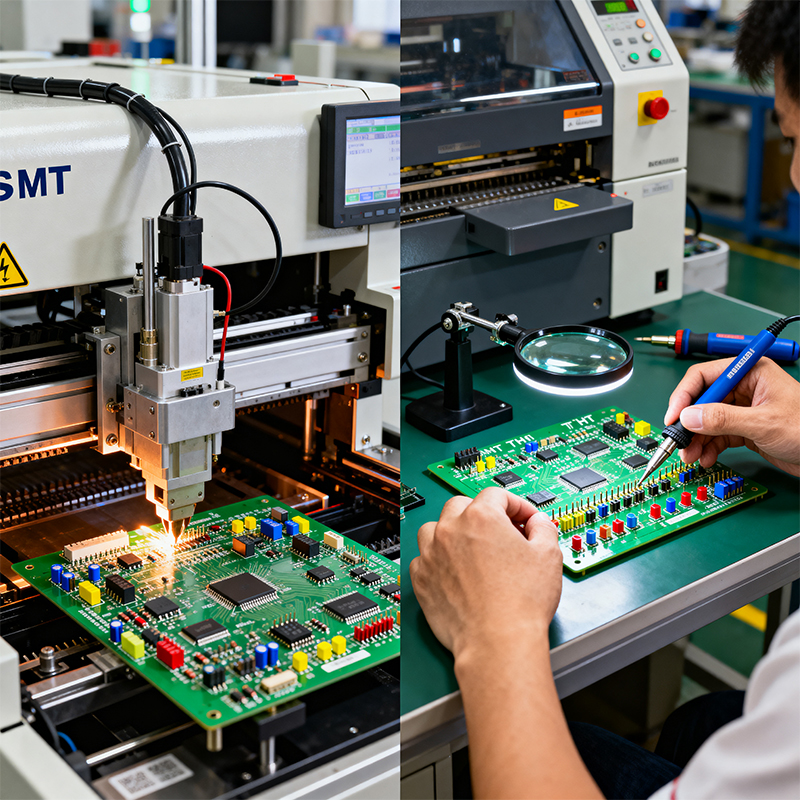
Surface Mount Technology is a method where electronic components (Surface Mount Devices or SMDs) are mounted directly onto the surface of a Printed Circuit Board (PCB). These components feature small metallic contacts (pads, leads, or balls) rather than traditional wire leads. The connection is established using solder paste that's melted during a controlled heating process called reflow soldering.
Through-Hole Technology is the traditional assembly method where component leads are inserted into drilled holes that pass completely through the PCB. The leads extend from the opposite side of the board where they are soldered to pads, creating both electrical connections and strong mechanical bonds.
Solder Paste Application: A stainless steel stencil aligns with the PCB, and solder paste is deposited through apertures onto the pads
Component Placement: Automated pick-and-place machines position components onto the solder paste deposits with micron-level precision
Reflow Soldering: The entire assembly passes through a multi-zone oven where controlled heating melts the solder paste, forming permanent connections upon cooling
Cleaning and Inspection: Automated optical inspection (AOI) and other testing methods verify assembly quality
Component Insertion: Components are inserted into pre-drilled holes, either manually or using automated insertion machines
Soldering: Typically performed using wave soldering where the board passes over a wave of molten solder that contacts all leads simultaneously
Lead Trimming: Excess lead length is trimmed from the soldered connections
Cleaning and Inspection: Visual inspection and electrical testing verify connections
| Parameter | Surface Mount Technology (SMT) | Through-Hole Technology (THT) |
|---|---|---|
| Board Space Utilization | Components on surface only; allows double-sided mounting; higher component density | Components require holes; typically single-sided mounting; lower density |
| Component Size Range | Very small (01005: 0.4×0.2mm) to large BGAs; enables miniaturization | Generally larger components; limited miniaturization capability |
| Mechanical Strength | Moderate; relies on solder joint strength | Excellent; leads pass through board creating strong mechanical bond |
| Thermal Performance | Good heat dissipation to board surface; can use thermal vias | Components often raised above board; heat dissipation can be challenging |
| High-Frequency Performance | Superior; shorter leads reduce parasitic inductance/capacitance | Limited; longer leads increase parasitic effects at high frequencies |
| Automation Potential | Highly automated; minimal manual intervention | Less automated; manual insertion often required for complex components |
| Rework and Repair | More challenging due to small components and close spacing | Generally easier; individual components accessible for replacement |
| Initial Setup Cost | Higher (requires stencils, precision placement equipment) | Lower (simpler equipment requirements) |
| Volume Production Cost | Lower at high volumes due to automation | Higher at high volumes due to slower process |
SMT Advantages:
Reduced parasitic inductance and capacitance due to shorter connection paths
Better signal integrity for high-speed digital and RF circuits
Lower electromagnetic interference (EMI) from compact layouts
Controlled impedance easier to achieve with consistent trace geometries
THT Advantages:
More robust connections for high-current applications
Better performance in high-voltage applications (creepage/clearance)
Lower thermal stress on components during soldering
SMT Limitations:
Solder joints experience more stress from thermal cycling
Vulnerable to mechanical shock and vibration without additional reinforcement
Board flex can fracture solder joints
THT Strengths:
Exceptional mechanical strength from through-board connections
Superior resistance to mechanical stress and vibration
Better suited for connectors and components subject to physical force
SMT Manufacturing Factors:
Requires precise solder paste printing and component placement
Reflow process must be carefully profiled for different component types
Demands flat PCBs with consistent solder mask application
Environmental controls necessary for handling moisture-sensitive devices
THT Manufacturing Factors:
Requires drilling holes, increasing board fabrication cost and time
Wave soldering can create solder bridges on fine-pitch components
Manual processes can introduce variability in production quality
Through-holes consume valuable routing space on inner layers
Consumer Electronics: Smartphones, tablets, wearables where size and weight are critical
High-Speed Computing: Servers, networking equipment requiring superior signal integrity
RF and Microwave Systems: Wireless devices, radar systems, communications equipment
High-Volume Production: Consumer goods where automation efficiency justifies initial setup costs
Miniaturized Devices: Medical implants, IoT sensors, compact instrumentation
High-Reliability Applications: Aerospace, military, medical life-support systems
High-Power Electronics: Power supplies, motor controllers, industrial equipment
Prototyping and Development: Easier manual assembly and modification
Components Subject to Mechanical Stress: Connectors, switches, transformers
Low-Volume Production: Where automation setup costs cannot be justified
Extreme Environments: Applications with significant thermal cycling or vibration
Many modern electronic assemblies use both technologies:
Primary Circuitry: SMT for the majority of components
Selected Components: THT for connectors, large capacitors, or components requiring extra mechanical strength
Implementation: Typically involves SMT assembly followed by selective THT processes
Miniaturization: Components shrinking to 0201 and 01005 sizes (0.25×0.125mm)
Advanced Packaging: Chip-scale packages, wafer-level packaging, 3D IC integration
Materials Development: Low-temperature solders, high-performance substrates
Process Innovations: Vacuum reflow, precision jet printing of solder paste
Selective Soldering: Precision application to specific through-hole components
Press-Fit Technology: Gas-tight connections without soldering for backplane applications
Advanced Materials: High-temperature plastics for connectors and housings
Increased Automation: Robotics and AI improving both SMT and THT processes
Sustainability Focus: Lead-free solders, halogen-free materials, recycling initiatives
Supply Chain Resilience: Dual-sourcing strategies for critical components
Digital Integration: Industry 4.0 implementation with real-time process monitoring
Electrical Requirements: Frequency, current, voltage, signal integrity needs
Mechanical Demands: Shock, vibration, thermal cycling, physical stress
Size Constraints: Available board space, height restrictions, packaging limitations
Environmental Conditions: Operating temperature, humidity, corrosive elements
Production Volume: Prototype, low-volume, or high-volume manufacturing
Cost Considerations: NRE, unit cost, tooling, equipment investment
Reliability Requirements: Expected product lifetime, failure rate tolerance
Start with SMT as the default for most applications
Use THT selectively for components with specific mechanical or electrical needs
Consider mixed technology for optimal balance of performance and reliability
Evaluate total cost including rework, testing, and field failure implications
Design for manufacturability regardless of technology choice
Plan for testability during initial design phase
The choice between Surface Mount Technology and Through-Hole Technology represents a fundamental design decision in electronics manufacturing. SMT offers clear advantages in miniaturization, high-frequency performance, and automated production efficiency, making it the dominant choice for modern consumer and commercial electronics. THT provides superior mechanical strength and reliability for demanding applications where physical robustness is paramount.
Most contemporary designs utilize a hybrid approach, leveraging the strengths of both technologies: SMT for the majority of components to achieve density and performance goals, with selective use of THT for connectors, power components, and elements requiring enhanced mechanical integrity. This balanced approach allows designers to optimize both electrical performance and physical reliability.
As both technologies continue to evolve—with SMT pushing the boundaries of miniaturization and THT adapting to new materials and processes—the informed selection between them remains a critical skill for electronics designers and manufacturers. Understanding their respective strengths, limitations, and appropriate applications enables the creation of optimal electronic products for diverse market requirements.

Kaboer manufacturing PCBs since 2009. Professional technology and high-precision Printed Circuit Boards involved in Medical, IOT, UAV, Aviation, Automotive, Aerospace, Industrial Control, Artificial Intelligence, Consumer Electronics etc..


 English



 Wechat
 +86 13670210335
 +86 13670210335
 E-mail