
Date: 2026-06-11
You're designing an electronic product. Maybe it's a smartwatch, a drone, a medical sensor, or an automotive camera module. You keep running into the same problem: not enough space, weird shapes, and the board has to bend.
Regular rigid PCBs (FR4) are thick, stiff, and won't fit. That's when you need a flexible circuit board.
In this guide, I'll explain what flexible circuit boards are, what problems they solve, and what you absolutely must ask your supplier before ordering. No engineering degree required – just plain talk from a custom flex PCB manufacturer.
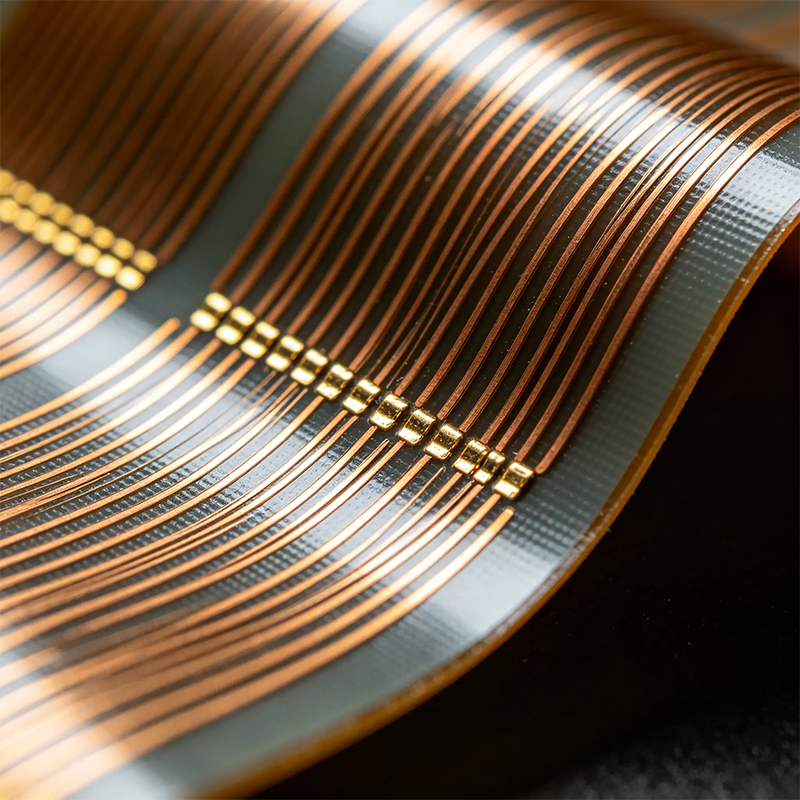
A flexible circuit board (FPC) is made of bendable insulating material – usually polyimide film (Kapton) – instead of rigid fiberglass. Copper traces are laminated onto this film, then covered with a protective overlay (the flex version of soldermask).
Compare it to things you know:
Rigid PCB = plywood. Strong, but bulky and can't bend.
Flex PCB = thick paper or a plastic card. It can bend, fold, twist, and even roll into a cylinder.
A basic flex PCB has just three layers: flexible insulator + copper + overlay. Where you need to solder components, the overlay is opened (like a window) to expose the copper pads.
I've seen too many engineers struggle with rigid boards plus cables, ending up with thick, unreliable designs. Here are the five telltale signs that flex is your answer:
1. Tight, irregular spaces
Smartwatches, hearing aids, endoscope cameras – their enclosures are curved and tiny. A rigid board won't fit. A flex board can bend to match the shape.
2. Dynamic bending
Printer printhead cables, foldable phone hinges – these parts bend thousands of times during the product's life. Only a properly designed flex PCB (using rolled annealed copper and special stackups) can survive.
3. Weight or thickness is critical
Drones, wearables, implantable medical devices – every gram matters. Flex PCBs can be as thin as 0.1mm (70% lighter than rigid boards of the same area).
4. Reducing connectors and wiring harnesses
A traditional design might use 3 rigid boards plus 2 cables and 4 connectors. Connectors are a major failure point. A single rigid‑flex board can replace the whole assembly – no connectors, no cable assemblies, just one reliable piece.
5. High‑frequency or high‑speed signals
5G antennas, radar modules, optical transceivers. Flex PCBs made with low‑loss materials (like LCP or PTFE) provide stable impedance and minimal signal loss.
| Type | Structure | Typical Use |
|---|---|---|
| Single‑layer FPC | One copper layer, two overlay layers | Simple jumpers, keypads, LED strips |
| Double‑layer FPC | Two copper layers with insulation between | Crossover wiring, camera modules |
| Multi‑layer FPC | 3+ copper layers | Complex sensors, shielded signal lines |
| Rigid‑flex PCB | Rigid sections + flex sections pressed together | Phone cameras, drone flight controllers, medical probes |
Rigid‑flex is the most advanced. It combines the stability of rigid boards (for heavy chips and connectors) with the bendability of flex boards (for folding and interconnection) – all in one piece. No connectors, no cables. Very reliable, but also the hardest to design and manufacture.
Don't just send a Gerber file and hope for the best. Ask these five questions before ordering:
1. Static bend or dynamic flex?
Static bend – the board is bent once during assembly and then stays that way. Example: a foldable device hinge.
Dynamic flex – the board bends repeatedly during normal use. Example: a printer head cable.
Dynamic flex requires rolled annealed (RA) copper (not ED copper), special coverlay opening rules, and stress relief features. If you don't specify, the factory will use cheaper ED copper – and your board will crack after a few hundred bends.
2. Where do you need stiffeners?
A flex board is too floppy to solder a connector or screw into a housing. You need a stiffener (polyimide, FR4, or stainless steel) glued to the back of the flex board at specific locations. You must tell the factory: which areas get connectors? Which need screw holes? How thick should the stiffener be?
3. Impedance control?
If you have high‑speed signals (USB 3.0, MIPI, RF antenna), you need controlled impedance. Flex materials have different dielectric constants than FR4, so trace widths and stackups must be calculated separately. Ask for an impedance test coupon and report.
4. Assembly (PCBA) – on rigid part, flex part, or both?
If components need to be soldered onto the flexible part (e.g., LEDs on a flex strip), the board will warp during SMT without a special carrier fixture. Ask the supplier if they have a dedicated flex assembly line with carriers.
5. Do you offer dynamic flex testing?
For products with moving flex, don't trust the factory's word. Ask for a dynamic bend life test (e.g., 100,000 cycles at a specified radius and speed) on a sample. This is not standard – you have to request it.
We are a custom flexible circuit board manufacturer that also does rigid‑flex, HDI high‑frequency, and full PCBA. What makes us different?
Design support up front – Send us your schematic or layout. We'll run a DFM (design for manufacturing) check and flag issues before you order: no components in bend areas, proper coverlay openings, correct stiffener placement. We save you from expensive revisions.
All in‑house – We make flex boards, rigid‑flex, HDI, and do the assembly all under one roof. No back‑and‑forth between a board house and an assembly shop. One window, one responsibility.
High‑frequency capability – Rogers, Taconic, PTFE, LCP – we handle them. Impedance tolerance ±5% or better. Perfect for 5G, radar, optical modules.
Rigid‑flex is our specialty – 2 to 10 layers, seamless transition between rigid and flex sections. Many factories refuse complex rigid‑flex designs; we embrace them.
PCBA with flex‑specific processes – We have a dedicated flex assembly line with custom‑made carriers, high‑speed placement, 3D solder paste inspection (SPI), AOI, and flying probe testing. Typical assembly yield >98%.
Industries we serve: consumer electronics (smartwatches, TWS earbuds, foldable phone hinge FPCs), automotive (sensors, camera modules, BMS), medical (endoscopes, hearing aids, neurostimulators), industrial (robot joints, encoders).
Step 1 – Send us your files
You'll need: Gerber or PCB design files (Altium, PADS, KiCad – any format), BOM (if you need assembly), and a note about special requirements (bend radius, cycle count, impedance, preferred material brand).
Step 2 – We review and quote
Within 24 hours, you'll receive: a free DFM report (potential design issues), sample pricing and lead time, and volume pricing tiers.
Step 3 – Sample, then small batch, then mass production
We start with 10‑20 samples. You test bending and function. If everything looks good, we move to small batch (50‑500) and then volume. No pressure to commit to large quantities upfront – we earn your trust with quality samples.
I've seen too many projects spend months struggling with rigid boards and cables, only to fail the bend test or find out the board won't fit inside the enclosure. By then, tooling is paid for and timelines are blown.
If your product has tight space, bending requirements, weight sensitivity, or high‑frequency signals – consider flexible circuit boards early in the design phase. A quick sample run is cheap compared to a redesign.
Do you have a project in mind? Even if it's just a rough sketch or a list of requirements – send it over. We'll give you honest advice. If we can't do it, we'll tell you why and how to modify your design so we can.
When you contact us, please include:
Target application (what product, does it bend, high‑frequency?)
Approximate size and layer count
Estimated quantity (samples or production)
We're here to turn your bendable idea into a reliable, manufacturable product. Let's talk.

Kaboer manufacturing PCBs since 2009. Professional technology and high-precision Printed Circuit Boards involved in Medical, IOT, UAV, Aviation, Automotive, Aerospace, Industrial Control, Artificial Intelligence, Consumer Electronics etc..


 English



 Wechat
 +86 13670210335
 +86 13670210335
 E-mail