
Date: 2026-05-09
You’ve designed a circuit board. You’ve sent the Gerber files to a fab. A few weeks later, a box shows up with bare boards. Now what?
If you think you can just solder a few components and call it done – for a real product, that’s a recipe for disaster. The PCB assembly process (or PCBA) is where your board actually becomes functional. And if done poorly, it’s also where your project dies.
Let’s walk through what really happens on a professional assembly line – no fluff, just the steps that matter. And since we specialize in flexible circuits, rigid-flex, HDI, and high-frequency boards, I’ll also tell you where those need extra care.
First step: applying solder paste onto the bare board. A stainless steel stencil sits on top of the board. A squeegee spreads paste through the openings – exactly where components will sit.
For standard boards, this is straightforward. But for flexible PCBs, the board isn’t stiff. It can wiggle. If the paste shifts even by a hair, you get bridges or missing solder later. We use special vacuum tooling to hold flex boards perfectly flat during printing. Otherwise, nothing else works.
Next, a machine picks components from reels or trays and places them onto the paste-covered pads. We’re talking resistors so small you need a microscope to see them. This happens fast – sometimes 20,000 parts per hour.
Here’s where rigid-flex boards get tricky. The rigid sections are fine, but the flex tails can curl up if not supported. We use customized fixtures to keep everything level. For HDI boards with microvias and fine-pitch ICs (like 0.4mm pitch BGAs), placement accuracy needs to be within ±0.025mm. Our machines can do that. A cheap assembly house? Probably not.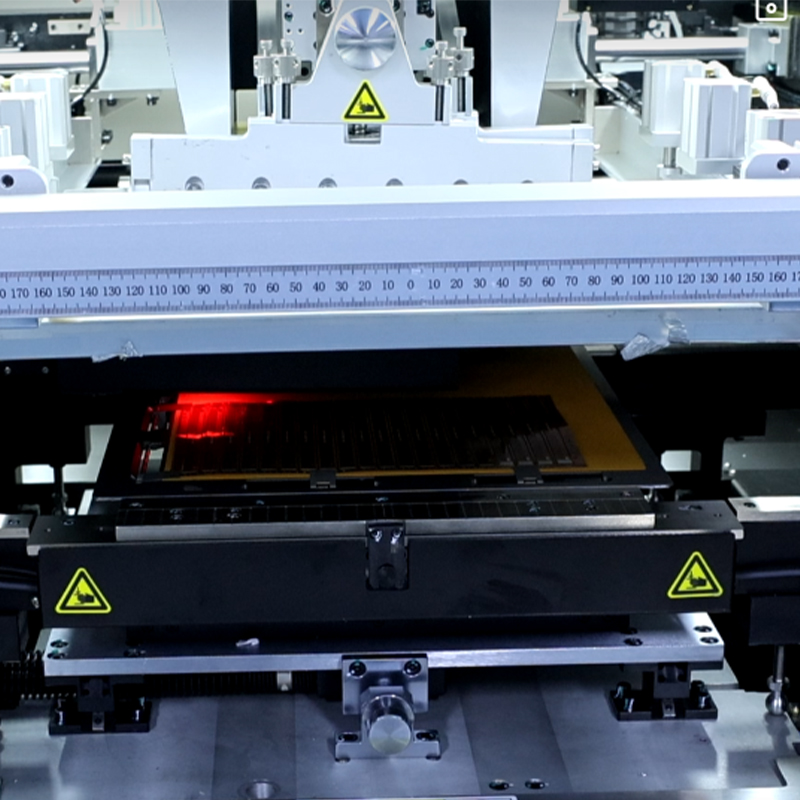
After placement, the board goes into a reflow oven. It moves through different temperature zones – preheat, soak, reflow, cooling. The solder paste melts, then solidifies, locking components in place.
For high-frequency boards (Rogers, PTFE, etc.), the thermal profile matters a lot. Heat them too fast and the material expands unevenly – you lose signal integrity. Too slow and you risk damaging components. We profile every board type individually. No guesswork.
Once the board cools down, it goes under high-resolution cameras. AOI checks:
Missing components
Polarity reversals (a diode turned around)
Solder bridges
Insufficient solder
For flexible and rigid-flex, we adjust lighting angles because polyimide material can reflect light weirdly. For HDI, we crank up the resolution to inspect those tiny 01005 components and fine-pitch leads. If a defect is found, the board is flagged for rework or scrap.
We don’t skip AOI. Ever. Even on a single prototype.
Not everything can be surface-mounted. Connectors, large transformers, or components that take mechanical stress – those go through-hole. For these:
Manual insertion: an operator places parts by hand.
Wave soldering: the board passes over a flowing wave of molten solder. Only the bottom side gets soldered.
With rigid-flex boards, wave soldering needs careful masking. Solder can wick into the flex area if you’re not careful. We’ve seen other shops ruin entire batches that way. We prevent it.
Assembly done. But does the board work? We run several tests:
In-circuit test (ICT) – probes touch test points to check resistors, capacitors, opens, shorts.
Functional test (FCT) – we power up the board and simulate real-world signals. For a Bluetooth module, we check if it pairs. For a motor driver, we spin a motor.
For high-frequency boards, we also run impedance and insertion loss tests. You don’t want your 5G signal to drop by half because of a bad assembly.
Some boards get a protective coating – especially flex and rigid-flex used in humid or dusty environments. We spray a thin acrylic or silicone layer. It stops corrosion and stray solder balls from causing shorts.
Then we pack boards in anti-static trays or vacuum-sealed bags. For flex PCBs, we use stiffeners or curved supports so they don’t crease during shipping.
We don’t treat your board like a generic product. We know that a flexible circuit behaves differently from a rigid one. We know that an HDI board with 0.2mm vias needs a different inspection standard. And we know that if you’re making medical devices or automotive electronics, one cold solder joint could cost you a recall.
Here’s what we offer:
Custom stencil design for flex and rigid-flex to prevent paste smearing.
Dedicated fixtures for odd-shaped boards – no wobbling during placement.
Tailored reflow profiles for high-frequency materials like Rogers, Taconic, and Isola.
100% AOI and ICT – no sampling, no “we’ll trust the machine.”
Fast turnaround on prototypes – because you need to test before committing to volume.
Whether you have a rigid board, a flexible one, a rigid-flex hybrid, or an HDI high-frequency beast – we can assemble it. Send us your BOM (bill of materials), Gerber files, and any special notes. We’ll send back a clear quote, a lead time, and answers to your questions.
Don’t let a sloppy assembly kill a great design. Let’s talk.

Kaboer manufacturing PCBs since 2009. Professional technology and high-precision Printed Circuit Boards involved in Medical, IOT, UAV, Aviation, Automotive, Aerospace, Industrial Control, Artificial Intelligence, Consumer Electronics etc..


 English



 Wechat
 +86 13670210335
 +86 13670210335
 E-mail