
Date: 2026-05-04
If you’ve been in hardware design for more than a minute, you know the drill: motors are usually the bulkiest, heaviest part of any small device. But things are shifting. We’re moving away from the old-school "iron and wire" setup toward something much sleeker: the PCB motor.
At its core, a PCB motor (often an axial flux type) replaces those messy, hand-wound copper coils with something we’re all familiar with—etched copper traces on a standard circuit board.
Think about how a regular brushless motor works. You’ve got magnets and you’ve got coils. When electricity hits the coils, you get a magnetic field, and things start to spin.
In a PCB motor, the "board" is the stator. Instead of wrapping miles of wire around a metal core, we use HDI (High-Density Interconnect) techniques to "print" the windings across multiple layers of the PCB. When you stack 8, 10, or 12 layers of precision-etched copper, you’ve essentially created a high-performance electromagnet that's less than 2mm thick.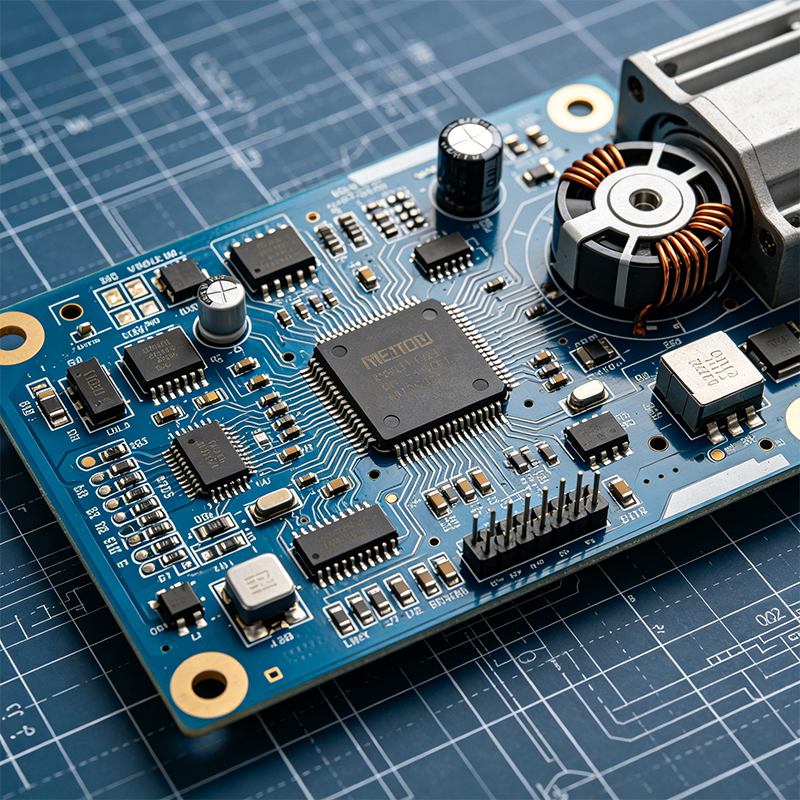
The obvious win is the size. You can make a motor as flat as a pancake. But for the engineers we talk to, the real "aha!" moment comes from these three points:
Massive Weight Savings: By ditching the heavy iron core, you’re looking at a motor that weighs 60-80% less than a traditional one. For drones or wearable medical tech, that's a game-changer.
Zero Cogging Torque: Since there’s no iron in the stator, there’s no "notchy" feeling when you turn the motor by hand. It’s buttery smooth, which is vital for high-end optics or precision robotics.
Perfect Consistency: Machines print PCBs. Humans (or specialized machines) wind coils. The tolerances you get with a PCB-based winding are far tighter, meaning every motor that comes off the line performs exactly like the last one.
Now, here’s the kicker: you can’t just send an RFQ to any standard board shop and expect a working motor. To get enough torque, the copper needs to be thick (we’re talking heavy copper PCB territory), and the alignment between layers has to be spot-on. This is where the marriage of Flex PCB and PCBA expertise matters. Often, the best designs use a Rigid-Flex approach where the control circuitry and the motor windings are part of the same seamless assembly.
The PCB motor isn't just a gimmick; it’s a total rethink of motion. As we push for smaller, lighter, and more reliable tech, putting the "engine" directly on the circuit board just makes sense.

Kaboer manufacturing PCBs since 2009. Professional technology and high-precision Printed Circuit Boards involved in Medical, IOT, UAV, Aviation, Automotive, Aerospace, Industrial Control, Artificial Intelligence, Consumer Electronics etc..


 English



 Wechat
 +86 13670210335
 +86 13670210335
 E-mail