
Date: 2026-03-06
You know when your laptop fan speeds up because it's working hard? Or when your phone warns you it's too hot to charge? There's a tiny component behind those smarts—a thermistor.
The name says it all: "thermally sensitive resistor" . Unlike regular resistors that try to stay the same no matter what, a thermistor changes its resistance dramatically as the temperature changes. And that simple trick makes it one of the most useful sensors in electronics.
This guide breaks down what thermistors are, how they work, and why they matter for your products—no engineering degree required.
A thermistor is a temperature-sensing component made from semiconductor materials, typically metal oxides like manganese, nickel, or cobalt . These materials are pressed into tiny shapes—beads, disks, wafers—and processed at high temperatures to create a ceramic-like element that's surprisingly sensitive to heat .
Think of it this way: a regular resistor tries to maintain its resistance value. A thermistor does the opposite—it lets you read temperature by measuring how its resistance changes.
Once you calibrate it, those resistance changes translate directly into temperature readings . And because thermistors are so sensitive, they can detect tiny temperature variations that other sensors might miss.
Here's where it gets interesting. Thermistors come in two flavors, and they behave completely differently:
As temperature goes up, resistance goes down. This is the most common type, used for temperature measurement and control .
Why does this happen? In NTC materials, electrons need a little energy to move around. When it's cold, they're sluggish, so resistance is high. As things warm up, electrons get more energetic and move more freely—resistance drops . Engineers call this "hopping conduction," and it's what gives NTC thermistors their characteristic curve.
As temperature goes up, resistance goes up too. But here's the kicker—at a certain temperature called the "Curie point," the resistance can jump by several orders of magnitude almost instantly .
This makes PTC thermistors perfect for protection rather than measurement. Think of them as resettable fuses. When current gets too high or things get too hot, their resistance skyrockets and shuts down the circuit. Cool things down, and they reset automatically .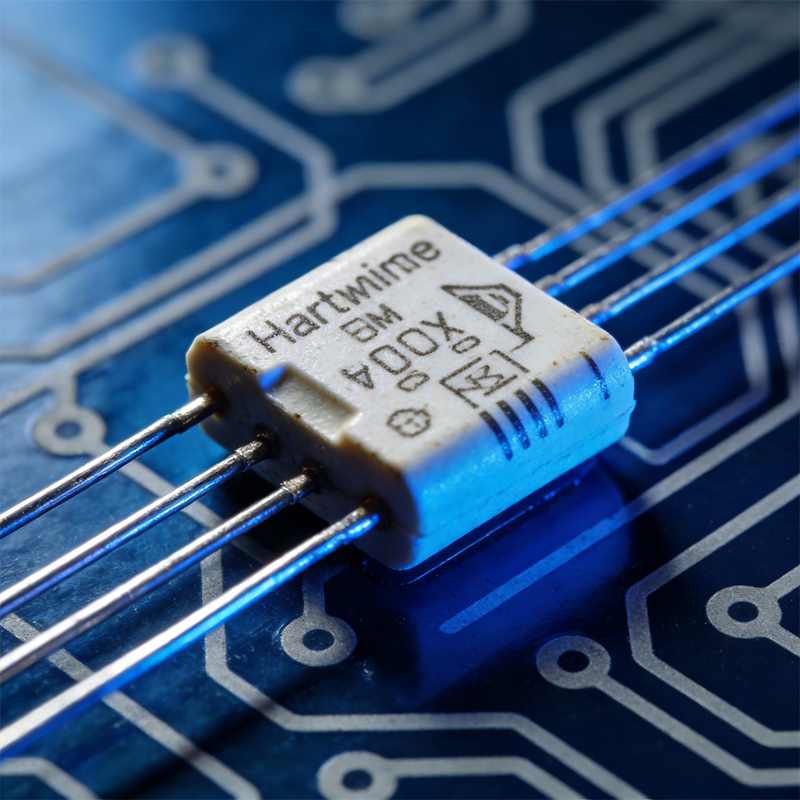
Thermistors aren't the only temperature sensors out there—RTDs and thermocouples exist too. But thermistors have some serious advantages:
High sensitivity. A thermistor can change by hundreds of ohms per degree Celsius . That means you can detect tiny temperature shifts that would barely register on other sensors.
Fast response. Because they're small, thermistors react quickly to temperature changes . Good for catching overheating before it causes damage.
Simple circuitry. Their high resistance means lead wires don't mess up your readings. Two-wire connections work fine—no need for fancy three- or four-wire setups like RTDs require .
Small size. Bead thermistors can be smaller than 0.15mm . You can put them almost anywhere.
Low cost. Compared to precision RTDs or thermocouples, thermistors are budget-friendly.
The trade-off? They're not linear, they cover narrower temperature ranges (typically -50°C to 300°C), and they're not as rugged as RTDs . But within their sweet spot, nothing beats them.
When you're picking a thermistor, you'll run into a few numbers that matter:
R25 (Nominal Resistance). The resistance at 25°C. Common values range from a few ohms to 10 MΩ . Choose based on your circuit—10kΩ is a popular choice.
B Value (Beta Constant). This describes how much the resistance changes with temperature . Higher B means higher sensitivity. Manufacturers usually give B25/50 and B25/85 (calculated between 25°C and those temperatures).
Thermal Dissipation Constant (δ). How much power (in mW) it takes to heat the thermistor by 1°C through self-heating . If you're doing precision measurement, you want this low—or you need to account for the error.
Thermal Time Constant (τ). How fast the thermistor responds to temperature changes. Specifically, the time to reach 63.2% of a temperature step . Small thermistors respond faster.
Tolerance. Standard thermistors might be ±0.5°C to ±1.5°C. Precision ones can hit ±0.1°C or ±0.2°C . You pay for that accuracy.
Thermistors are everywhere once you start looking:
In your pocket. Smartphones use NTC thermistors to monitor battery temperature—critical for preventing overheating and fires . They also compensate for temperature drift in camera modules.
In your car. Modern vehicles have dozens. Battery management systems in EVs use 2-4 thermistors per module to prevent thermal runaway . Engine management, cabin climate control, transmission fluid monitoring—thermistors handle it all.
In medical gear. Patient temperature monitors, incubators, PCR machines for DNA testing—all rely on precision thermistors .
In computers. Those fans that spin up when you're gaming? A thermistor told the system it was getting hot inside . CPU temps, GPU temps, ambient case temps—thermistors track them.
In appliances. Refrigerators, ovens, air conditioners, water heaters. If it needs to know temperature, there's probably a thermistor inside.
In industrial gear. Motor windings, bearing temps, process control—thermistors keep things from melting down .
This is the first decision you'll make:
Choose NTC for measurement and control. If you need to know the exact temperature—for monitoring, compensation, or closed-loop control—NTC is your friend .
Choose PTC for protection. Overcurrent? Overtemperature? PTC thermistors act like switches. They're used as resettable fuses, motor protectors, and overheating safeguards .
Some specialty types exist too:
CTR (Critical Temperature Resistors) – Switch sharply at a specific temp, used in defrost controls
Linear thermistors – Compensated for more linear response, used where precision matters
Thermistors aren't plug-and-play. You need to think about a few things:
Excitation. Thermistors need a small current to measure their resistance. Too much, and self-heating skews your reading . For precision work, keep it under 100µA .
Linearization. Thermistors are beautifully sensitive but terribly non-linear. You have options:
Use the Steinhart-Hart equation (three constants, very accurate)
Use the Beta parameter equation (simpler, less accurate)
Use lookup tables in software
Add external resistors to linearize the curve
Wiring. Good news: two wires are fine. Thermistor resistance is high enough that lead wire resistance doesn't matter .
Placement. A thermistor measures itself, not the air or the surface it's touching. Good thermal contact matters. Sometimes that means potting compound, thermal grease, or careful mechanical design.
Ignoring self-heating. That little current you're using to measure? It heats the thermistor. In precision applications, you need to account for this—or keep the current tiny.
Misunderstanding response time. A thermistor's time constant tells you how fast it responds. If you need to catch quick temperature spikes, pick a small bead with fast response .
Forgetting about drift. Epoxy-coated thermistors can drift 0.2°C per year. Hermetically sealed ones drift ten times less . For long-life products, packaging matters.
Using the wrong B value. Beta values vary by manufacturer. A 10kΩ thermistor from one supplier isn't necessarily interchangeable with another's unless B values match .
Thermistors are simple components that do a critical job. They sense temperature, protect circuits, and keep our devices from cooking themselves. Within their temperature range, nothing beats them for sensitivity, speed, and cost.
Choose NTC for measurement. Choose PTC for protection. Pay attention to R25, B value, and packaging. And remember—that tiny bead or chip is doing more work than you probably realize.
Need help selecting or sourcing thermistors for your next project? At Kaboer, we've been manufacturing custom PCBs since 2009—including designs that integrate precision temperature sensing. Send us your requirements, and we'll help you figure out the best solution. Better yet, come visit our Shenzhen factory and see how we build boards that keep their cool.

Kaboer manufacturing PCBs since 2009. Professional technology and high-precision Printed Circuit Boards involved in Medical, IOT, UAV, Aviation, Automotive, Aerospace, Industrial Control, Artificial Intelligence, Consumer Electronics etc..


 English



 Wechat
 +86 13670210335
 +86 13670210335
 E-mail