
Date: 2026-05-19
You have a circuit board that used to work. Now it doesn’t. You’ve checked the obvious stuff – power supply, loose connections, burnt components. Everything looks fine. But something is still wrong. Chances are, you have a broken trace.
A broken trace is a tiny crack or gap in the copper pathway on a PCB. It’s invisible to the naked eye more often than not. But it’s a surprisingly common problem, and the good news is: you can usually fix it yourself with basic tools.
Let’s walk through how to find a broken trace, how to repair it step by step, and what tools you’ll need.
First, What Is a Circuit Board Trace?
A trace is the flat copper line that connects different points on a circuit board. Think of it like a wire that’s been flattened and glued to the board. Traces carry electricity from one component to another – from a resistor to a chip, from a connector to a capacitor.
When a trace is broken, electricity can’t get through. The circuit stops working or becomes intermittent.
How Does a Trace Break in the First Place?
Traces don’t break for no reason. Here are the usual suspects:
Physical damage – A scratch from a screwdriver, dropping the board, or bending it too hard.
Overheating – Holding a soldering iron on a trace too long can lift and crack it.
Age and thermal cycling – Over years of heating and cooling, copper can fatigue and crack.
Corrosion – Moisture or chemicals eat away the copper over time.
Flexing – On flexible PCBs, repeated bending can crack traces if the bend radius is too tight.
What You’ll Need to Fix a Broken Trace
You don’t need a professional lab. Most repairs can be done with:
A magnifying glass or jeweler’s loupe – To see the tiny crack.
A multimeter with continuity test – To find the break.
Soldering iron – Fine tip preferred.
Flux – Essential for clean soldering.
Solder – Thin 0.5–0.8mm solder wire.
Wire to use as a jumper – Thin insulated wire (like AWG30 wrapping wire) or a single strand from a multi‑strand wire.
Utility knife or fiberglass pen – To scrape away the solder mask.
Isopropyl alcohol – For cleaning.
Optional: conductive pen – For quick, no‑solder fixes.
Step 1: Find the Broken Trace
You can’t fix what you can’t find. Here’s how to locate the break.
Method A – Visual inspection – Under bright light and magnification, follow the trace from one end to the other. Look for scratches, dark spots, or any place where the copper looks different. Sometimes the break is obvious – a visible gap or a lifted piece of copper.
Method B – Continuity test with a multimeter – Set your meter to continuity mode (the one that beeps). Touch one probe to one end of the trace, the other probe to the other end. If it beeps, the trace is good. If not, it’s broken somewhere.
Now move one probe closer to the other. For example, test from the start of the trace to its midpoint. If that beeps, the break is in the second half. Keep narrowing down until you pinpoint the exact location.
Method C – Wiggle test – For intermittent breaks (where the trace sometimes connects), gently press or wiggle the board while watching the meter. If the beep comes and goes, you’ve found the general area.
Step 2: Prepare the Area for Repair
Once you’ve located the break, you need to expose clean copper on both sides of the gap.
Clean the area – Use isopropyl alcohol and a cotton swab to remove dirt, flux, or grease.
Scrape off the solder mask – The green (or other color) coating on top of the trace is solder mask. Use a utility knife, fiberglass pen, or a sharp scalpel to gently scrape it off about 2–3mm on each side of the break. Go slow. You want to reveal the shiny copper underneath, not cut through it.
Apply flux – Put a small drop of flux on both exposed copper areas.
Step 3: Choose Your Repair Method
Now you have options. Pick the one that fits your skill level and the trace size.
Method 1: Solder bridge (for very small gaps) – If the gap is less than 1mm, you might be able to simply bridge it with solder. Tin your iron, touch the gap, and let the surface tension pull solder across. This works best with flux. Not reliable for high‑current traces.
Method 2: Jumper wire (most reliable) – Cut a short piece of thin insulated wire (or strip a single strand from a multi‑strand wire). Strip both ends. Tin the exposed copper pads on the board. Then solder one end of the wire to one side of the break, and the other end to the other side. The wire acts as a new bridge.
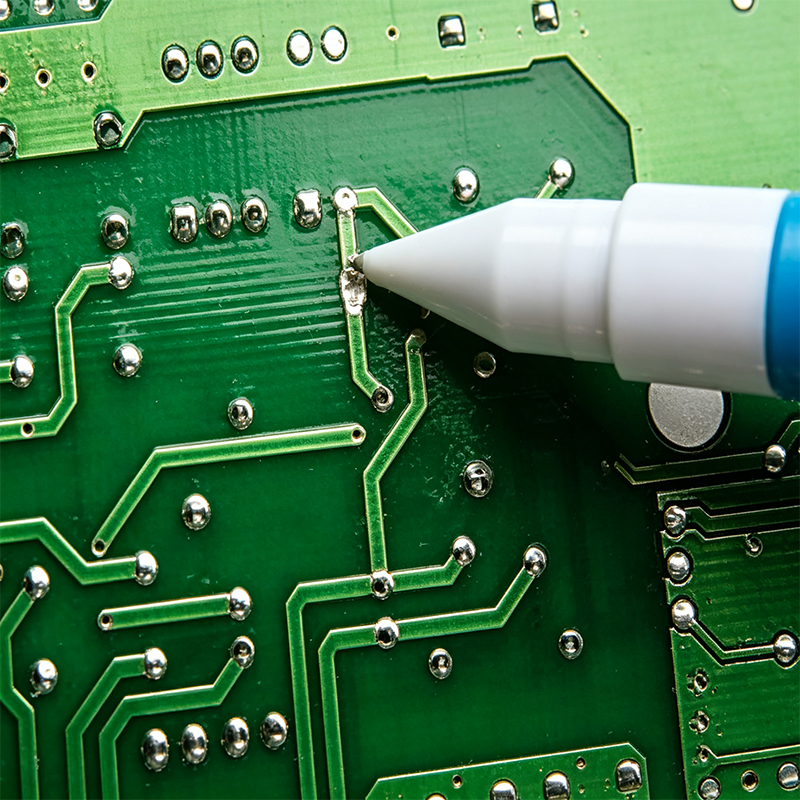
Method 3: Conductive pen – If you have a silver or carbon conductive pen, you can simply “draw” a new trace over the gap. Let it dry according to the instructions. This is easy but less durable than soldering. Good for low‑current, low‑vibration applications.
Method 4: Copper tape – Cut a tiny strip of copper tape (the kind used for EMI shielding or crafts). Solder it across the gap like a jumper wire. This works well for wide traces.
Step 4: Clean and Test
After your repair:
Clean off excess flux – Use isopropyl alcohol and a small brush.
Test continuity again – Touch your multimeter probes to both ends of the repaired trace. It should beep.
If possible, power up the board – See if the device works. If not, double‑check your repair or look for additional breaks.
Special Cases: Fixing Traces on Different Board Types
Flexible PCB traces – Flex boards (the orange, bendy ones) are trickier. The material is polyimide, which is tough but can melt if you overheat. Use a lower soldering iron temperature (about 300°C). Use flexible wire (stranded) for the jumper, not solid wire. After repair, reinforce with a dab of flexible epoxy or a piece of Kapton tape to prevent the same spot from breaking again.
High‑density (HDI) boards – Traces are extremely fine. A soldering iron may be too big. Use a conductive pen or a very fine soldering tip. Sometimes the best fix is to bypass the trace entirely by running a wire from component pin to component pin.
Trace near a connector or edge – These areas see more mechanical stress. After soldering a jumper, add a drop of epoxy or hot glue to relieve strain on the repair.
What If You Can’t Find the Break?
Sometimes the break is under a chip or inside a via. You can’t get to it without removing components. In that case:
Bypass the whole segment – Run a wire from the component pin on one side of the break to the component pin on the other side, bypassing the hidden break entirely.
Use a scraped trace – If you know roughly where the trace goes, you can scrape the solder mask at two accessible points along the trace and solder a jumper between them, effectively bypassing the hidden break.
How to Prevent Broken Traces in the Future
Handle boards carefully – Don’t bend rigid boards. Don’t scratch them with metal tools.
Avoid excessive heat – Use a temperature‑controlled iron. Don’t linger on the same spot.
Add strain relief – For connectors and cables, use glue or clamps so movement doesn’t transfer to the board.
Use flexible PCBs properly – Follow the manufacturer’s minimum bend radius. Add stiffeners where needed.
Conformal coating – A thin protective layer can reduce corrosion and physical damage.
When Is It Not Worth Fixing a Trace?
The board is extremely cheap (like a $5 power supply). Just replace it.
Multiple traces are broken in a dense area. You’ll spend hours with low chance of success.
The board is water‑damaged or heavily corroded. Even if you fix one trace, others will fail soon.
The break is under a large BGA or QFP chip. Removing the chip is difficult and risky.
A Real‑World Example: The Dead Keyboard
A friend’s mechanical keyboard stopped registering the “E” key. He opened it up and saw a faint scratch across a trace leading to that switch. He scraped the solder mask off on both sides of the scratch, tinned the exposed copper, and soldered a tiny piece of wire across the gap. The “E” worked again. Total repair time: 10 minutes. Cost: a few cents for a piece of scrap wire.
Final Answer – How to Fix a Circuit Board Trace
To fix a broken circuit board trace:
Find the break – Use a magnifier and a multimeter continuity test.
Prepare the area – Scrape off solder mask to expose clean copper on both sides. Apply flux.
Repair – Solder a jumper wire across the gap, use a conductive pen, or (for small gaps) a solder bridge.
Clean and test – Remove excess flux and verify continuity with a multimeter. Then test the device.
Most trace repairs are simple and take less than 15 minutes. You don’t need to be a professional. With a steady hand and a little patience, you can bring many dead boards back to life.

Kaboer manufacturing PCBs since 2009. Professional technology and high-precision Printed Circuit Boards involved in Medical, IOT, UAV, Aviation, Automotive, Aerospace, Industrial Control, Artificial Intelligence, Consumer Electronics etc..


 English



 Wechat
 +86 13670210335
 +86 13670210335
 E-mail