
Date: 2026-01-16
You might be looking for a solution to make circuits "disappear" inside your device. Whether it's for cool LED lighting effects, unique industrial design, or certain functions that must transmit light, traditional green or black circuit boards just won't work. That's when "transparent circuit boards" become an exciting yet confusing option—they sound like future tech, but also raise concerns about cost, reliability, and manufacturing difficulty.
Let's clarify what transparent circuit boards really are and whether they're right for your next project.
First, let's be clear: transparent circuit boards aren't just regular boards with the green solder mask removed. That would only expose the copper traces, which aren't transparent at all. Real transparent circuit boards use completely different material systems. There are three main technical approaches:
This is like "drawing" circuits on a piece of glass. The most common transparent conductive material is ITO (Indium Tin Oxide)—the same material on your smartphone touchscreen. Circuits are patterned onto glass through photolithography or laser etching.
Advantages:
Extremely high transparency (can exceed 90%)
Perfectly flat surface
Good stability and high-temperature resistance
Disadvantages:
Glass is fragile and requires careful handling
Multilayer boards are difficult or impossible
Higher cost
Typical Applications: Integrated lighting for high-end display cases, backlit automotive console panels, special instrument windows for laboratories.
Using transparent plastics like PMMA (acrylic) or PC (polycarbonate) as substrates, with circuits "printed" using silver nanowires, conductive polymers, or special transparent conductive inks.
Advantages:
Lightweight with some flexibility
Can be formed into curved shapes
Relatively controllable cost
Disadvantages:
Poor heat resistance requires low-temperature soldering
Potential aging issues with long-term use
Conductivity inferior to traditional copper traces
Typical Applications: Smart home control panels, decorative circuits for wearables, interactive display installations.
This is the most practical and common approach. Use transparent materials only in areas that need transparency, while the rest uses traditional PCB technology, then combine both.
Advantages:
Balances functionality, cost, and reliability
Leverages mature PCB processes
Offers greater design freedom
Disadvantages:
Visible joints between materials may affect aesthetics
Requires precise assembly techniques
Typical Applications: Instrument panels with transparent viewing windows, switch panels with integrated indicator lights.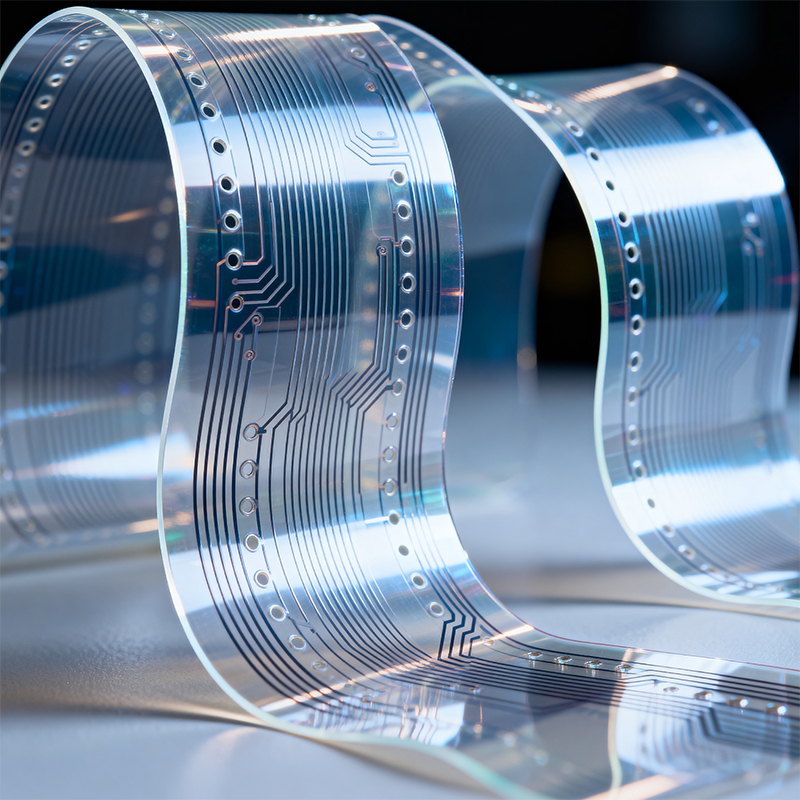
Before diving into technical details, clarify your real needs:
Is transparency a functional requirement or an aesthetic one?
If functional (e.g., must see through for observation), transparency is a hard requirement
If aesthetic (e.g., making circuits part of the design), there may be many alternatives
What kind of electrical signals need to be carried?
Just simple power and low-speed signals? Transparent materials might suffice
Need to transmit high-speed data or RF signals? This could be challenging
What's the operating environment?
Indoor, mild conditions? Most materials can handle this
High temperature, humidity, or outdoor use? Material and process selection requires caution
What's your expected production volume?
Small batch prototypes? Consider manual fabrication or outsourcing
Mass production? Must evaluate supply chain and costs carefully
What's your budget?
Transparent circuit boards typically cost 3-10 times more than traditional PCBs. Does this fit your project budget?
Transparent conductive materials have much higher resistivity than copper. ITO typically has sheet resistance of 10-100 ohms/square, while copper foil's is negligible. This means:
Not suitable for high-current applications
Significant signal attenuation over longer distances
Limited high-frequency performance
Solutions:
Keep transparent trace lengths as short as possible
Increase trace width to reduce resistance
Use fine copper wires embedded in transparent layers for critical sections (hybrid design)
Soldering components onto glass or plastic requires special processes:
For glass substrates:
Use low-temperature solder (like indium-based alloys)
Employ conductive adhesives
May need special fixtures to prevent thermal stress cracking
For plastic substrates:
Strictly control soldering temperature and duration
Consider using connectors instead of direct soldering
May require pre-embedded solder pads
Transparent materials can be more fragile or prone to aging:
Glass is impact-sensitive
Plastics are susceptible to scratching and UV damage
Transparent conductive layers may degrade from bending or moisture
Solutions:
Add protective coatings (like hard coatings)
Incorporate mechanical support in the design
Conduct rigorous environmental testing
Transparent circuit boards are harder to test and repair:
Traditional test probes may slip or damage surfaces
Heating during repair may affect transparent materials
Fault points are harder to locate visually
Recommendations:
Design in additional test points
Prepare specialized test fixtures
Consider modular design for easier replacement
Understanding cost breakdown can help optimize your design:
Material Costs (40-60%):
Specialty glass or optical-grade plastics
ITO targets or specialty conductive inks
Specialized adhesives and protective coatings
Processing Costs (30-50%):
Cleanroom environment requirements
Precision laser processing or photolithography equipment
Special lamination and curing processes
Equipment amortization for low volumes
Design & Engineering Costs (10-20%):
Special DFM (Design for Manufacturability) analysis
Process development and validation
Test program development
Cost Reduction Possibilities:
Reduce transparent area size
Use hybrid designs
Choose more mature technology paths
Collaborate early with suppliers to optimize processes
If your main goal is aesthetic effect, consider these alternatives:
1. Semi-Transparent Effects
Traditional PCBs with light-colored or semi-transparent solder mask, combined with careful layout, can create a "hint of circuitry" aesthetic, costing only 10-20% more.
2. Selective Windows
Create openings in specific areas of traditional PCBs (like around LEDs) to expose the copper below, then cover with transparent or translucent housings for similar effects.
3. 3D Printed Circuits
For some non-critical applications, 3D printed transparent structures with embedded conductive traces offer another innovative approach.
We've handled some transparent circuit board projects and have gained practical insights:
About Technology Selection:
For most clients, we typically recommend starting with "hybrid designs." For example, a smart mirror project only needed transparent circuits along the edges for LED drivers. We suggested using traditional PCB for the main body and only glass substrates for the lighting sections, reducing costs by 60%.
About Supplier Management:
The supply chain for transparent circuit boards is completely different from traditional PCBs. We recommend clients audit at least two material suppliers and ensure they have stable quality control and backup sources.
About Design Iterations:
Transparent circuit board designs often require more iterations. One client's project went through 7 design revisions from concept to mass production. Allowing sufficient development time and budget is crucial.
About Quality Control:
We've established specialized inspection standards for transparent boards, including light transmittance tests, conductive layer adhesion tests, and targeted environmental reliability tests. This upfront investment prevents batch issues later.
If you decide to proceed, we recommend these steps:
Proof of Concept Phase (1-2 weeks)
Create the simplest functional sample
Test basic electrical and optical performance
Assess process feasibility
Design Optimization Phase (2-4 weeks)
Discuss design options in depth with manufacturers
Create prototypes close to the final version
Conduct comprehensive reliability testing
Small Batch Trial Production (3-6 weeks)
Produce 50-100 trial units
Verify production process stability
Gather real-world usage feedback
Mass Production Preparation (4-8 weeks)
Optimize production processes
Establish quality control systems
Prepare for volume manufacturing
Transparent circuit boards represent a fascinating technological field that can make products stand out. But they're not a universal solution—they're better suited for products where transparency is core to the value proposition, not just for "looking cool."
If you're considering this direction, the most important things are an open mind and a practical attitude. Start by clarifying requirements, understand the pros and cons of various options, and validate feasibility step by step. Sometimes, the simplest solution turns out to be the most effective.
Whether your project ultimately uses transparent circuit boards or not, understanding this technology's possibilities and limitations will make you a better product designer and decision-maker.

Kaboer manufacturing PCBs since 2009. Professional technology and high-precision Printed Circuit Boards involved in Medical, IOT, UAV, Aviation, Automotive, Aerospace, Industrial Control, Artificial Intelligence, Consumer Electronics etc..


 English



 Wechat
 +86 13670210335
 +86 13670210335
 E-mail