
Date: 2026-01-16
When you search for "bare circuit board," you might be looking for a PCB supplier for a new product or trying to understand why the same design gets wildly different quotes from different factories. Perhaps you're selecting a PCB supplier for a critical project and want to know how to avoid pitfalls that affect yield. Whatever your specific need, understanding the basics of bare boards will help you make smarter decisions throughout the PCBA process.
Simply put, a bare board is a printed circuit board that has completed all circuit fabrication but hasn't had any electronic components installed yet. Think of it like a wall before painting—the structure and electrical conduits are in place, but switches, outlets, and lights haven't been installed.
A complete bare board typically includes:
Insulating substrate (most commonly FR-4)
Circuit patterns formed by copper foil
Drilled holes (for component leads and interlayer connections)
Surface finish (protects copper and ensures solderability)
Silkscreen markings (component placement and orientation)
Solder mask (prevents solder shorts)
Design Validation Phase:
When a factory receives your Gerber files, the first step is a DFM (Design for Manufacturability) check. A responsible manufacturer will check if trace widths and spacings match their process capabilities, if pad designs are reasonable, if drill holes are too close to board edges, etc. Solving problems at this stage costs far less than discovering them on the production line.
Material Selection and Preparation:
Just as baking different pastries requires different flours, different applications need different substrates:
Standard consumer electronics typically use basic FR-4
High-frequency applications need low-loss materials (like Rogers, Taconic)
High-reliability products may require high-Tg (glass transition temperature) materials
Flexible circuits use polyimide film
Pattern Transfer Process:
This is the key step that "prints" the circuits. Factories use photolithography to transfer your circuit design onto copper-clad laminate. The process is somewhat like old film photography—through exposure and development, the design pattern is transferred to photosensitive material, then unwanted copper is etched away.
Drilling and Hole Metallization:
After drilling those tiny holes (some finer than a human hair), copper needs to be deposited on the hole walls to create electrical connections between layers. The quality of this step directly affects multilayer board reliability. Rough hole walls or insufficient copper thickness can lead to future failures.
Surface Finish Selection:
Different surface finishes suit different applications:
HASL: Lowest cost, but limited flatness
ENIG: Flat surface, good for fine-pitch components
Immersion Silver: Good electrical performance but may oxidize over time
OSP: Most environmentally friendly but has limited shelf life
Quality Testing and Verification:
Every bare board must be tested before shipping. Basic electrical testing ensures no opens or shorts. For complex or high-reliability products, additional tests like impedance testing or thermal shock testing may be needed.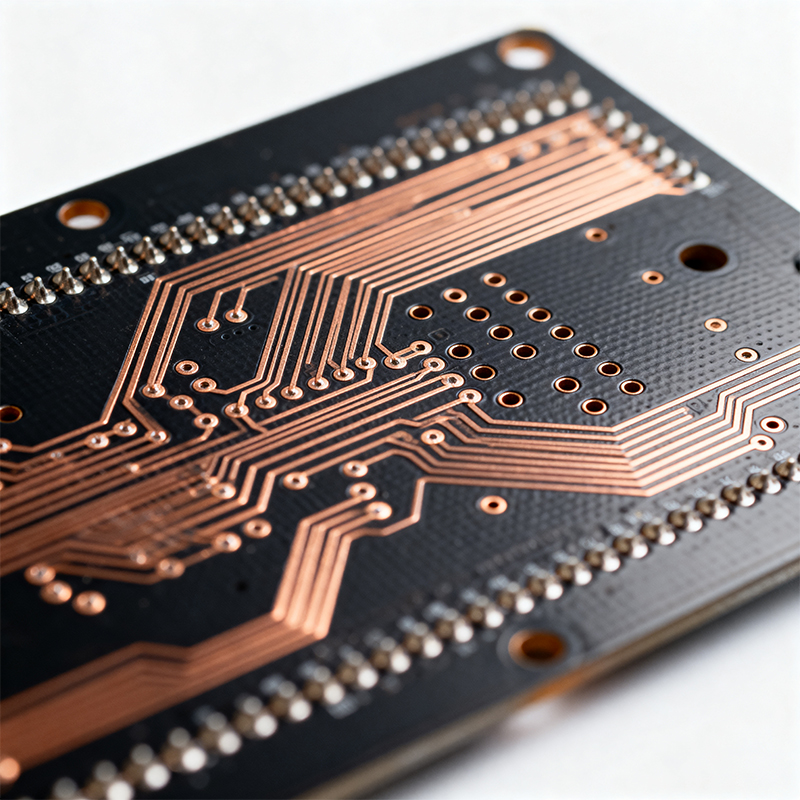
Single-sided: Most basic type, only one copper layer, lowest cost
Double-sided: Copper on both sides, connected by vias, most common choice
Multilayer: Four layers or more, for complex circuit designs
Rigid boards: Most common type, maintain fixed shape
Flexible boards: Can bend, for space-constrained or wearable devices
Rigid-flex boards: Part rigid, part flexible, combining both advantages
Heavy copper boards: For high-current applications
High-frequency boards: For RF and high-speed digital circuits
Metal-core boards: For applications with extreme heat dissipation needs
Impedance control accuracy: Critical for high-speed signals, typically requiring ±10% control
Insulation resistance: Ensures no leakage between different nets
Voltage withstand capability: Prevents high-voltage breakdown
Dimensional accuracy: Especially hole positions and board edge accuracy, affecting assembly
Surface flatness: Affects soldering of fine-pitch components
Hole wall quality: Copper thickness and uniformity in holes
Thermal shock resistance: Ability to withstand reflow temperature changes
Chemical resistance: Resistance to flux and cleaner erosion
Peel strength: Bond strength between copper foil and substrate
A professional bare board specification should include:
Material Specifications:
Substrate type, brand, and model
Copper thickness (typically in ounces, e.g., 1oz = 35μm)
Solder mask and silkscreen ink types
Process Parameters:
Minimum trace width/clearance
Minimum hole size and annular ring
Layer-to-layer registration tolerance
Board thickness and tolerance
Surface Finish:
Finish type and thickness
Storage conditions and shelf life
Testing Standards:
Electrical test coverage (100% or sampling)
IPC standard class adopted (Class 1, 2, or 3)
Special test requirements (like impedance testing)
Answer: Price differences may come from:
Material quality differences (imported vs. domestic, well-known brands vs. generic)
Different process capabilities (affecting yield and final quality)
Different testing standard strictness
Factory operating costs and management efficiency
Class 1: General consumer electronics, allows more cosmetic imperfections
Class 2: Standard for most industrial, automotive, and communications equipment
Class 3: High-reliability products like medical, aerospace, military applications
This depends on the factory's focus. Prototype-focused factories may accept small orders of 5-10 pieces, while mass-production-focused factories may require at least 100 pieces or more. Some factories charge engineering fees or premiums for small orders.
Standard lead times are typically:
Single/double-sided: 5-10 working days
4-layer: 7-14 working days
Complex multilayer: 2-4 weeks
Expedited services are usually possible but increase costs and may affect quality
Review the factory's actual process capability chart
Request a facility tour or at least provide videos/photos
Ask what types of boards they specialize in producing
Understand their quality control processes
Ask about defective product handling procedures
Review testing equipment and personnel qualifications
Is initial communication professional and timely?
Do they proactively ask questions or suggest improvements?
Are their quotations detailed and transparent?
If possible, place a small sample order first
Check the sample's process details
Test key performance parameters
Choose standard materials when performance requirements permit
Avoid unnecessary special processes
Consider panel utilization to reduce material waste
Plan order quantities reasonably to balance MOQ and inventory
Choose standard lead times over expedited ones
Consider establishing long-term relationships with factories for better pricing
Choose appropriate test coverage based on product importance
For mature products, consider sampling rather than 100% testing
Discuss test cost optimization options with suppliers
More environmentally friendly halogen-free materials
Higher performance high-frequency materials
Better thermal conductivity materials
Finer trace widths and clearances (moving below 30μm)
More advanced drilling technologies (like laser drilling)
More environmentally friendly surface finishes
More automated inspection equipment
Data-driven process optimization
More traceable production processes
Involve suppliers early in the design: Consult on manufacturability suggestions before finishing layout to avoid many subsequent issues
Clarify your priorities: Is cost, quality, or lead time most important? Different priorities lead to different choices
Build long-term relationships: Establishing stable cooperation with trusted suppliers often brings better overall benefits than constantly searching for the lowest-priced supplier
Keep learning: PCB technology continues to evolve; stay informed about new technologies, materials, and processes
While bare boards are just one component of electronic products, they carry all electrical connections and form the foundation of product reliability. Investing time in understanding bare boards will pay off at every stage of product development.

Kaboer manufacturing PCBs since 2009. Professional technology and high-precision Printed Circuit Boards involved in Medical, IOT, UAV, Aviation, Automotive, Aerospace, Industrial Control, Artificial Intelligence, Consumer Electronics etc..


 English



 Wechat
 +86 13670210335
 +86 13670210335
 E-mail