
Date: 2026-04-29
You press the power button, and... nothing happens. No lights, no buzzing, no life. In the world of electronics, this frustrating silence usually means one thing: you’ve got an open circuit.
But what does that actually mean? Is it broken? Is it dangerous? Let’s strip away the jargon and look at how electricity actually moves (or stops).
Imagine you are driving on a highway, and you need to cross a bridge to get home. If a section of that bridge is missing, you're stuck. No matter how fast your car is, you aren't getting to the other side.
In electronics, an open circuit is exactly that—a broken bridge. Electricity (the "cars") wants to flow from the power source, through your device, and back to the source. If there is a gap anywhere in that loop, the "cars" stop. The loop is broken, and the electricity simply sits there, unable to move.
To understand "open," you have to know "closed."
Closed Circuit: The loop is perfect. The switch is on, the wires are connected, and the electrons are happily dancing through the circuit. Your light bulb glows.
Open Circuit: The path is interrupted. This could be intentional (like when you flip a light switch to "off") or accidental (like a wire that snapped inside your charger).
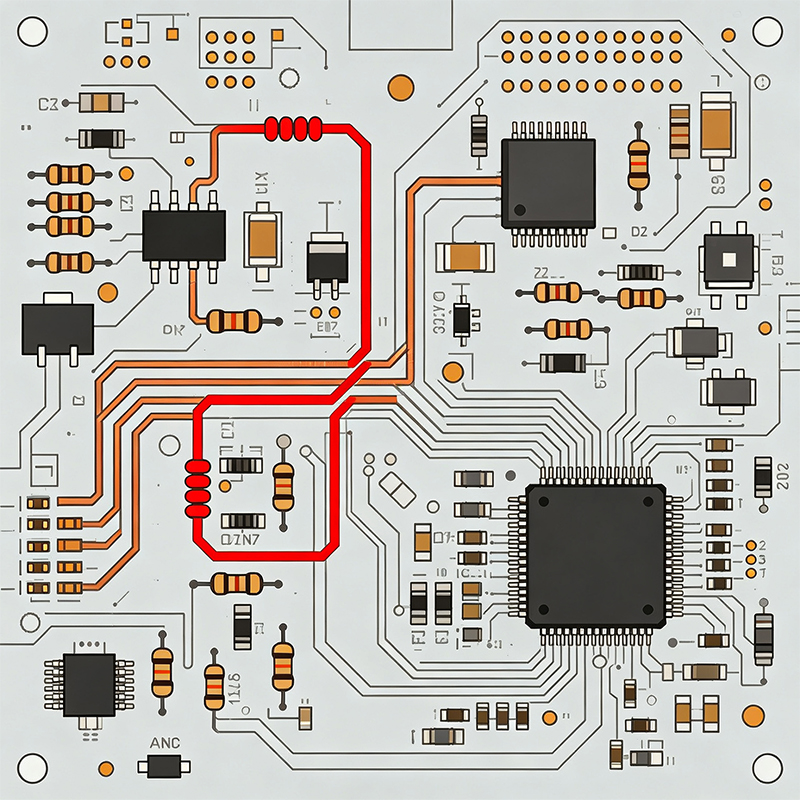
If you're dealing with a device that suddenly died, the "open" part of your circuit is usually hiding in one of these spots:
A Blown Fuse: This is actually an intentional open circuit. The fuse "sacrifices" itself by breaking the path to protect your device from too much power.
Bad Solder Joints: This is a classic in the manufacturing world. A "cold solder joint" might look connected, but microscopically, there’s a tiny gap that blocks the electricity.
Broken Traces on a PCB: On high-tech boards (like HDI or Rigid-Flex boards), the copper paths are so thin that a tiny scratch or too much bending can cause a hairline fracture.
Loose Wires: Sometimes, it's just a plug that isn't pushed in all the way.
You can't usually see an open circuit with your eyes because electricity is invisible. That’s where a multimeter comes in. Engineers use the "Continuity Setting" (the one that beeps). You touch the two ends of a wire with the probes. If it beeps, the bridge is solid. If it’s dead silent? You’ve found your open circuit.
Unlike a short circuit (which can cause sparks and fires because too much energy flows too fast), an open circuit is generally safe because nothing is happening. However, the voltage is still waiting at the "edge" of that gap. If you touch the wrong thing while trying to fix it, you might become the "bridge" yourself—which is definitely not a good idea!

Kaboer manufacturing PCBs since 2009. Professional technology and high-precision Printed Circuit Boards involved in Medical, IOT, UAV, Aviation, Automotive, Aerospace, Industrial Control, Artificial Intelligence, Consumer Electronics etc..


 English



 Wechat
 +86 13670210335
 +86 13670210335
 E-mail