
Date: 2026-04-29
If you’ve ever opened up a high-end gadget, you’ve probably seen thousands of microscopic components perfectly aligned on a circuit board. How do they stay there during manufacturing? They aren't held by magic—they are held by soldering paste.
But if you’re asking, "what is soldering paste for?" you’re likely realizing it’s a bit more complex than the silver wire your grandpa used to fix the radio.
Think of soldering paste as a high-tech "peanut butter." It’s a thick, grey cream that is actually a mixture of two main things:
Tiny Solder Balls: Thousands of microscopic beads of metal (usually a mix of tin, silver, or lead).
Flux: A chemical cleaning agent that looks like jelly.
The flux cleans the metal surfaces so the solder can actually "stick." Without it, oxygen creates a layer of "crust" (oxidation) that makes soldering impossible.
This is the number one question beginners ask. Imagine trying to solder a chip the size of a grain of rice with a thick soldering iron and a roll of wire. It’s like trying to do surgery with a butter knife.Soldering paste is designed for precision. It allows you to apply the exact amount of "glue" to a hundred tiny pads at once using a stencil. It’s about speed and microscopic accuracy.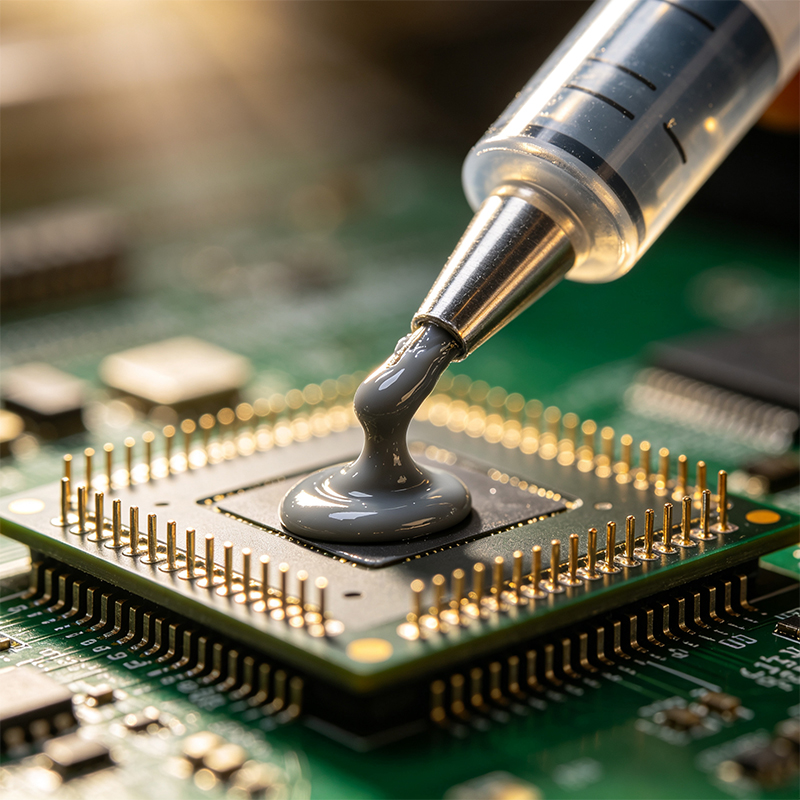
The "magic" happens in two stages:
The Tacky Stage: When you first apply the paste, it’s sticky. This is crucial because it holds the tiny components in place so they don't blow away or shift before they are permanently welded.
The Reflow Stage: You put the whole board into an oven (reflow oven). The heat melts the tiny balls, the flux boils away after cleaning the metal, and suddenly, you have perfect, shiny solid joints.
In modern manufacturing (called SMT or Surface Mount Technology), we don't poke wires through holes anymore. We lay components flat on the surface. Soldering paste is the "bridge" that makes this possible. Without it, your smartphone would be the size of a brick because we couldn't pack the parts so close together.
Believe it or not, soldering paste is a bit of a diva. It needs to be kept in the fridge. If it gets too warm, the flux separates from the metal balls, and you’ll end up with a mess of "solder balls" or "tombstoning" (where a component stands up on one end like a tiny grave).

Kaboer manufacturing PCBs since 2009. Professional technology and high-precision Printed Circuit Boards involved in Medical, IOT, UAV, Aviation, Automotive, Aerospace, Industrial Control, Artificial Intelligence, Consumer Electronics etc..


 English



 Wechat
 +86 13670210335
 +86 13670210335
 E-mail