
Date: 2026-01-03
If you’ve been involved in cross-border electronics trade, you’ve likely encountered the term HTS Code (Harmonized Tariff Schedule) or its close cousin, HS Code (Harmonized System Code). In simple terms, it’s a globally standardized “product ID number” used by customs authorities worldwide to identify goods, calculate import duties, and track trade statistics.
This code directly impacts:
How much duty you pay: Different codes carry different tariff rates.
Whether your shipment clears customs smoothly: An incorrect code can lead to seizures, fines, and delays.
Your logistics costs: Certain codes may be subject to quotas or additional regulatory requirements.
There isn’t a single, exclusive code for PCBA boards in the HS system. The correct classification depends on the board’s function, composition, and technical characteristics. Here are the most common relevant codes and when they might apply:
1. The Most Common Code (for bare boards): 8534.00.00
This is the code for “Printed Circuits.” It applies to bare, unpopulated PCB boards. If your board is already assembled with components, you typically should NOT use this code.
2. The Go-To Codes for Assembled PCBA: 8542.31.00 / 8542.32.00
These are the codes you’re usually looking for when shipping assembled PCBAs. Here’s the breakdown:
8542.31.00: “Printed circuit assemblies, fitted with integrated circuits (ICs).” If your PCBA has any chips (microcontrollers, memory, logic ICs, etc.), this is most likely the correct code in the vast majority of cases.
8542.32.00: “Printed circuit assemblies, fitted with electronic components other than integrated circuits.” If, hypothetically, the board only has passive components like resistors, capacitors, and inductors (rare for a functional PCBA), it might fall here.
3. Classification by Function: e.g., 8517.62.00, etc.
If the PCBA is a complete, self-contained functional module (e.g., a defined communication module or power control module), it might sometimes be classified elsewhere based on its principal function. This requires very professional and careful judgment.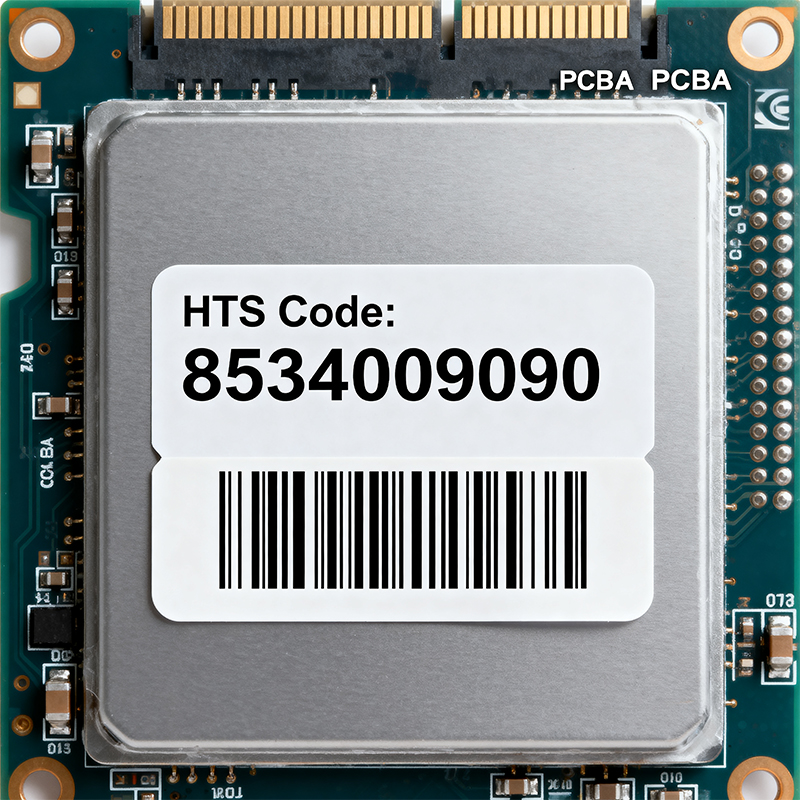
“This seems too complicated” – Here’s a simple starting point.
If you’re unsure, a relatively safe first step is: determine if your PCBA contains any Integrated Circuits (ICs/chips). If yes, 8542.31.00 is usually the correct starting point. But remember, this is just the starting point; final determination requires more details.
A few common pitfalls to avoid:
Don’t rely on product names: Customs classification is based on the physical composition and technical function, not marketing names.
Distinguish between “parts” and “assemblies”: Individual components for repair/replacement (like a standalone chip or resistor) have their own codes, different from an assembled PCBA.
“Unassembled” vs. “Assembled” matters: The tariff and regulations for a bare PCB (8534.00.00) and an assembled PCBA (8542 series) can be completely different. Getting this wrong causes headaches.
Technical details are decisive: Sometimes, details like whether the board has a programmed memory chip or includes connectors can affect the final classification.
Professional advice is key: This article provides general information only. Always consult with a licensed customs broker, freight forwarder, or your local customs authority for the definitive classification of your specific goods. They have access to the latest rulings and local interpretations.
Prepare detailed product information: Provide your broker with clear photos, a BOM list, a schematic, or a functional description to help them make an accurate call.
Check destination country requirements: Interpretations and regulations for the same goods can vary between countries. Verify the specific requirements of the destination country before shipping.
Document and verify: Once you determine a code for a product, document it and try to be consistent for future shipments of identical items. If in serious doubt, you can apply to customs for a Binding Ruling (Advance Ruling) in many jurisdictions.
As a PCBA manufacturer based in Shenzhen, Kaboer has gathered some experience assisting clients with export documentation. We generally advise clients to work closely with their freight forwarders to ensure all paperwork is accurate. If you have any technical questions about the PCBA itself that might help your broker understand the product better, we are happy to assist.
This guide is compiled by Kaboer (a PCBA manufacturing factory in Shenzhen) based on common industry experience for informational purposes only. It does not constitute professional customs classification advice. The final decision rests with the relevant customs authorities.

Kaboer manufacturing PCBs since 2009. Professional technology and high-precision Printed Circuit Boards involved in Medical, IOT, UAV, Aviation, Automotive, Aerospace, Industrial Control, Artificial Intelligence, Consumer Electronics etc..


 English



 Wechat
 +86 13670210335
 +86 13670210335
 E-mail