
Date: 2026-06-09
If you’ve ever looked closely at an old‑school computer motherboard, a hobby electronics kit, or even a classic arcade game board, you’ve probably noticed those small, black, rectangular chips with two parallel rows of metal legs sticking out. That, my friend, is a DIP package – short for Dual In‑line Package.
In this guide, I’ll walk you through everything you need to know about DIP packages: what they are, how they work, why they were (and still are) so popular, and where you can find them today. No engineering degree required – just plain, everyday language.
Let’s start with the basics. A DIP package is a way to physically package an integrated circuit (IC) – like a microcontroller, memory chip, or logic gate – so that it can be easily handled, soldered onto a circuit board, or plugged into a socket.
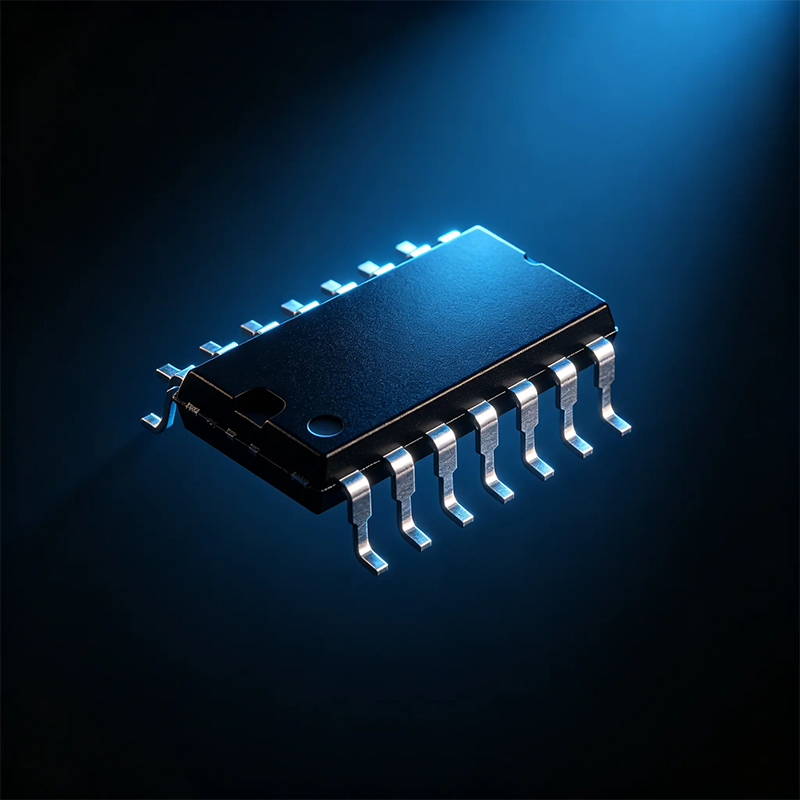
Imagine a tiny silicon brain (the chip itself) sealed inside a black plastic or ceramic body. Along the two long sides of that body, you’ll see a row of metal pins – usually 8, 14, 16, 20, 24, or 40 pins in total, with the same number on each side. Those pins are spaced 0.1 inches (2.54 mm) apart, which has become a standard that’s been around for decades.
The term “dual in‑line” simply means “two straight lines” – the pins are arranged in two parallel rows. And that’s it. Simple, right?
Back in the 1970s and 1980s, DIP was the king of chip packaging. Before DIP, connecting a chip to a circuit board was clumsy – you had wires sticking out in all directions, or you needed special tools. Then came the DIP.
Because the pins are spaced exactly 0.1 inches apart, engineers could design circuit boards with matching holes (called “through‑holes”) and solder the chip directly, or use a DIP socket – a plastic holder that you solder onto the board first, then just snap the chip in. No heat damage to the chip, and you could easily replace it if it broke.
That socket‑friendly feature made DIP packages a hit for hobbyists, educators, and repair technicians. You could swap out a bad chip in seconds.
Also, DIP chips are through‑hole components – meaning their pins go all the way through the board and are soldered on the other side. That creates a very strong mechanical bond, so they’re great for devices that might get bumped or vibrated.
Let me paint you a mental picture – or you can think of the classic 555 timer or Op‑amp chips.
Body shape: Rectangular, usually black plastic (sometimes ceramic, which is more expensive and used for high‑reliability or military applications).
Pins: Two rows of metal legs that bend down slightly, like a tiny centipede.
Pin 1 marker: A small dot or notch at one end of the chip tells you which pin is number 1 – crucial for putting it in the right orientation.
Text on top: Usually a part number, manufacturer logo, and sometimes a date code.
Most DIP chips are 0.3 to 0.6 inches wide and between 0.2 and 2 inches long, depending on the pin count. The body is thin – about 0.15 inches thick, not counting the pins.
Not all DIPs are identical. Here are a few common variations you might run into:
| Type | Full Name | What’s Different |
|---|---|---|
| PDIP | Plastic Dual In‑line Package | Most common, cheap, black plastic body. |
| CDIP | Ceramic Dual In‑line Package | White or gray ceramic body, better heat dissipation, used in space or military gear. |
| Skinny DIP | Narrow DIP | Same pin count but narrower body – useful for tight spaces. |
| SDIP | Shrink DIP | Pins closer together (1.778 mm pitch instead of 2.54 mm) – less common today. |
For everyday electronics, you’ll almost always see PDIP.
Even though modern smartphones and laptops use tiny surface‑mount chips (like SOIC, QFP, or BGA), DIP packages haven’t disappeared. They’ve just moved to places where ease of use and durability matter more than super‑small size.
Here’s where you still see them:
Breadboards – That white plastic board with rows of holes? It’s designed specifically for DIP chips. Perfect for prototyping and learning electronics.
Through‑hole soldering kits – Think of hobby clocks, digital thermometers, or DIY synthesizers. DIP chips are much easier for beginners to solder by hand.
Repair and retro computing – Old arcade machines, vintage computers (Commodore 64, Apple II), and industrial controllers often have DIP chips that can be easily replaced.
Educational labs – Universities and schools use DIP chips in their courses because students can plug them into sockets and measure signals with oscilloscopes without special tools.
Automotive and industrial modules – Some modules still use DIP chips for their strong mechanical grip and easy field replacement.
Let’s be honest – every packaging style has its strengths and weaknesses.
Easy to hand‑solder – Even a beginner with a cheap soldering iron can solder a DIP chip.
Socketable – You can plug them into zero‑insertion‑force (ZIF) sockets or standard DIP sockets, making replacement a breeze.
Robust – The through‑hole pins hold the chip firmly on the board, resistant to vibration and bending.
Breadboard friendly – The 0.1‑inch pin spacing matches the standard breadboard grid.
Still widely available – You can buy classic chips (555, 7400 series logic, op‑amps, microcontrollers like ATmega328P) in DIP form from major distributors.
Large footprint – Compared to surface‑mount packages, DIP chips take up a lot of board space.
Limited pin count – Most DIPs max out at 40 or 64 pins. For modern processors with hundreds of pins, DIP is impossible.
Poor high‑frequency performance – The long leads act like tiny antennas, so DIP packages are terrible for radio‑frequency (RF) or high‑speed digital circuits.
Harder to automate – Surface‑mount boards are assembled much faster by pick‑and‑place machines. Through‑hole assembly is slower and more expensive.
To help you see the big picture, here’s how DIP stacks up against common alternatives:
| Feature | DIP | SOIC (Surface‑Mount) | QFP | BGA |
|---|---|---|---|---|
| Hand‑soldering | Easy | Moderate | Hard | Nearly impossible |
| Socketable | Yes | No | No | No |
| Board space | Large | Medium | Small | Very small |
| Pin count | ≤ 64 | ≤ 44 | ≤ 300+ | ≤ 1000+ |
| Best for | Learning, repairs, prototyping | Mass production, compact devices | High‑density, high‑speed | Ultra‑high‑density |
For a hobbyist or student, DIP is still the most beginner‑friendly option.
You might already know some of these:
NE555 – The classic timer chip.
LM358 / LM324 – Operational amplifiers.
ATmega328P – The brain of Arduino Uno (many kits still use the DIP version).
74HC00 series – Logic gates (AND, OR, NOT, etc.).
MAX232 – RS‑232 serial communication driver.
PIC16F84A – Early PIC microcontroller.
EEPROM chips like 28C64 – For retro computer builds.
If you’re just getting started with electronics, here are some practical tips:
Always check pin 1 orientation – Look for the dot or notch. Inserting a DIP backwards can fry the chip.
Use a DIP socket – Especially if you’re prototyping. Solder the socket to your board, then plug the chip in. That way you can reuse the chip or replace it without desoldering.
Buy a cheap DIP extractor – A small plastic tool that grips both ends of the chip to pull it straight out of a socket without bending pins.
Breadboard first – Test your circuit on a breadboard with a DIP chip before soldering anything.
For high‑speed or RF circuits, avoid DIP – Use surface‑mount breakout boards instead.
No, not at all. While you won’t find DIP chips inside your iPhone or laptop, they are far from dead. Think of them like vinyl records – not the mainstream choice anymore, but still beloved and widely used in certain communities.
Every year, millions of DIP chips are sold for education, prototyping, repair, and industrial control. In fact, many semiconductor companies continue to produce classic DIP chips because the demand is steady.
So, if you’re learning electronics, repairing an old game console, or building a DIY project, the DIP package is still your reliable, friendly friend.
The DIP package may be old – over 50 years old, actually – but it’s not going away anytime soon. Its simplicity, durability, and ease of use make it perfect for beginners, educators, and anyone who enjoys tinkering with hardware.
Next time you see a black rectangular chip with two rows of legs, you’ll know exactly what it is: a Dual In‑line Package – a true classic in the world of electronics.
Happy soldering!

Kaboer manufacturing PCBs since 2009. Professional technology and high-precision Printed Circuit Boards involved in Medical, IOT, UAV, Aviation, Automotive, Aerospace, Industrial Control, Artificial Intelligence, Consumer Electronics etc..


 English



 Wechat
 +86 13670210335
 +86 13670210335
 E-mail