
Date: 2026-08-01
You've definitely seen them in a hospital. The patient monitor with waveforms displaying heartbeat and respiration. The complex equipment in an operating room with probes, electrodes, and sensors connected by cables. These seemingly ordinary cables are medical wire harnesses.
A medical wire harness is a specialized cable assembly used in medical devices to transmit power, signals, and data. Without wire harnesses, medical electronic devices simply cannot function.
In this guide, I'll explain what medical wire harnesses are, where they're used, what special requirements they must meet, and how to choose a reliable supplier. Plain English, no fluff.
A medical wire harness is a connecting cable product used in medical devices and medical equipment. It consists of multiple wires, optical fibers, and sensors bundled together with insulating materials, with connectors on both ends, transmitting power, signals, and data between different modules of a device.
Think of it this way: a medical wire harness is the "blood vessels and nerves" of medical equipment. It delivers power to every module, carries sensor signals back to the processor, and transmits the doctor's commands to the actuators.
The biggest difference between medical wire harnesses and ordinary harnesses is: they're used in life-or-death situations. If a harness fails on a patient monitor, the heartbeat signal is lost. If a harness fails on a surgical robot, the scalpel could go out of control. That's why the reliability requirements for medical wire harnesses are far higher than for ordinary harnesses.
Medical wire harnesses are everywhere in healthcare. Almost every type of medical device contains them:
Patient Monitoring Equipment: ECG monitors, pulse oximeters, blood pressure monitors — these devices need to carry sensor signals from the patient to the host device. ECG lead wires, SpO2 probe cables, and blood pressure cuff cables are all medical wire harnesses.
Diagnostic Imaging Equipment: CT, MRI, ultrasound, X-ray machines — these devices have extensive signal and power transmission needs. Under high voltage, high frequency, and strong magnetic fields, shielding and insulation requirements are extremely demanding.
Surgical Equipment: Electrosurgical units, ultrasonic scalpels, endoscopes, surgical robots — these devices come into direct contact with patients, requiring strict biocompatibility and sterilization tolerance.
Therapeutic Equipment: Ventilators, infusion pumps, dialysis machines, pacemakers — these devices run continuously for extended periods, demanding exceptional durability and reliability.
Emergency and Transport Equipment: Patient monitors, defibrillators, portable ventilators in ambulances — these devices operate in moving, vibrating environments, requiring cables that are bend-resistant and pull-resistant.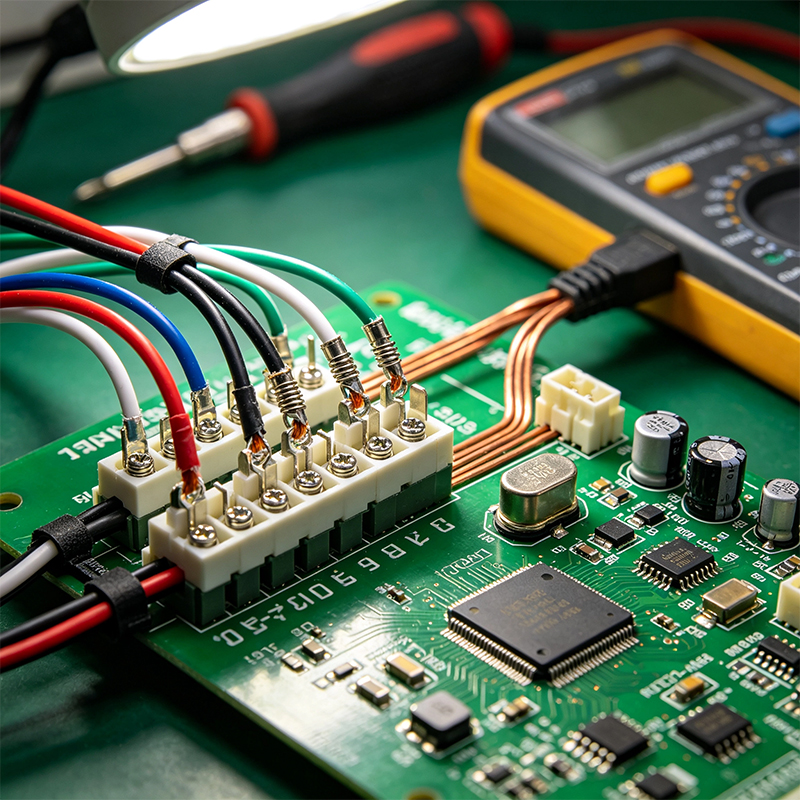
Medical wire harnesses are different from ordinary harnesses. They must meet a rigorous set of standards.
1. Quality Management: ISO 13485
ISO 13485 is the most important quality management system standard for the medical device industry. It requires documented procedures and measurable acceptance criteria for every single step. Medical wire harness suppliers must have ISO 13485 certification.
2. Electrical Safety: IEC 60601-1
IEC 60601-1 is the core electrical safety standard for medical electrical equipment, covering insulation performance, electric shock protection, leakage current limits, and mechanical durability. Medical wire harnesses must remain safe and reliable over their entire service life.
3. Manufacturing Standard: IPC/WHMA-A-620
IPC/WHMA-A-620 is the globally recognized standard for cable and wire harness assembly. It covers every process — wire cutting, stripping, crimping, soldering, ultrasonic welding, connector assembly, shielding, and overmolding. Suppliers must manufacture and inspect to this standard. Based on the application, medical wire harnesses typically need to meet Class 2 (Dedicated Service) or Class 3 (High Performance) requirements.
4. Biocompatibility: ISO 10993
Materials that come into direct contact with a patient's skin or bodily fluids must pass ISO 10993 biocompatibility testing. Materials must not cause allergic reactions, irritation, or toxicity. Common materials include medical-grade PVC, silicone, TPE, and PTFE.
5. Flammability and Safety: UL 544
UL 544 is a safety standard for medical device cables, ensuring reliable flame retardancy, insulation, and material safety.
| Feature | Medical Wire Harness | Ordinary Industrial Harness |
|---|---|---|
| Quality standards | ISO 13485, IPC/WHMA-A-620 Class 2/3 | ISO 9001, IPC Class 1/2 |
| Materials | Medical-grade, biocompatible | Industrial-grade |
| Cleanliness | Cleanroom manufacturing | Standard workshop |
| Traceability | Full traceability per unit | Batch traceability |
| Reliability | Critical — life-or-death | High — downtime costs money |
| Cost | High | Moderate |
The global medical wire harness market is growing fast. Global medical device wiring harness sales reached approximately $7.87 billion in 2025** and are projected to hit **$12.89 billion by 2032, with a 7.3% CAGR. Other reports project growth from $6.88 billion in 2025 to $12.3 billion by 2032 at an 8.9% CAGR.
The top ten global manufacturers hold approximately 68% of the market share. This high concentration reflects the technical barriers — not just any wire harness shop can make medical-grade products.
Medical wire harness manufacturing follows a strict process:
1. Cutting and Stripping: Cut wires to precise lengths and strip insulation from both ends. Precision is critical — too long and it won't fit; too short and it won't reach.
2. Crimping and Soldering: Attach terminals to stripped wire ends. Crimp height and pull force must meet strict standards. Medical-grade crimp pull force requirements are typically 20-30% higher than industrial-grade.
3. Connector Assembly: Insert terminated wires into connector housings. Medical connectors often use international brands like TE Connectivity and Molex.
4. Overmolding: For waterproof and pull-resistant harnesses, overmold the connector backshell. Medical overmolding requires no bubbles, no flash, and a smooth surface.
5. 100% Electrical Testing: Every single medical wire harness must pass continuity, insulation, and hi-pot testing. Not sampling — 100% inspection. Any parameter out of spec and the entire harness is scrapped.
6. Cleaning and Packaging: Medical wire harnesses are manufactured in cleanroom environments, packaged in anti-static, anti-contamination medical-grade packaging.
Medical wire harnesses are the "lifelines" of medical equipment — they transmit power, signals, and data between every module.
The key difference from ordinary harnesses: they're used in life-or-death situations. ISO 13485 quality management, IPC/WHMA-A-620 manufacturing standards, IEC 60601-1 electrical safety, ISO 10993 biocompatibility — medical wire harnesses must meet a complete set of rigorous standards.
The global medical wire harness market is growing at over 7% annually and is expected to exceed $12 billion by 2032. Behind every medical wire harness is a patient's safety.

Kaboer manufacturing PCBs since 2009. Professional technology and high-precision Printed Circuit Boards involved in Medical, IOT, UAV, Aviation, Automotive, Aerospace, Industrial Control, Artificial Intelligence, Consumer Electronics etc..


 English



 Wechat
 +86 13670210335
 +86 13670210335
 E-mail