
Date: 2026-06-29
You've definitely seen a circuit board. Green, stiff, covered in copper traces and solder points. But have you ever wondered: what is the board itself actually made of? Why is it so hard? Why is it green? Why do most circuit boards use this same material?
The answer is FR4.
FR4 is the most common substrate material in PCB manufacturing. Over 80% of circuit boards use it. In this guide, I'll explain what FR4 is, what it's made of, its key specifications, and how it compares to other materials. Plain English, no fluff.
FR4 stands for Flame Retardant 4. In plain terms, it's a glass-reinforced epoxy laminate composite.
Simply put, FR4 uses woven fiberglass cloth as the "skeleton" and epoxy resin as the "glue" — the two are pressed together to form a rigid board. Think of it as "layers of glass fabric glued together and pressed into a solid sheet."
It's called FR4 because it meets the UL 94 V-0 flame retardant standard — meaning it doesn't catch fire easily and will self-extinguish if it does. The "4" doesn't mean "fourth generation" — it's simply a classification number in the UL standard for glass-reinforced epoxy materials.
Key characteristics of FR4:
Hard: Strong enough to support heavy components without deforming.
Flame retardant: Meets safety standards — won't easily catch fire.
Insulating: Copper traces won't leak current to each other.
Cheap: Mature manufacturing processes keep costs low — the most cost-effective PCB substrate.
Easy to process: Can be drilled, cut, and laminated — perfect for mass production.
An FR4 board has two core materials: fiberglass cloth and epoxy resin. The fiberglass cloth provides strength and rigidity. The epoxy resin bonds the fiberglass layers together and provides insulation and heat resistance.
FR4's thermal performance depends heavily on the epoxy resin formulation. Tg is one of the most critical parameters for FR4 — it determines the temperature at which the board starts to soften. Standard FR4 has a Tg of about 130-140°C. Mid-Tg FR4 is around 150°C. High-Tg FR4 can reach 170-180°C or higher. If your product needs to go through lead-free reflow (which runs hotter), high-Tg FR4 is the better choice for reliability.
The resin content also directly affects FR4's dielectric properties. Higher resin content lowers the dielectric constant (Dk). Lower Dk means faster signal transmission and less delay. That's why high-frequency applications often specify specific resin content.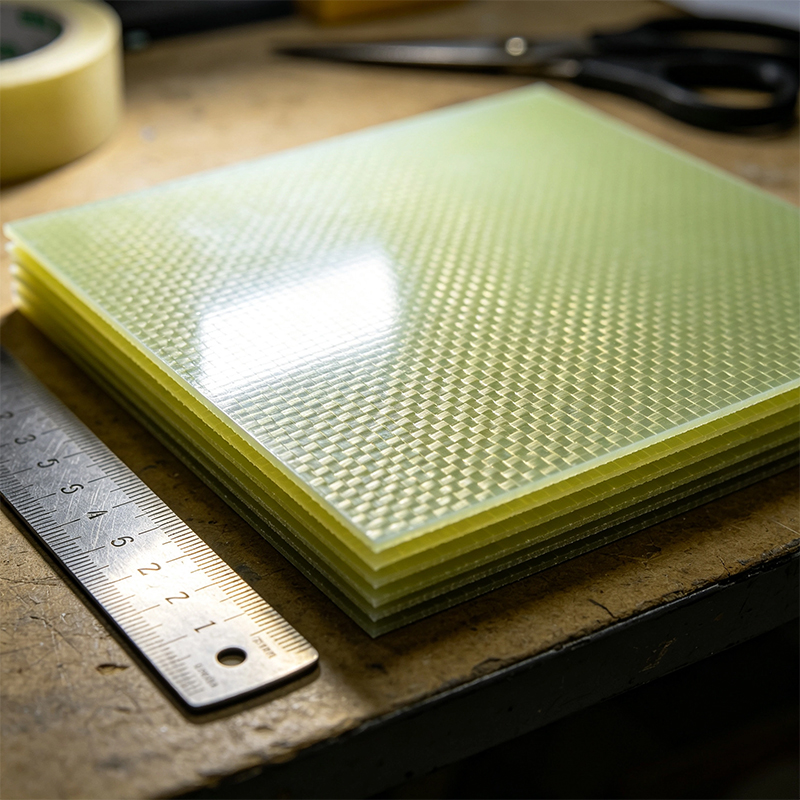
1. Glass Transition Temperature (Tg)
Tg is the temperature where the board starts to soften. Above Tg, the board's physical properties degrade significantly. Standard FR4 Tg is 130-140°C. High-Tg FR4 can reach 170-180°C.
2. Dielectric Constant (Dk)
Dk determines how fast signals travel through the board. FR4's Dk is typically 4.2-4.8 (at 1MHz), varying with frequency, temperature, and humidity. Lower Dk means faster signal speed.
3. Dissipation Factor (Df)
Df measures how much signal energy is lost as heat during transmission. FR4's Df is typically 0.015-0.020. Lower Df means less signal loss.
4. Coefficient of Thermal Expansion (CTE)
CTE measures how much the board expands when heated. FR4's CTE in the X/Y direction is about 14-17 ppm/°C, which matches copper (16-18 ppm/°C) well. But in the Z direction (through the board thickness), CTE can reach 50-70 ppm/°C — this is a major cause of via failure.
5. Dielectric Breakdown Voltage
FR4's breakdown voltage is about 30-50 kV/mm. This is extremely high, meaning FR4 is a very reliable insulating material.
6. Thermal Conductivity
FR4's thermal conductivity is only 0.25-0.4 W/(m·K) — it's a poor conductor of heat. If your product has high-power components, you'll need copper planes, thermal vias, or metal-core boards to help with heat dissipation.
FR4 isn't a single material — it's a whole family, with different grades for different applications:
| Grade | Tg (°C) | Best For |
|---|---|---|
| Standard FR4 | 130-140 | General consumer electronics, basic appliances |
| Mid-Tg FR4 | ~150 | General-purpose products needing higher heat resistance |
| High-Tg FR4 (Lead-Free Compatible) | 170-180 | Lead-free reflow, automotive, industrial equipment |
| Halogen-Free FR4 | 130-180 | Products with strict environmental requirements (EU exports) |
If your product needs to go through lead-free reflow (peak temperature typically 235-245°C), choose high-Tg FR4. Standard FR4 can delaminate or warp under the higher heat of lead-free soldering.
| Feature | FR4 (Rigid) | Polyimide (Flexible) |
|---|---|---|
| Can it bend? | No — rigid | Yes — bends and folds |
| Tg | 130-180°C | 250-400°C |
| Cost | Cheap | Expensive |
| Best for | Fixed devices that don't bend | Products that need to bend (wearables, foldables) |
FR4 is rigid; polyimide is flexible. Most everyday electronics use FR4. You only need polyimide when you actually need the board to bend.
| Feature | FR4 | Rogers |
|---|---|---|
| Dk | 4.2-4.8 | 2.2-3.5 (lower) |
| Df | 0.015-0.02 | 0.001-0.004 (much lower) |
| Cost | Cheap | 5-10× more expensive |
| Max frequency | ~3GHz | 10GHz+ (5G, radar) |
FR4 works fine at lower frequencies but struggles above 3-6GHz. 5G mmWave, radar, and satellite communications need low-loss materials like Rogers.
FR4 is the most common substrate in circuit board manufacturing. It's a glass-reinforced epoxy laminate that meets UL 94 V-0 flame retardant standards.
It's hard, flame retardant, insulating, cheap, and easy to process. Standard FR4 Tg is 130-140°C. High-Tg FR4 reaches 170-180°C. Dk is 4.2-4.8, Df is 0.015-0.020. Over 80% of circuit boards use FR4.

Kaboer manufacturing PCBs since 2009. Professional technology and high-precision Printed Circuit Boards involved in Medical, IOT, UAV, Aviation, Automotive, Aerospace, Industrial Control, Artificial Intelligence, Consumer Electronics etc..


 English



 Wechat
 +86 13670210335
 +86 13670210335
 E-mail