
Date: 2026-06-26
You've definitely seen a smartphone motherboard. That board packed with tiny traces and pads, lines thinner than a hair, holes so small you can barely see them. It looks different from a regular circuit board. That's because it is different. It's called an HDI PCB.
HDI stands for High Density Interconnect. It's not a specific type of board — it's a complete set of higher-density, finer-feature, more complex PCB manufacturing technologies. Simply put, HDI means packing more circuitry into a smaller space.
In this guide, I'll explain what HDI is, how it differs from regular PCBs, what types exist, and where it's used. Plain English, no fluff.
Here's the core difference: regular PCBs use through-holes — holes that drill all the way from the top layer to the bottom layer. HDI uses microvias and buried vias — these holes don't go all the way through the board, they only connect adjacent layers.
Think of HDI as "micro-sculpting" for circuit boards. Traditional through-holes pass through every layer, taking up routing space on each one. HDI microvias only connect between adjacent layers — they don't punch through the entire board, leaving valuable routing channels open on other layers. Traces can be finer (0.05mm or smaller), holes can be smaller (0.075mm), and copper can be thinner.
This is why your phone can keep getting thinner while packing more features — HDI makes it possible.
Traditional through-hole boards have been around for decades, but they have clear limitations:
Limited routing density: Through-holes pass through every layer, consuming space on each one.
Limited signal quality: Through-holes introduce parasitic capacitance and inductance at high frequencies.
Thickness limitations: There's a limit to how thin you can make a traditional multi-layer board.
HDI solves these problems. It lets you fit more traces and smaller components in the same area. The benefits:
Smaller size: Phones and watches can get thinner.
Better signal quality: Microvias are shorter than through-holes, with less parasitics — great for high-speed signals.
More design flexibility: You can freely combine connections between any layers.
In HDI, you'll often hear "1-order," "2-order," "3-order," and "any-layer." "Order" refers to how many laser drilling steps are used to reach an inner layer.
Standard multi-layer (non-HDI) : All holes are through-holes, drilling through the entire board.
1-order HDI: Drills from the outer layer to layer 2. This is the most basic HDI — used in standard phones and consumer electronics.
2-order HDI: Drills from the outer layer to layer 3. Requires two stacked laser drilling steps. Higher density than 1-order — used in flagship phone motherboards.
3-order and above: Drills from the outer layer to deeper inner layers. Used in the highest-density products.
Any-layer HDI: Every layer can connect directly to adjacent layers using microvias — no through-holes needed at all. This is the highest level of HDI capability, used in the most extreme products — ultra-thin smartphones, smartwatches, AI chip substrates.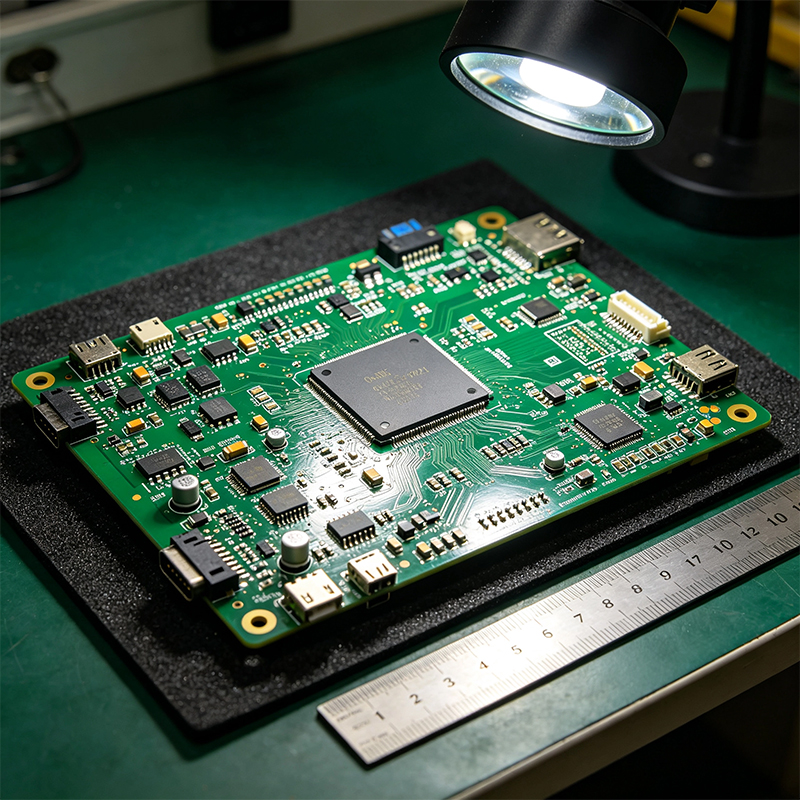
1. Laser drilling
HDI doesn't use mechanical drill bits. It uses CO₂ or UV lasers to drill microvias. Mechanical drilling bottoms out around 0.15mm. Laser drilling can achieve 0.075mm or even smaller.
2. Fine traces
HDI can achieve trace/space of 0.05mm (2mil) or less. Standard PCBs are typically 0.1mm (4mil) or more. Finer traces mean more routing in the same area.
3. Thin substrates
HDI uses much thinner materials than standard PCBs. Some boards are under 0.8mm total thickness.
4. Stacked vias
2-order and higher HDI requires stacking microvias on different layers — requiring extremely precise process control.
Smartphones: Almost every smartphone motherboard uses HDI. From budget phones to flagships — HDI is standard. Flagship models typically use any-layer HDI.
Wearable devices: Smartwatches, TWS earbuds, AR glasses — these products have extreme space constraints. HDI is almost the only choice.
Automotive electronics: ADAS (Advanced Driver Assistance Systems), automotive radar, camera modules. As cars get smarter, HDI demand grows.
Medical devices: Endoscopes, hearing aids, implantable devices — extremely small spaces demand high reliability.
Communications equipment: 5G base stations, optical modules, high-speed switches. High-frequency signals need low-loss HDI designs.
AI chip substrates: GPU and AI accelerator chip substrates — these high-end chips need extremely fine traces and high layer counts. Any-layer HDI is standard.
| Feature | Regular PCB | HDI PCB |
|---|---|---|
| Drilling method | Mechanical | Laser drilling primarily |
| Hole types | Through-holes | Blind, buried, microvias |
| Minimum hole size | 0.15mm | 0.075mm |
| Minimum trace width | 0.1mm | 0.05mm |
| Layer count | Any | Typically 6-10+ layers |
| Cost | Low | High (2-5× regular) |
| Best for | General products, industrial, appliances | Smartphones, wearables, 5G, AI |
HDI PCB is a high-density circuit board technology using finer traces, smaller microvias, and thinner materials.
Its core is "microvias" replacing "through-holes" — letting traces route in tighter spaces. It comes in 1-order, 2-order, 3-order, and any-layer — higher order means higher density and higher cost. Smartphones, wearables, 5G, automotive electronics, and AI chips all depend on it.

Kaboer manufacturing PCBs since 2009. Professional technology and high-precision Printed Circuit Boards involved in Medical, IOT, UAV, Aviation, Automotive, Aerospace, Industrial Control, Artificial Intelligence, Consumer Electronics etc..


 English



 Wechat
 +86 13670210335
 +86 13670210335
 E-mail