
Date: 2026-07-01
You've definitely seen a circuit board before. Green, covered in shiny silver solder joints and gold traces. But have you ever wondered: why are circuit boards green? What is that green stuff? What does it actually do?
That green stuff is called solder mask (also known as solder resist or green oil). It's a thin protective coating applied to the surface of a circuit board. Although it looks like a layer of paint, it actually serves a critical purpose. In this guide, I'll explain what solder mask is, what it does, and why it's almost always green. Plain English, no fluff.
Solder mask is simply the thin protective coating on the surface of a circuit board. It covers the copper traces and "masks" the areas that aren't meant to be soldered.
The most common color for solder mask is green, but other colors exist — red, blue, black, white, yellow, and more. Green is most common because early solder mask formulations were green, and the color offers the best visual contrast for manual inspection under typical factory lighting, reducing eye strain.
The chemistry behind that green layer is a photoimageable polymer coating. Think of it like a special "paint" — you apply it, expose it to UV light through a film negative, and the exposed areas harden. Then you wash away the unexposed parts, leaving the pads exposed.
Copper exposed to air slowly oxidizes, forming a non-conductive layer that solder won't stick to. Solder mask covers the copper traces, leaving only the pads exposed.
Solder mask prevents solder bridging. During reflow, melted solder paste can flow. Without solder mask, it might run onto nearby pads and create unintended shorts. Solder mask acts like a fence, keeping solder where it belongs.
Tightly packed copper traces can leak current if dust or moisture settles on them. Solder mask is an insulator that prevents this. It also protects copper from scratches, chemicals, and corrosion.
There are two main application methods:
1. Liquid Photoimageable Solder Mask (LPSM)
This is the most common method today. Liquid solder mask is applied to the board and dried. UV light is shone through a film negative — the pad areas are blocked, while the rest of the mask hardens. The unhardened mask is washed away, exposing the copper pads.
2. Dry Film Solder Mask
A solid dry film is laminated onto the board with heat, then exposed and developed the same way. This gives a more uniform thickness but costs more.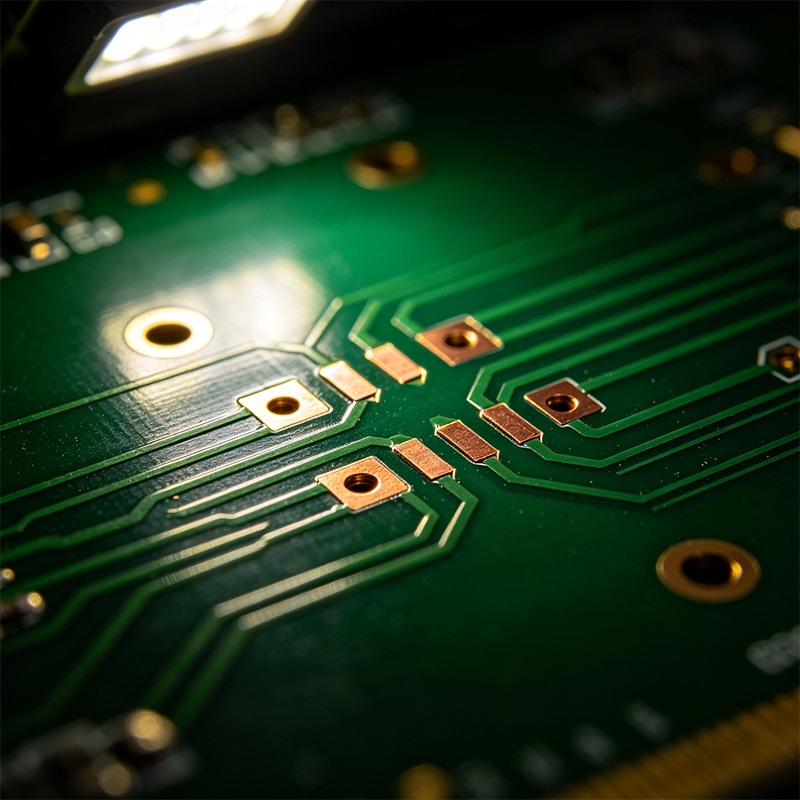
Solder mask color isn't just about looks — different colors have different characteristics.
Green: The classic, most common, and cheapest option. It provides the best contrast for visual inspection and is easiest on the eyes. Over 90% of circuit boards use green.
Red, Blue, Black: These look "cooler" and are often used in high-end or showcase products. But they have worse contrast than green — inspecting solder joints is harder. Black solder mask makes traces almost invisible, making repair and inspection very difficult.
White, Yellow: Higher contrast, often used on LED boards because white reflects light well. But white solder mask gets dirty easily and requires tighter process control.
Clear/Transparent: Used for special aesthetic requirements, like transparent PCBs or designs where you want to see the underlying traces.
Choosing a color depends on your needs. Green is cheapest for high-volume production. Blue or black look premium but make inspection harder. White is best for LED boards. Clear is for special designs.
Solder mask is important, but it's not applied everywhere. It cannot cover gold fingers (needed for conductive contacts), test points (needed for electrical access), or thermal pads (needed for large-area soldering and heat dissipation). These areas are "opened" in the design, and solder mask doesn't cover them.
Solder mask is a protective coating on circuit board surfaces, covering copper traces and leaving only the pads exposed.
It prevents copper oxidation, stops solder bridging, provides insulation, and protects against physical damage. It's usually green, but comes in many colors. It's applied through a photoimaging process and is an essential step in PCB manufacturing.

Kaboer manufacturing PCBs since 2009. Professional technology and high-precision Printed Circuit Boards involved in Medical, IOT, UAV, Aviation, Automotive, Aerospace, Industrial Control, Artificial Intelligence, Consumer Electronics etc..


 English



 Wechat
 +86 13670210335
 +86 13670210335
 E-mail