
Date: 2026-07-01
You’ve definitely heard of an “RLC circuit” — a circuit made of resistors, inductors, and capacitors. But what about “ELO”? Is it the same thing? Are they related?
Here’s the short answer: ELO and RLC are not the same thing. They belong to completely different categories in electronics. RLC is a circuit structure — made of R (resistor), L (inductor), and C (capacitor). ELO is an abbreviation — and it can mean several different things depending on the context.
In this guide, I’ll explain both ELO and RLC, what they mean, how they differ, and where you’ll see them. Plain English, no fluff.
RLC stands for Resistor, Inductor, and Capacitor. An RLC circuit is simply an AC circuit made of these three components.
What does each component do?
Resistor (R) : Opposes current flow and turns electrical energy into heat. It treats AC and DC the same.
Inductor (L) : Resists changes in current. The higher the frequency, the more it “blocks”.
Capacitor (C) : Stores electrical charge. It blocks DC but lets AC through. The higher the frequency, the more it “passes”.
What can an RLC circuit do?
The most interesting thing about an RLC circuit is resonance — at a specific frequency, the inductor’s and capacitor’s “resistances” cancel each other out, giving maximum current (in series) or minimum current (in parallel). This is used in radio tuning, wireless charging, power supply filtering, oscillators, and almost every electronic device.
In electronics, ELO can mean at least three different things — none of which are related to RLC.
1. ELO = Electronics (abbreviation)
The simplest explanation. “ELO” is sometimes used as an abbreviation for “Electronics” — you might see it in course codes or document titles. For example, a course called “ELO221 Electronics I” uses ELO to mean “Electronics”.
2. ELO = Epitaxial Lateral Overgrowth
This is a semiconductor manufacturing technique. Simply put, it’s a method for selectively growing single-crystal silicon layers on a chip substrate, used to make high-performance semiconductor devices. This technique is used in gallium nitride (GaN) power devices and SOI (Silicon‑on‑Insulator) technology.
3. ELO = Elo TouchSystems
This is a global leader in touchscreen technology, formerly a brand of Tyco Electronics. Its touchscreens are used in ATMs, POS systems, industrial control panels, and more.
Outside of electronics, ELO also has a famous use — the Elo rating system for chess and competitive gaming. But that’s not electronics-related, so we won’t go into it here.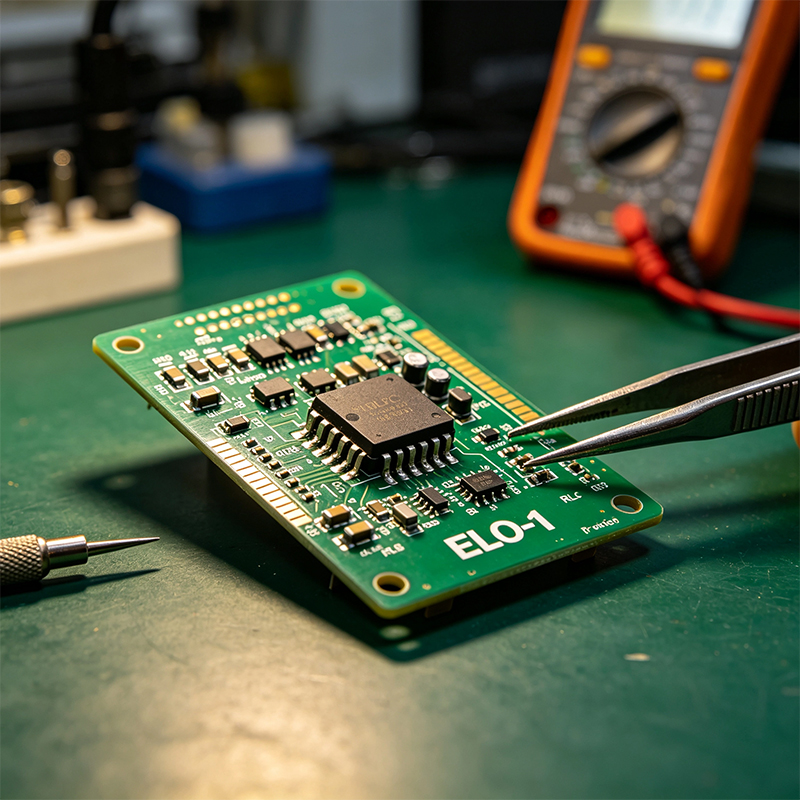
There is none.
RLC is a circuit — made of actual resistors, inductors, and capacitors. ELO is an abbreviation — it could mean “Electronics,” a semiconductor process, or a touchscreen company. They operate on completely different levels.
If someone asks you “what are ELO and RLC,” the most accurate answer is: RLC is a circuit. ELO is an abbreviation used in electronics. They’re not the same thing, and they don’t belong to the same category.
| RLC | ELO | |
|---|---|---|
| Full form | Resistor-Inductor-Capacitor | Electronics / Epitaxial Lateral Overgrowth / Elo TouchSystems |
| What it is | An AC circuit made of three components | An abbreviation — meaning depends on context |
| What it does | Filtering, frequency selection, oscillation, impedance matching | Refers to electronics / semiconductor manufacturing / touchscreen brand |
| Relationship | None | None |
RLC is a circuit. ELO is an abbreviation. Remember that, and you’ll never confuse them again.

Kaboer manufacturing PCBs since 2009. Professional technology and high-precision Printed Circuit Boards involved in Medical, IOT, UAV, Aviation, Automotive, Aerospace, Industrial Control, Artificial Intelligence, Consumer Electronics etc..


 English



 Wechat
 +86 13670210335
 +86 13670210335
 E-mail