
Date: 2026-07-08
You've definitely seen a circuit board before. Green, covered in shiny silver solder joints and gold traces. But have you ever wondered: why are circuit boards green? What is that green stuff? What does it actually do?
That green stuff is called solder mask (also known as solder resist or green oil). It's a thin polymer coating applied to the surface of a circuit board. Although it looks like a layer of paint, it actually serves a critical purpose. In this guide, I'll explain what solder mask is, what it does, and how it's made. Plain English, no fluff.
Solder mask is a permanent, heat-resistant insulating protective layer applied to the copper surface of a printed circuit board (PCB). Its core job is to resist soldering — selectively covering non-soldering areas and "masking" the areas that aren't meant to be soldered.
In EDA design software, the solder mask layer is typically represented as a separate layer (e.g., Top Solder Mask and Bottom Solder Mask) using negative output logic. This means the areas you draw in the software are actually "openings" in the solder mask — where copper is exposed.
Solder mask isn't just for "looking good." It serves several critical functions:
1. Prevents Solder Bridging
During reflow soldering, molten solder can flow. Without solder mask, it might run onto nearby pads and create unintended shorts. Solder mask acts like a fence, keeping solder where it belongs.
2. Prevents Copper Oxidation
Copper exposed to air slowly oxidizes, forming a non-conductive layer that solder won't stick to. Solder mask covers the copper traces, leaving only the pads exposed.
3. Provides Electrical Insulation
Tightly packed copper traces can leak current if dust or moisture settles on them. Solder mask is an insulator that prevents this.
4. Protects Against Physical Damage
Solder mask also protects copper from scratches and chemical corrosion.
Simply put: solder mask protects the board and makes it reliable.
Solder mask manufacturing follows a standard process. There are several coating methods:
| Method | Characteristics | Best For |
|---|---|---|
| Screen Printing | Traditional — squeegee ink through a screen | Low-precision, simple boards |
| Spray Coating | Uniform spray application | Special board types or thick boards |
| Curtain Coating | Ink flows like a curtain over the board | High efficiency, uniform coating, high volume |
| Electrostatic Spray | Electrostatic attraction | High ink utilization, ultra-thin uniform coating |
Today, Liquid Photoimageable (LPI) solder mask is the mainstream choice for modern high-density PCBs. The complete process looks like this:
Preparation: Clean the board, remove oxides and contaminants, micro-etch the copper surface to improve adhesion.
Coating: Apply liquid photoimageable solder mask ink evenly across the board via screen printing, spraying, or curtain coating.
Pre-bake: Low-temperature drying to partially cure the ink into a solid film.
Exposure: UV light is shone through a film negative — exposed areas harden, unexposed areas remain soluble.
Development: Developer solution washes away unexposed ink, exposing the pads that need soldering.
Final Cure: High-temperature baking fully cures the solder mask into its final permanent protective film.
Inspection: AOI (Automated Optical Inspection) or visual inspection checks for defects.
The vast majority of circuit boards are green, and that's not by accident. Green solder mask accounts for over 80% of high-performance electronic products. Here's why:
Best photo-resolution: Green ink has the most balanced UV absorption and transmission, allowing the narrowest solder dams — critical for packages with 0.4mm pitch or less.
Best visual contrast: Green provides the highest contrast with copper and white silkscreen, reducing false positives in Automated Optical Inspection (AOI).
Lowest cost: Green ink cures fastest, with the shortest production cycle and lowest cost.
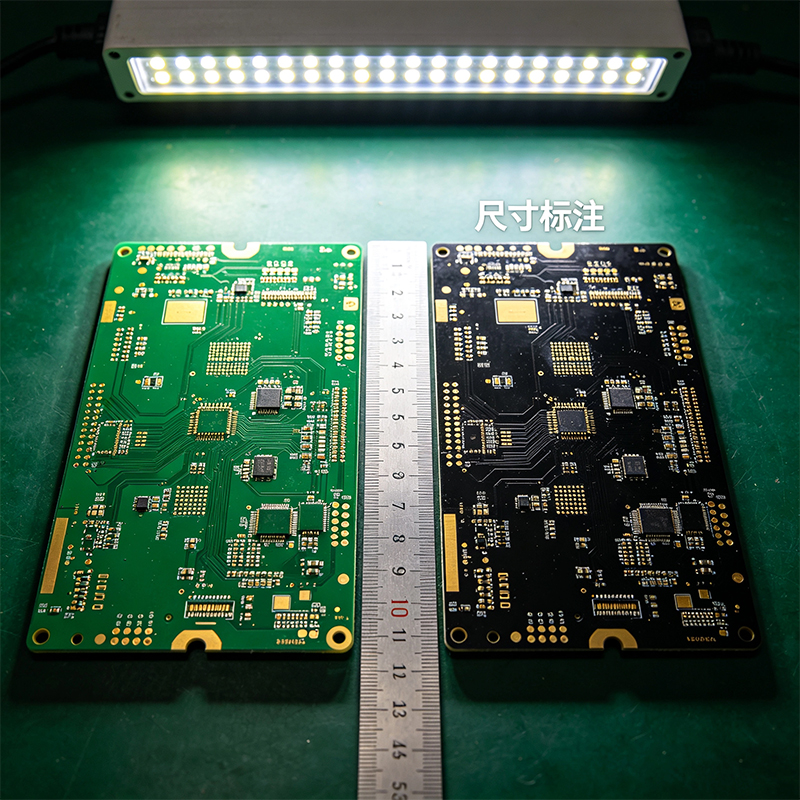
While green is the most common, solder mask comes in many colors:
Green: The classic — cheapest, best contrast — over 90% of boards use green
Red, Blue, Black: Look "cooler" — often used in consumer products for visual differentiation. But black absorbs heat and is harder to inspect
White: Common for LED boards because white reflects light well
Purple, Yellow, Matte colors: Special requirements or个性化 choices
Choose color based on function and cost. Green is cheapest for high-volume production. Blue or black look premium but are harder to inspect.
Solder mask thickness is typically controlled between 10-40 micrometers (μm). IPC standards (like IPC-SM-840) specify a minimum thickness of 10μm above copper traces, with local areas requiring at least 5-8μm to ensure insulation.
Thicker isn't always better — too thick can affect soldering, too thin compromises insulation protection. The exact thickness depends on product class (Class 2/3) and application, and should be negotiated with the manufacturer.
Solder mask is the protective coating on circuit board surfaces, covering copper traces and leaving only the pads exposed. It prevents solder bridging, prevents copper oxidation, provides insulation, and protects against physical damage. It's applied through a Liquid Photoimageable (LPI) process — coating, exposure, development, and curing. It's usually green, but comes in many colors.

Kaboer manufacturing PCBs since 2009. Professional technology and high-precision Printed Circuit Boards involved in Medical, IOT, UAV, Aviation, Automotive, Aerospace, Industrial Control, Artificial Intelligence, Consumer Electronics etc..


 English



 Wechat
 +86 13670210335
 +86 13670210335
 E-mail