
Date: 2026-07-08
You've definitely seen them before. Those little circuit boards with a chip or sensor in the middle, surrounded by rows of整齐的 pins that plug right into a breadboard. If you've ever played with an Arduino or Raspberry Pi, you've probably used one — but you might not have known what it's called.
That little board is a breakout board. It's not complicated — it's simply a small PCB that takes the tiny, hard-to-solder pins of a complex chip and "breaks them out" into an easy-to-use format . In this guide, I'll explain what a breakout board is, what it does, what types exist, how to choose one, and how it's different from a development board. Plain English, no fluff.
A breakout board is simply a small circuit board that "adapts" a complex component . Its core job is to take a chip or sensor with pins that are too small, too dense, or spaced in a non-standard way and convert them into something easy to plug in, easy to connect, and using a standard spacing .
Many advanced electronic components use surface-mount (SMD) packages — their pins are tiny and tightly spaced, often 0.5mm or less. You simply can't hand-solder these chips onto a breadboard or plug them into jumper wires . A breakout board does this: it solders the chip onto a small board, then "routes" its pins out to standard 2.54mm headers . Now you can plug it into a breadboard or connect it to an Arduino or Raspberry Pi just like any other through‑hole component .
Think of a breakout board as an "interface converter" — the chip has a "micro USB port," and the breakout board turns it into a "standard USB port." Without it, you'd have to hand‑solder wires to pins thinner than a hair — a nightmare .
Breakout boards do one thing: make your life easier. Specifically:
1. Make Complex Chips Usable
They take chips with extremely dense, nearly impossible‑to‑hand‑solder packages (like BGA, QFN) and convert them into something easy to work with . You don't need to be a soldering master to use the latest sensors and chips.
2. Make Sensors and Modules "Plug and Play"
Almost every sensor on the market — temperature, humidity, accelerometers, gyroscopes, GPS modules, thermal cameras — has a breakout board version . Buy it, plug it in, and start using it. No custom PCBs, no soldering.
3. Speed Up Prototyping and Testing
During early development, breakout boards let you quickly test if a chip or sensor meets your requirements . Once you confirm it works, you can decide how to integrate it into your final PCB . This is much faster and cheaper than building a full PCB from scratch .
4. Lower the Barrier to Entry
For hobbyists and students, breakout boards are a shortcut into electronics and programming . You don't need to understand complex PCB design or master advanced soldering to start using sensors and modules.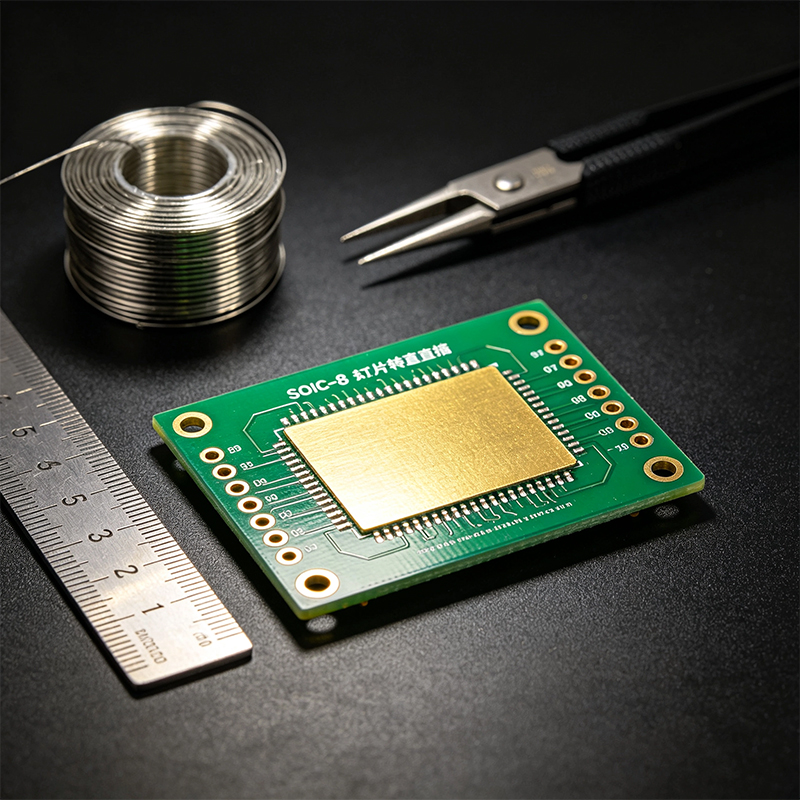
There are breakout boards for almost every chip or sensor you can imagine . The most common categories are:
Sensor Breakout Boards: Temperature/humidity sensors, accelerometers, gyroscopes, magnetometers, barometers, ambient light sensors, color sensors, thermal cameras, and more .
Communication Breakout Boards: WiFi modules, Bluetooth modules, LoRa modules, GPS/GNSS modules, Ethernet modules, RS-232 level shifters, and more .
Motor Driver Breakout Boards: Stepper motor drivers, DC motor drivers, servo drivers .
Power Management Breakout Boards: Voltage converters, Li‑ion battery charging modules, USB PD power modules .
Interface Expansion Breakout Boards: ADC/DAC converters, GPIO expanders, level shifters.
Special Function Breakout Boards: Capacitive touch sensors, OLED displays, audio codecs, real‑time clock modules, and more .
A lot of people confuse breakout boards with development boards. Here's the difference:
A development board is a complete "mini computer" — it has a main chip (MCU), power management, and various interfaces. Plug it in and it runs programs . Arduino Uno, Raspberry Pi, and ESP32 boards are all development boards.
A breakout board is an "accessory" — it doesn't compute on its own. It just takes the pins of a chip or sensor and "breaks them out" so you can connect them to a development board .
Think of it this way: the development board is the "computer," and the breakout board is the "peripheral." The development board is the brain. Breakout boards are the eyes, ears, and hands — they don't think, but they let the brain sense the world and take action.
When choosing a breakout board, focus on three things:
1. Voltage Compatibility
Does your development board use 3.3V or 5V? Does the breakout board support that voltage ? Voltage mismatch means either no data or a fried chip.
2. Communication Interface
Does the sensor use I2C, SPI, or UART? Does your development board have the right interface ? Most sensors use I2C — just two wires (SDA and SCL) — making it the most convenient option.
3. Size and Mounting
How much space does your project have? Do you need to plug it into a breadboard, or mount it inside an enclosure ?
A breakout board is a small circuit board that takes a complex chip's tiny, hard‑to‑solder pins and "breaks them out" into an easy‑to‑use format . It makes advanced chips usable — buy it, plug it into a breadboard, and start using it .
The difference between a breakout board and a development board: the development board is the "computer"; the breakout board is the "peripheral." Sensors, communication modules, motor drivers, power management — there's a breakout board for almost every function you can think of . They make electronics prototyping faster, simpler, and cheaper .

Kaboer manufacturing PCBs since 2009. Professional technology and high-precision Printed Circuit Boards involved in Medical, IOT, UAV, Aviation, Automotive, Aerospace, Industrial Control, Artificial Intelligence, Consumer Electronics etc..


 English



 Wechat
 +86 13670210335
 +86 13670210335
 E-mail