
Date: 2026-06-29
You've definitely seen a circuit board before. Green, stiff, covered in tiny components. Some components are smaller than a sesame seed. Some are little black squares. Some are flat chips. How do these components get "stuck" onto the board? The answer is Surface Mount Technology.
Surface Mount Technology (SMT) is the process of mounting electronic components directly onto the surface of a printed circuit board. In this guide, I'll explain what SMT is, how it differs from older methods, how the process works, and what equipment is used. Plain English, no fluff.
Surface Mount Technology is simply the process of soldering electronic components directly onto the surface of a circuit board.
Before SMT existed, components were "plugged" into the board — each component had two or more metal leads that went through holes in the board and were soldered on the back. This is called Through-Hole Technology (THT) .
Surface Mount Technology is different. Components don't have long leads going through the board. They sit directly on pads on the board's surface and are held in place with solder paste and reflow soldering. Components can be incredibly small, and both sides of the board can be populated.
Think of it this way: Through-hole is like planting trees — roots go through the soil. Surface mount is like placing flower pots on the ground — no digging required.
| Feature | Surface Mount Technology (SMT) | Through-Hole Technology (THT) |
|---|---|---|
| Component mounting | Components sit on the board surface | Leads go through holes in the board |
| Component size | Small (down to 01005, 0.4×0.2mm) | Large |
| Board utilization | Both sides can be populated, high density | Only one side populated, low density |
| Soldering method | Reflow soldering | Wave soldering or hand soldering |
| Mechanical strength | Moderate | Strong (leads physically pass through the board) |
| Best for | High-density, high-volume, compact products | High-power, high-reliability, connector-intensive products |
Today, over 90% of electronic components are assembled using SMT. Smartphones, computers, wearables — all of these high-density electronics rely on SMT. But through-hole hasn't disappeared — it's still used for large power components, connectors, and anything that needs extra mechanical strength.
SMT components look completely different from traditional through-hole components. They don't have long leads. Instead, they have very small metal terminations or short leads.
Chip resistors and capacitors: Those little brown or black squares — small ones are the size of a grain of sand (0402, about 1.0×0.5mm), big ones are like a grain of rice.
SOP/QFP chips: Flat square chips with fine short leads around all four sides — like a centipede's legs.
QFN chips: Leads are hidden underneath the chip — you can barely see them from the outside.
BGA chips: The bottom is covered in tiny solder balls. Once soldered, you can't see the joints at all — you need X‑ray inspection.
These components are placed by automated pick-and-place machines. Nobody hand-solders these with a standard iron.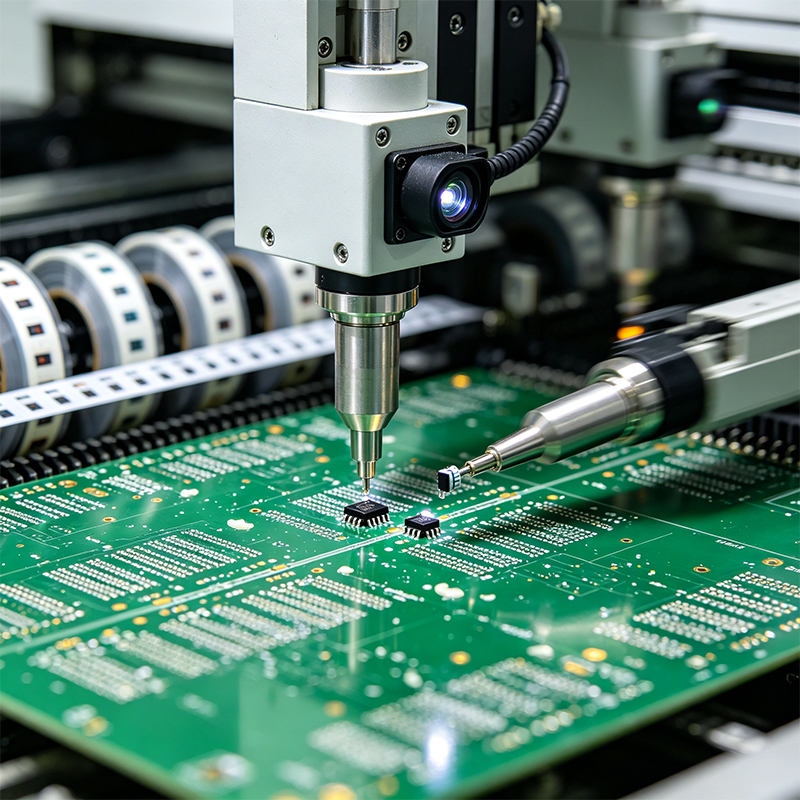
Surface Mount Technology has four main steps:
Step 1: Solder Paste Printing
This is the first step. A stencil is placed over the PCB. The stencil has small openings where solder paste needs to go. A squeegee pushes solder paste across the stencil, and the paste falls through the openings onto the PCB pads. Solder paste is a mixture of microscopic solder spheres and flux — it's about the consistency of toothpaste.
Step 2: Component Placement (Pick and Place)
After paste printing, the board goes to a pick-and-place machine. This machine works like an ultra-fast automatic sticker applicator — it uses a vacuum nozzle to pick components from tape reels and places them precisely onto the pasted pads. High-speed machines can place tens of thousands of components per hour.
Step 3: Reflow Soldering
The populated board goes through a reflow oven. The oven has multiple heating zones that gradually heat up and then cool down. The solder paste melts at high temperature, then solidifies as it cools, permanently attaching the components to the board.
Step 4: Inspection
After reflow, the boards are inspected. Common inspection methods include:
AOI (Automated Optical Inspection) : High-res cameras compare the board to a reference image.
X-Ray inspection: Used for BGAs and other components with hidden solder joints.
ICT (In-Circuit Test) : Tests electrical connections on each component.
An SMT production line has several core machines:
1. Printer: Applies solder paste through the stencil. Accuracy is critical — a misalignment of even 0.1mm can cause defects.
2. Placement Machine: Places components. High-speed machines handle small passives; flexible/panasonic machines handle large ICs and odd‑shaped components.
3. Reflow Oven: Solders everything. The temperature profile must be precisely controlled — wrong profiles cause cold joints or bridging.
4. Inspection Equipment: AOI, X-Ray, ICT — ensuring quality at every step.
Advantages:
Small and lightweight: Components can be as small as 01005 (0.4×0.2mm) — smaller than a grain of salt. Modern electronics are this small thanks to SMT.
High density: Both sides of the board can hold components — more function in less space.
Automated, high-volume production: Fast, precise, low labor cost.
Better high-frequency performance: Shorter leads mean less parasitic inductance and capacitance — great for high‑frequency circuits.
Limitations:
Requires specialized equipment: Can't hand-solder SMT components with a standard iron.
Difficult to repair: Components are tiny — rework requires microscopes and special tools. BGA rework requires professional rework stations.
Less mechanical strength: Solder joints rely on surface tension — not as strong as leads that pass through the board.
Surface Mount Technology is the process of mounting electronic components directly onto the surface of a circuit board. It uses tiny components, high-density layouts, automated placement, and reflow soldering to make electronics smaller, lighter, and cheaper.
Over 90% of electronic components are assembled using SMT. The phone in your hand, the watch on your wrist, the computer on your desk — nearly every component inside them was mounted using Surface Mount Technology.

Kaboer manufacturing PCBs since 2009. Professional technology and high-precision Printed Circuit Boards involved in Medical, IOT, UAV, Aviation, Automotive, Aerospace, Industrial Control, Artificial Intelligence, Consumer Electronics etc..


 English



 Wechat
 +86 13670210335
 +86 13670210335
 E-mail