
Date: 2026-07-01
You’ve definitely learned about circuits before. Battery, wire, light bulb — that’s the simplest DC circuit. But in the real world, most circuits use AC, and they don’t just have resistors. They also have inductors and capacitors. Put all three together, and you get an RLC circuit.
RLC stands for the three components: Resistor, Inductor (L), and Capacitor. Together, they can filter signals, select frequencies, and oscillate — making radios work, wireless charging possible, and power supplies stable.
In this guide, I’ll explain what an RLC circuit is, what each component does, and what happens when you put them together. Plain English, no fluff.
First, let’s get to know each component and what it does.
R — Resistor
A resistor is the most straightforward component in a circuit. Its job is simply to resist the flow of current. More current means more heat. Resistors treat AC and DC the same — no matter which way current flows, the resistor resists.
Think of a resistor like a narrow section in a water pipe — water (current) slows down as it passes through, and pressure drops. The resistor turns electrical energy into heat.
L — Inductor
An inductor is usually a coil of wire. Its superpower is resisting changes in current — if current tries to suddenly increase, the inductor pushes back; if current tries to drop, the inductor holds on.
Think of an inductor like a water wheel — water (current) hits the wheel, it spins up slowly, and it keeps water moving steadily. In an AC circuit, the higher the frequency, the more the inductor resists. High-frequency signals find it hard to pass through an inductor.
C — Capacitor
A capacitor is two metal plates separated by an insulator. Its job is storing charge — like a tiny water tank that can hold water and release it. A capacitor blocks DC (direct current) but lets AC through.
Think of a capacitor like a water tank — water (current) flows in and fills the tank. Once full, water can’t flow through anymore (DC). But if the water direction keeps reversing (AC), the tank keeps filling and emptying — it looks like water is “getting through.” In AC circuits, the higher the frequency, the more the capacitor “opens up.”
Connect a resistor, an inductor, and a capacitor end‑to‑end, and you get a series RLC circuit. The current flows through each component, encountering three different types of “resistance” along the way. Together, they form a total impedance — which is a more complete measure of how the circuit opposes AC current (whereas resistance alone only measures the energy‑dissipating opposition of the resistor).
The most interesting thing about a series RLC circuit is that it resonates at a specific frequency — called the resonant frequency. At resonance, the inductor’s and capacitor’s “resistances” cancel each other out, the circuit’s impedance is at its lowest, and the current is at its highest.
This is exactly how radio tuning works. The tuning circuit in a radio is an RLC circuit — by adjusting the capacitor (or inductor), you set the resonant frequency to match the station you want, and all other frequencies are blocked out.
Connect a resistor, an inductor, and a capacitor side‑by‑side across the power source, and you get a parallel RLC circuit. In a parallel RLC circuit, voltage is the same across all three components, but current splits into three paths.
At resonance, the inductor and capacitor currents cancel each other out (they “circulate” internally). From the power supply’s perspective, the total current is at its minimum and the impedance is at its maximum. This is often used in frequency selection and filtering — letting a specific frequency pass through while blocking others. Wireless charging uses this principle.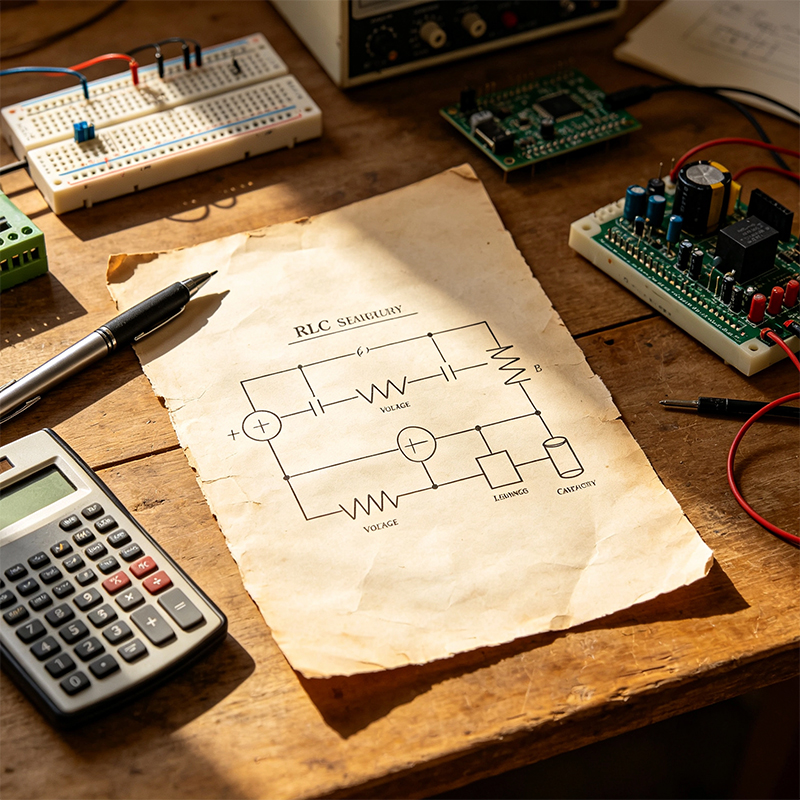
RLC circuits are everywhere in electronics:
1. Filtering
Power supplies often use RC, LC, or RLC filters to remove unwanted noise (ripple) from the output. Your phone charger has one inside.
2. Frequency Selection
Tuning circuits in radios, TVs, and walkie‑talkies are RLC circuits. You “tune” to a frequency and pick up that signal while rejecting others.
3. Oscillation
RLC circuits can generate stable, periodic signals — used in clocks and signal generators.
4. Impedance Matching
Between an antenna and an amplifier, RLC circuits can match impedance for maximum power transfer. RF circuits in phones are full of RLC networks.
5. Power Factor Correction
Large motors and transformers contain lots of inductance, which lowers the power factor on the grid. Power companies fine you for that. RLC circuits compensate for reactive power and bring the power factor close to 1.
In RLC circuits, you’ll often hear about Q factor (Quality Factor) . Q measures how “sharp” the resonance is — higher Q means a narrow, sharp resonance peak (better selectivity); lower Q means a wide, flat resonance peak (broader bandwidth). Q depends on R — lower resistance gives higher Q.
High‑Q RLC circuits are used where precise frequency selection matters — like radio tuners. Low‑Q RLC circuits are used where wide bandwidth is needed — like broadband filters.
An RLC circuit is an AC circuit made of a resistor (R), an inductor (L), and a capacitor (C).
Each component has its own behavior: resistors oppose current, inductors oppose changes in current, and capacitors store charge. In series, they peak current at resonance. In parallel, they minimize current at resonance. RLC circuits filter, select frequencies, oscillate, and match impedance — they’re inside almost every electronic device.

Kaboer manufacturing PCBs since 2009. Professional technology and high-precision Printed Circuit Boards involved in Medical, IOT, UAV, Aviation, Automotive, Aerospace, Industrial Control, Artificial Intelligence, Consumer Electronics etc..


 English



 Wechat
 +86 13670210335
 +86 13670210335
 E-mail