
Date: 2026-06-23
You're designing a new product. Maybe a wearable device, AR glasses, a drone, or a sensor that needs to fit inside a tight curved housing. A rigid board won't fit. Cables aren't reliable enough. What you need is a circuit board that bends.
That's a bendable circuit board — in the industry, it's called a flexible PCB (flex PCB) or a rigid-flex PCB. It's not some futuristic concept. It's inside the foldable phone in your pocket, the smartwatch on your wrist, and the sensor under your car seat.
In this guide, I'll explain what bendable circuit boards are, what problems they solve, what types exist, and how to choose the right partner. Plain English, no fluff.
A bendable circuit board is simply a circuit board that can bend.
A rigid board (rigid PCB) uses fiberglass (FR4) as its base — stiff like a piece of wood. A bendable circuit board uses polyimide (PI) or other flexible films as the base — bendable like a plastic card.
Think of it this way: a rigid board is a wooden plank; a bendable board is a thick piece of paper. The plank is strong but can't bend. The paper can be rolled and stuffed into any gap.
Key characteristics:
Bends and folds — fits into spaces where rigid boards can't go
Lightweight and thin — as thin as 0.1mm, over 70% lighter than rigid boards
Eliminates connectors — one bendable board replaces multiple rigid boards + cables + connectors
3D assembly — conforms to the product's shape, enabling three-dimensional assembly
If you're facing any of these situations, a bendable circuit board might be your answer:
1. Not enough space
Smartwatches, AR glasses, medical endoscopes — the internal space is curved and irregular. A rigid board won't fit. A flex board can conform to the shape of the enclosure.
2. Dynamic bending
Printer cables, foldable phone hinges, robot joints — these bend thousands of times a day. Only a bendable circuit board (with rolled annealed copper and special design) can survive.
3. Weight and thickness are critical
Drones, wearables, implantable devices — every gram counts. Flex boards are over 70% lighter than rigid boards.
4. Fewer connectors, better reliability
Connectors are failure points. One rigid-flex board replaces the whole "multiple rigid boards + cables + connectors" assembly.
5. High-frequency signals
5G antennas, radar, optical modules — flex boards with low-loss materials (LCP, PTFE) deliver stable impedance control and minimal signal loss.
Bendable circuit boards come in several varieties:
| Type | Structure | Best For |
|---|---|---|
| Single-sided flex | One copper layer | Simple jumpers, keypads, LED strips |
| Double-sided flex | Two copper layers with vias | Camera modules, sensors |
| Multi-layer flex | Three or more copper layers | Complex modules, shielded circuits |
| Rigid-flex | Rigid and flex sections in one board | Drone flight controllers, medical endoscopes, foldable phones |
Rigid-flex is the most advanced. Rigid areas hold heavy chips and connectors; flex areas bend and connect — all in one board. It's the hardest to design and manufacture.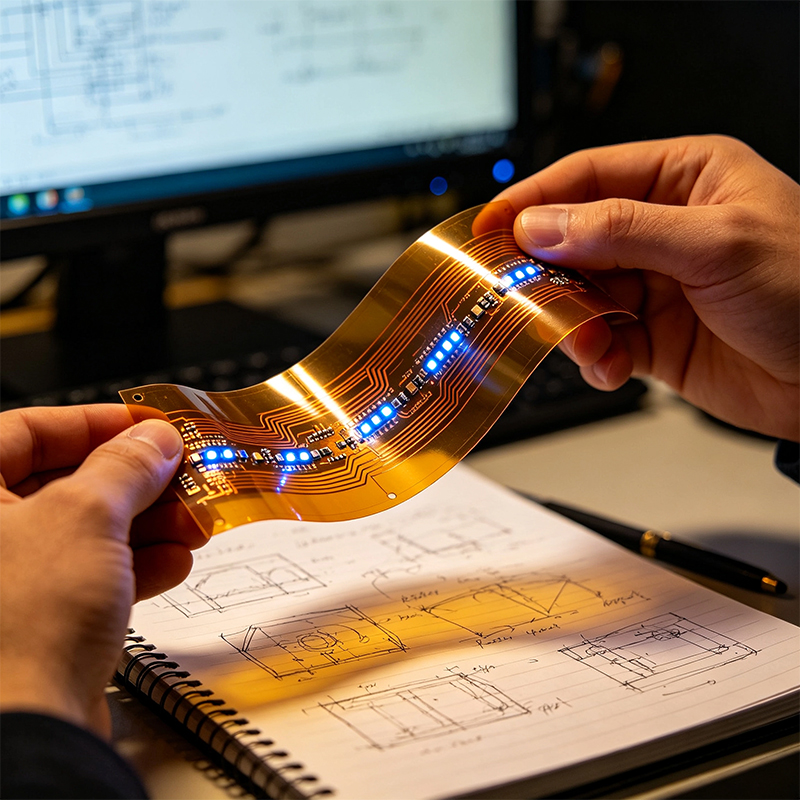
The global flexible PCB market reached $23.3 billion in 2025** and is projected to hit **$41.7 billion by 2030, with a compound annual growth rate of 12.3%.
Key drivers include wearables, foldable phones, EV battery management systems (BMS), 5G communications, and medical devices. If your product is in any of these areas, bendable circuit boards are a technology you can't ignore.
Designing bendable boards is completely different from rigid boards. A few critical points:
1. Bend radius matters
This is the most important rule. Bend it too tight, and the copper cracks. For dynamic bending (repeated flexing), the bend radius must be at least 10 times the board thickness. For static bends (bend once and leave it), at least 6 times.
2. No components or vias in bend areas
Solder joints and plated vias crack under repeated bending. Keep them out of the flex zone.
3. Route traces correctly
Traces should run perpendicular to the bend line, not parallel to it. This distributes stress more evenly.
4. Use rolled annealed copper
For repeated bending, you need rolled annealed (RA) copper — it's more fatigue-resistant. For static bends, electrodeposited (ED) copper is cheaper and sufficient.
5. Stiffeners are essential
Flex boards are too floppy to hold connectors or screws. In those areas, you need a stiffener — a piece of FR4, polyimide, or stainless steel laminated to the back.
Many people assume bendable board assembly is the same as rigid board assembly. It's not.
Flex boards have no rigidity — they warp, shift, and misalign during SMT placement. They must be mounted on a special carrier fixture for paste printing and placement. Without a carrier, placement accuracy is terrible.
Flex boards warp under heat during reflow. They need custom support fixtures and optimized temperature profiles.
The rigid-flex transition zone is the most fragile point. Thermal mass differences and stress control must be precise, or the board will crack.
This is why you need an experienced PCBA manufacturer for bendable boards — a standard SMT shop without flex-specific carriers and reflow profiles will have poor yields.
We are not a standard rigid-only PCB shop. We are a one-stop manufacturer that designs and makes flexible PCBs, rigid-flex boards, HDI high-frequency boards, and then does full PCBA.
All in-house — Flex, rigid-flex, HDI fabrication and PCBA assembly under one roof.
Over a decade of flex experience — We know how to avoid flex-to-rigid transition cracks, design proper stiffeners, and control impedance.
High-precision manufacturing — Minimum trace/space 0.05mm, minimum laser blind via 0.075mm. Supports 1-order to any-layer HDI.
High-frequency material experience — Rogers, PTFE, LCP — we've done them all.
Dedicated flex SMT line — Custom carrier fabrication, high-precision placement, 3D SPI, and AOI. Assembly yield consistently above 98%.
Free DFM review — Send your design files, get a DFM report within 24 hours with potential issues and optimization suggestions.
Projects we've served: consumer electronics (TWS earbuds, smartwatches, foldable phone FPCs), automotive (BMS, camera modules, radar high-frequency boards), medical (endoscopes, glucose monitors, hearing aids), aerospace (satellite rigid-flex boards), communications (5G antennas, optical modules).
Three simple steps:
Send your files — PCB design files (Gerber or source), BOM, special requirements (bend radius, impedance, materials, etc.).
We review and quote — Within 24 hours, you'll receive a DFM report, stackup recommendation, and sample/volume pricing.
Sample, then scale — We build 10-20 samples. You test functionality and bend reliability. Then we move to volume.
Bendable circuit boards aren't future technology — they're already inside every electronic device around you. From foldable phones to smartwatches, from automotive sensors to medical endoscopes, flexible circuit boards are redefining how small, light, and reliable electronic products can be.
If you're developing a product that bends, has tight space constraints, or demands lightweight construction, send us your requirements. We won't push a contract — we'll first run a free DFM review and let our expertise speak.
When you contact us, please include:
Product type and application
Whether bending is required (dynamic or static)
Estimated annual quantity (samples, small batch, or mass production)
We'll give you an honest answer — what we can do, what we can't, and how to modify your design to make it work.

Kaboer manufacturing PCBs since 2009. Professional technology and high-precision Printed Circuit Boards involved in Medical, IOT, UAV, Aviation, Automotive, Aerospace, Industrial Control, Artificial Intelligence, Consumer Electronics etc..


 English



 Wechat
 +86 13670210335
 +86 13670210335
 E-mail