
Date: 2026-06-25
You're developing a new product. Maybe a wearable device, a foldable phone, an automotive sensor, or a medical endoscope. You know you need flexible circuit boards. You search online and find dozens of "flexible printed circuit manufacturers" with prices ranging from cheap to expensive, promises ranging from modest to outrageous. You get quotes for the same specs and the prices are double apart. How do you actually choose?
Pick the wrong manufacturer, and you'll face delayed deliveries, low yields, or even a scrapped project and lost customers. In this guide, I'll walk you through how to evaluate, select, and work with a flexible printed circuit manufacturer. Plain English, no fluff.
Here's a number: the global flexible PCB market was valued at approximately $29.76 billion in 2025** and is projected to reach **$32.07 billion in 2026, with a CAGR of over 8%, hitting $51.32 billion by 2032. Flexible PCBs are no longer a "niche technology" — they're mainstream.
Key growth drivers include ultra-thin flexible PCB designs, miniaturization of consumer electronics, integration of flexible circuits into automotive systems, increasing demand for high-density multi-layer FPCs, and the growing use of heat-resistant and high-frequency FPCs. If your product falls into any of these categories, flexible circuit boards are a technology you can't ignore.
Evaluating a flexible PCB manufacturer isn't just about comparing prices. These five dimensions are what really determine whether you'll get a good product.
1. Manufacturing Capabilities
Flexible PCB manufacturing is completely different from rigid board manufacturing. It requires specialized equipment and processes — from polyimide substrate handling and precise coverlay lamination to laser drilling and specialized flex board lamination. A good manufacturer should have:
Multi-layer flex PCB capability (at least 1-6 layers, high-end up to 10+ layers)
Fine-line capability (trace/space 2/2mil or better)
Small-hole drilling capability (mechanical holes below 0.15mm, laser blind vias below 0.075mm)
Rigid-flex lamination capability (2-30 layers)
2. Quality Control and Certifications
Flexible PCBs have much higher reliability requirements than rigid boards. A qualified manufacturer should at least hold:
ISO 9001 (Quality Management)
IPC-6013 (Flexible Circuit Board Performance Standard)
For automotive applications, IATF 16949
For defense or aerospace, ITAR compliance
3. Engineering Support and DFM Capability
Flexible board design is completely different from rigid board design — bend radius, coverlay openings, stiffener placement, impedance control. An experienced manufacturer will run a DFM (Design for Manufacturing) check before prototyping, not tell you "we can't do this" after the boards are made.
4. Turnkey Solutions
If your product needs everything from flex board fabrication to SMT assembly, finding a manufacturer that does both PCB and PCBA saves you massive coordination costs. Flex board assembly is much harder than rigid board assembly — it requires special carriers, slow low-temperature reflow profiles, and extra process control. A standard SMT shop won't have these capabilities.
5. Lead Time and Supply Chain Stability
Prototype lead times typically run 7-15 days, with mass production extending to 15-25 days. But more importantly — does the factory have stable raw material supply? Do they have enough capacity to handle your volume?
At the technical level, a good flexible printed circuit manufacturer should be able to answer these questions:
Can you do rolled annealed (RA) copper? — Dynamic bending requires RA copper; standard ED copper cracks after a few bends.
What are your rules for bend area design? — Bend radius, trace direction, coverlay opening placement — these all matter.
How do you handle the rigid-flex transition zone? — This is the most fragile area and requires special design and process control.
Can you work with high-frequency materials (Rogers, PTFE, LCP)? — If your product involves 5G, radar, or high-frequency signals, this capability is essential.
Do you have dedicated carriers for flex board SMT? — Without carriers, placement accuracy will be terrible.
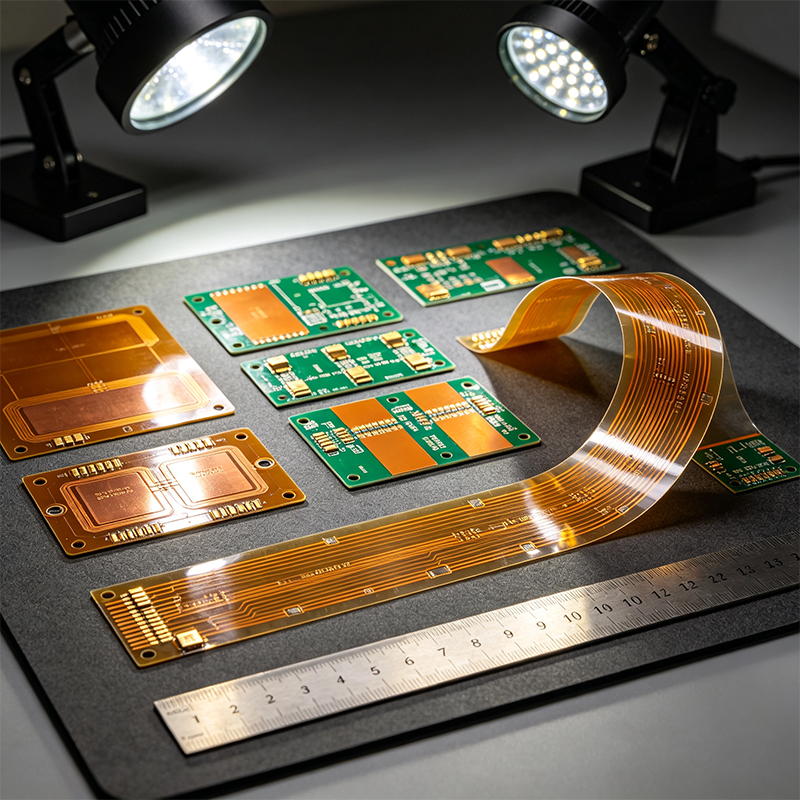
Flexible PCBs aren't "one-size-fits-all." Different industries have different requirements. A manufacturer with experience in your industry will save you a lot of trouble:
Consumer Electronics (smartwatches, TWS earbuds, foldable phones) — requires extreme thinness, light weight, high density
Medical Devices (endoscopes, hearing aids, glucose monitors) — requires high reliability, low outgassing, biocompatibility
Automotive Electronics (BMS, camera modules, sensors) — requires high temperature resistance, vibration resistance, IATF 16949 compliance
Aerospace (satellites, aircraft) — requires extreme reliability, weight sensitivity
We are not a standard rigid-only PCB shop. We are a one-stop manufacturer that designs and makes flexible PCBs, rigid-flex boards, HDI high-frequency boards, and then does full PCBA.
Over a decade of flex experience — We've been making flexible and rigid-flex boards for more than a decade. We know how to avoid flex-to-rigid transition cracks, design proper stiffeners, and control impedance.
All in-house — Flex, rigid-flex, HDI fabrication and PCBA assembly under one roof. From raw materials to finished boards, every step is under our control.
High-precision manufacturing — Minimum trace/space 0.05mm, minimum laser blind via 0.075mm. Supports 1-order to any-layer HDI, up to 20+ layers.
High-frequency material experience — Rogers, PTFE, LCP — we've done them all for 5G and radar applications.
Dedicated flex SMT line — Custom carrier fabrication, high-precision placement, 3D SPI, and AOI. Assembly yield consistently above 98%.
Free DFM review — Send your design files, get a DFM report within 24 hours with potential issues and optimization suggestions.
Projects we've served: consumer electronics (TWS earbuds, smartwatches, foldable phone FPCs), automotive (BMS, camera modules, radar high-frequency boards), medical (endoscopes, glucose monitors, hearing aids), aerospace (satellite rigid-flex boards), communications (5G antennas, optical modules).
Three simple steps:
Send your files — PCB design files (Gerber or source), BOM, special requirements (bend radius, impedance, materials, etc.).
We review and quote — Within 24 hours, you'll receive a DFM report, stackup recommendation, and sample/volume pricing.
Sample, then scale — We build 10-20 samples. You test functionality and bend reliability. Then we move to volume.
When choosing a flexible printed circuit manufacturer, don't just look at price. The cheap one might not have dedicated flex board carriers, might not have RA copper supply, might not have rigid-flex lamination experience. By the time you get samples that crack after a few bends or assemblies with only 70% yield, the money you saved won't cover the losses.
If you're looking for a reliable flexible printed circuit manufacturer, send us your requirements. We won't push a contract — we'll first run a free DFM review and let our expertise speak.
When you contact us, please include:
Product type and application
Whether bending is required (dynamic or static)
Estimated annual quantity (samples, small batch, or mass production)
We'll give you an honest answer — what we can do, what we can't, and how to modify your design to make it work.

Kaboer manufacturing PCBs since 2009. Professional technology and high-precision Printed Circuit Boards involved in Medical, IOT, UAV, Aviation, Automotive, Aerospace, Industrial Control, Artificial Intelligence, Consumer Electronics etc..


 English



 Wechat
 +86 13670210335
 +86 13670210335
 E-mail